
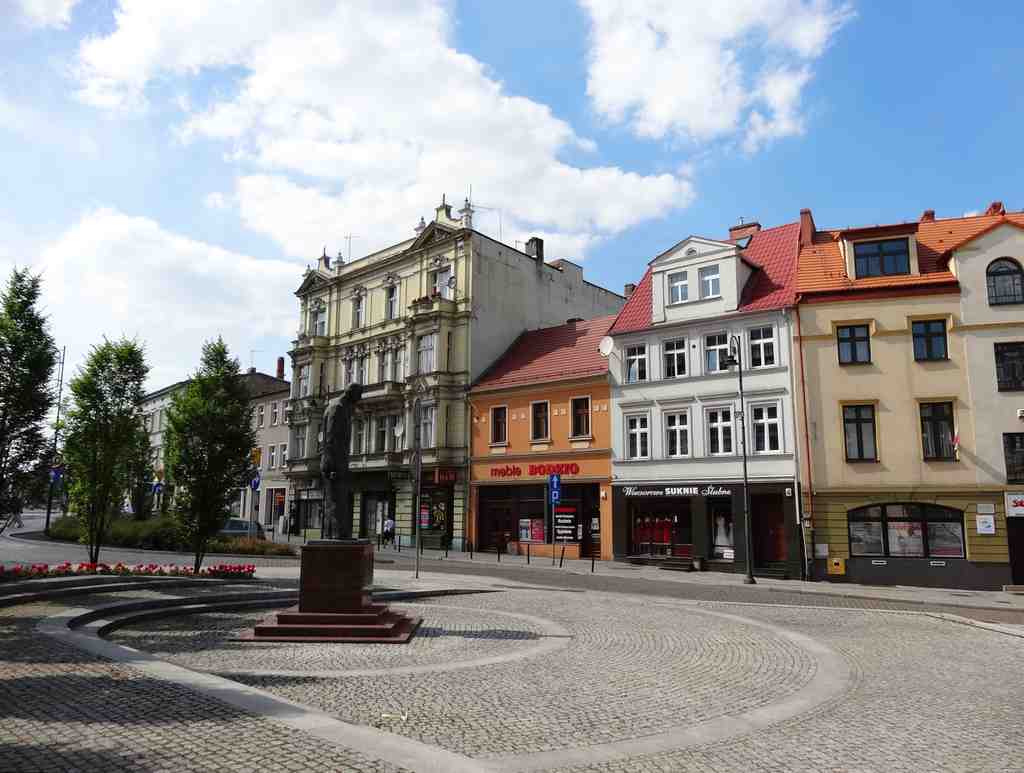
On your left, Wool Market Square opens as a triangular paved space framed by stucco-and-brick tenements, with a bronze statue standing at its center.
This little square has lived a lot of lives. Long before it turned into a neat historic pocket, this ground sat just outside the old Poznań Gate, one of the western entrances to medieval Bydgoszcz. That gate stood here from the fourteen hundreds into the early nineteenth century, rebuilt in wood and brick over the years, until the city finally knocked it down in eighteen twenty-eight because it squeezed Długa Street into a frustrating bottleneck. If you want a bird’s-eye clue, take a peek at the old map in the app... it helps you feel how this spot once hovered just beyond the walls.
By the late eighteen thirties, the square found its calling. Farmers from the surrounding countryside brought in firewood and wool, and the wool trade stuck so firmly that the name became official in eighteen fifty-four. There’s something kind of perfect about that. A place can change its face, but a good name keeps the memory warm.
Then came trams. The city’s first tram line ran through here in the late nineteenth century along Poznańska Street. And before electricity took over, the system used horse trams. Right here on the square stood a horse station, with spare harnessed horses waiting in huts while a boy managed the handoff. You can almost hear the rhythm of hooves, wheels, and people bargaining over bundles and bales. The line went electric in eighteen ninety-six, and the route through the square lasted until nineteen seventy.
Look around the edges and you’ll see why this place matters. Several of these houses are protected heritage buildings. Number four is the oldest, dating back to seventeen seventy-four, and it carries a strange little survivor: a cannonball set into the second floor facade, possibly a memory of the Kościuszko Uprising of seventeen ninety-four. Number two and number seven show off the work of Józef Święcicki, one of Bydgoszcz’s star architects, who loved facades with swagger... balconies, heavy ornament, and all that urban confidence.
The statue in the middle honors Leon Barciszewski, mayor of Bydgoszcz from nineteen thirty-two to nineteen thirty-nine. The Nazis murdered him and his son on the eleventh of November, nineteen thirty-nine. For decades, communist authorities blocked efforts to honor him, but local people kept pushing. Solidarność launched the monument campaign in nineteen eighty-one, and the statue finally appeared in nineteen eighty-nine, before the city moved it here in two thousand and seven. That matters, because from nineteen sixty until two thousand and eight, this square had been reduced to a parking lot. Imagine that... centuries of memory under parked cars.
Wool Market Square feels small, but it holds the whole city in miniature.
Take a moment here, and when you’re ready, we can wander on to Długa Street.




