
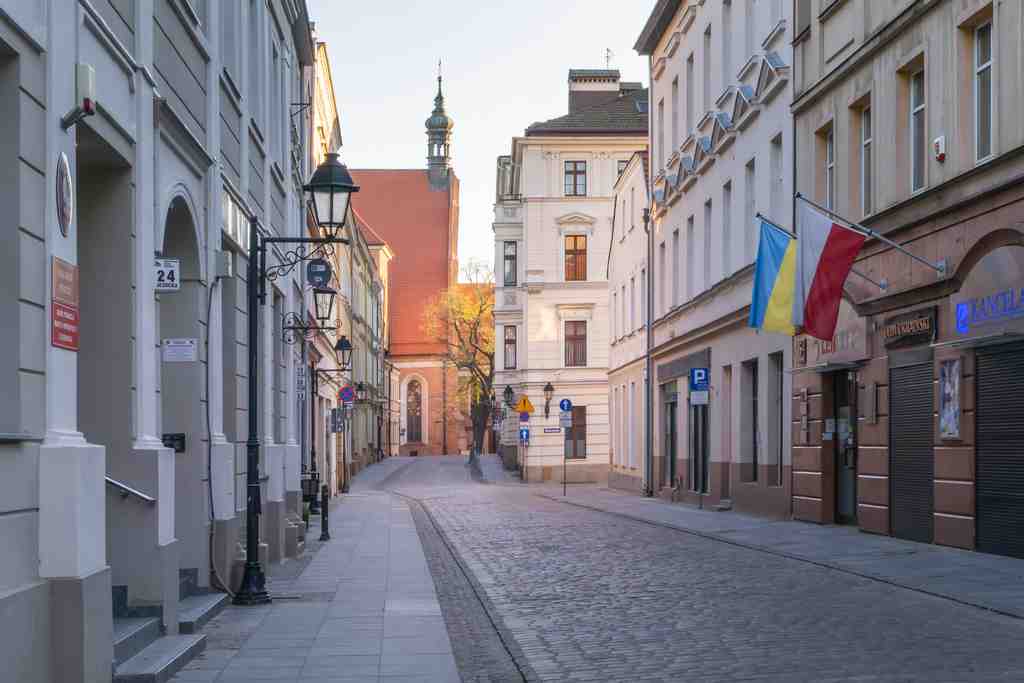
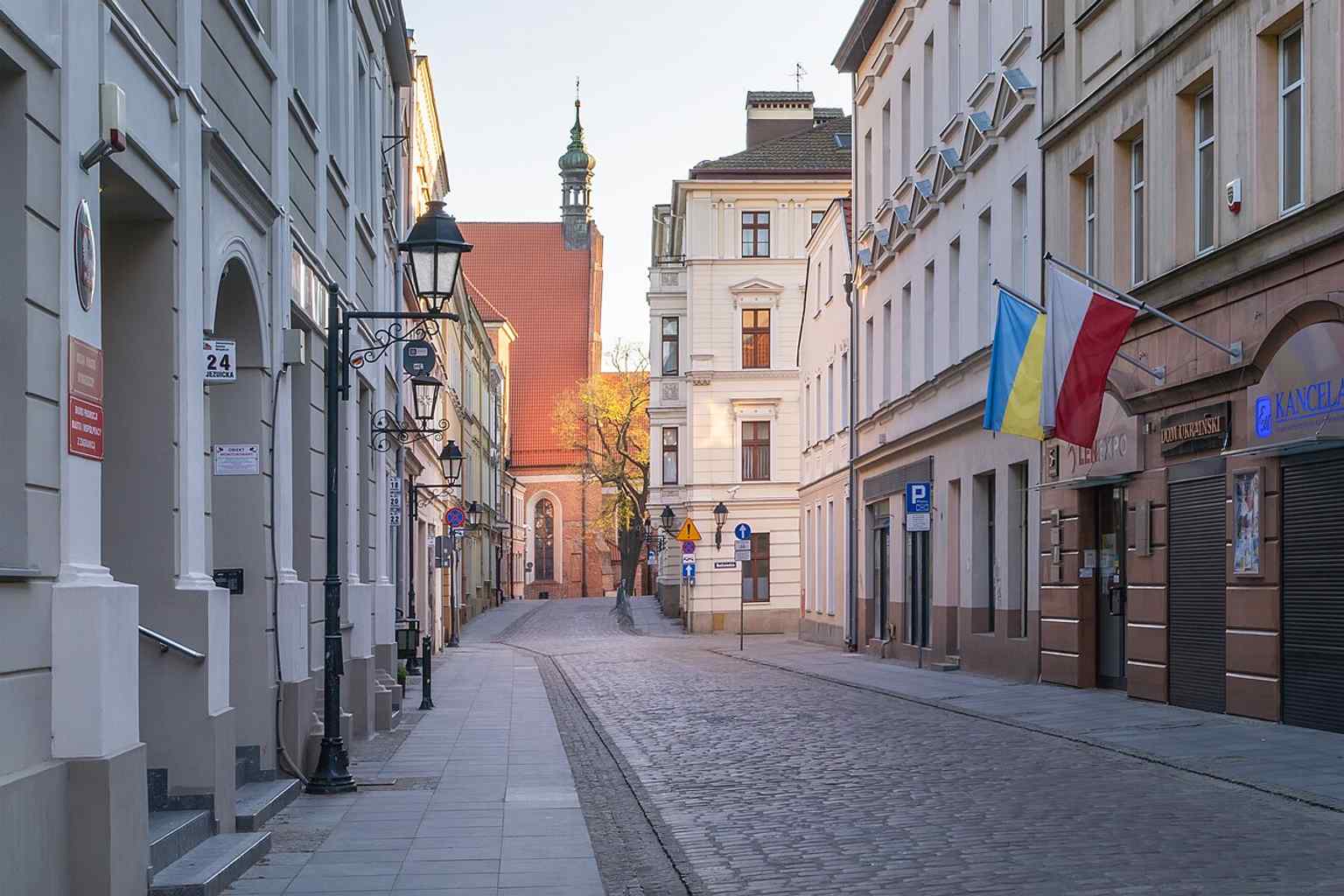
Look for a narrow stone-paved lane framed by plaster townhouses, with the long, formal brick-and-plaster bulk of the former Jesuit college standing like the street’s quiet anchor.
Jezuicka is short, only about a hundred and fifty meters, but it carries a wild amount of history for such a slim little corridor. The city marked it out in the mid-fourteenth century, when medieval Bydgoszcz took shape, and its original job was beautifully practical: lead people from Długa Street straight to the parish church.
Then the Jesuits arrived, and this lane changed character. In the seventeenth and eighteenth centuries, they controlled much of the surrounding block. Around sixteen forty, they closed one side of the square with their Church of the Holy Cross and their college, turning this area into the intellectual engine room of old Bydgoszcz.
Here’s the twist I love: the big building you associate with the Town Hall originally faced this street, not the market. Jezuicka was the grand front door. The side toward the Old Market Square was just the back, a service elevation hidden by other buildings. Only after the Germans demolished those neighboring structures in nineteen forty did the old back suddenly become the new face. Cities do that sometimes... they spin around without moving an inch.
If you glance at the image in the app, you can catch that restored frontage and imagine how this street once carried much more status than its size suggests.
The seventeenth century hit hard. During the Swedish Deluge, from sixteen fifty-five to sixteen sixty, fire tore through much of this area, plague sent people fleeing, and many dying residents left their property to churches, monasteries, and hospitals. That is one reason so many houses here were known simply as “Jesuit houses.”
And then, in autumn of sixteen fifty-seven, this narrow street played host to serious European diplomacy. King Jan Kazimierz and Queen Maria Ludwika stayed in Bydgoszcz, along with the Brandenburg elector Frederick William and his wife Luise. Their courtiers lodged in the Jesuit college and nearby houses right here, while negotiations connected to the Treaties of Wehlau and Bydgoszcz moved forward. Those deals helped end Poland’s control over Prussia as a fief... not a small consequence for one little street.
Later centuries filled the gaps. A plan from seventeen seventy-four still showed empty plots, but by eighteen hundred the street had solid rows of houses on both sides. In the nineteen twenties, poorer Polish and Jewish families lived here, including bakers and shoemakers. In September nineteen thirty-nine, Jezuicka became one of the first scenes of Nazi terror in the Old Town. A famous photograph shows an arrested Polish civilian being marched along these walls at gunpoint.
Today the street feels gentler again, with restored facades, city offices, galleries, and a local bookstore called Gratka, known for years not just for books, but for caring for stray cats in the courtyard. That feels right somehow... scholarship, survival, and cats.
Jezuicka is one of those streets that looks modest and thinks in centuries.
Take your time here, and when you’re ready, we can wander on to the next stop.





