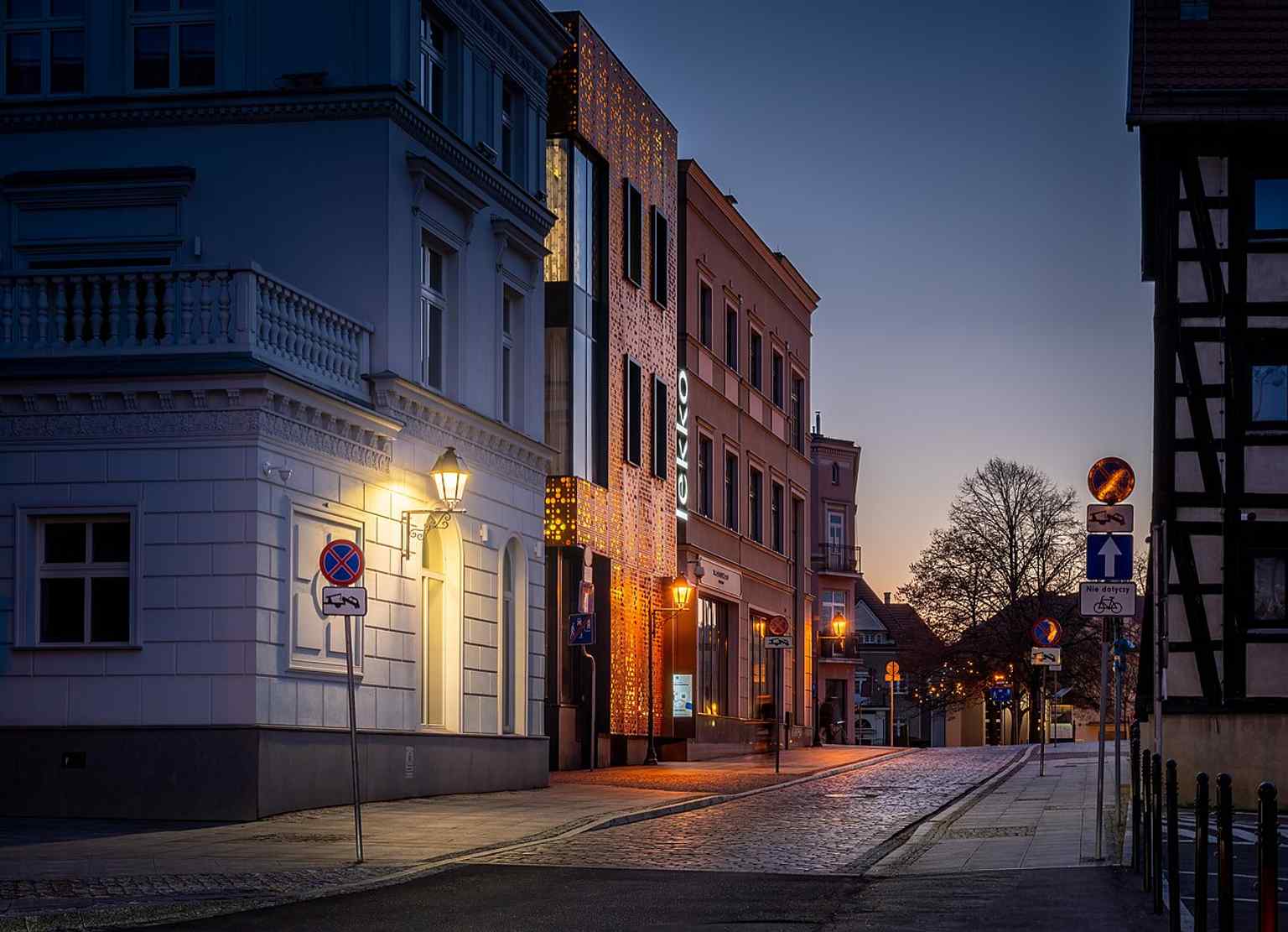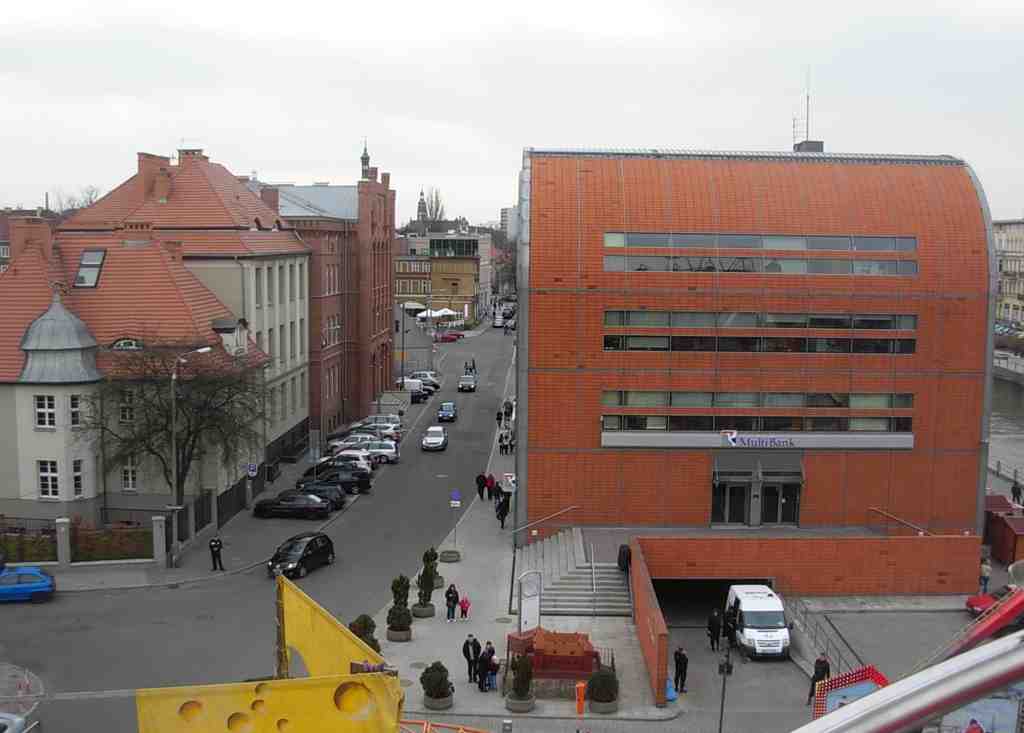
Look for a broad stone-paved riverside street lined with brick and timber-fronted facades, with old granaries at one end and a striking glass granary-shaped bank marking its modern edge.
Grodzka is not just a street... it’s a long stitched seam where Bydgoszcz kept repairing and reinventing itself. Town planners laid it out in the mid-fourteenth century, right when Bydgoszcz became a charter city, and ever since then this stretch along the Brda has carried trade, prayer, schooling, theater, and a whole lot of reinvention in about four hundred thirty meters.
The wild part is how deep its story goes. The eastern end of Grodzka cuts through the oldest settled part of Bydgoszcz. Archaeologists spent decades digging here and found traces of an early medieval stronghold on an island shaped by the river’s bends: log-cabin homes, work buildings, and even wooden harbor structures. Tree-ring dating pinned some of those fortifications to one thousand and thirty-seven and one thousand and thirty-eight. That is early... seriously early. Later digs near the corner with Bernardyńska added more wooden remains, and many of those finds ended up in the archaeological displays at the White Granary on Mill Island.
For centuries, this was the city’s northern edge and its main axis. One end pointed toward the cathedral, the other toward the old castle. Somewhere near the Podwale crossing stood the Grodzka Gate, the one passage between town and castle, with a bridge over the moat just beyond it. Archaeologists never found the gate itself, but old written records proved it stood here. Then the Swedish invasions tore down both gate and castle, and the city never raised them again.
This street even had a bathing district. The western part once took its name from public baths. In fifteen forty-nine, Andrzej Kościelecki reached an agreement with the city council to place public baths on the waterfront here. In fifteen seventy-three, Jan Kościelecki pushed for repairs so people could use them again for basic hygiene. Records still mention bathing activity in seventeen seventeen, which gives Grodzka this funny, practical side among all the grander stories.
Trade shaped the look of the place. The river side filled with granaries and harbor business, while the opposite side grew houses and institutions. That’s why Grodzka feels like a conversation between storage and ceremony: late eighteenth-century granaries, the Dutch Granary turned museum, the shipping-company elegance of Lloyd’s Palace, the neo-Gothic seminary on the old moat line, and then the bold glass forms of the mBank “new granaries,” which became an icon of modern Polish architecture.
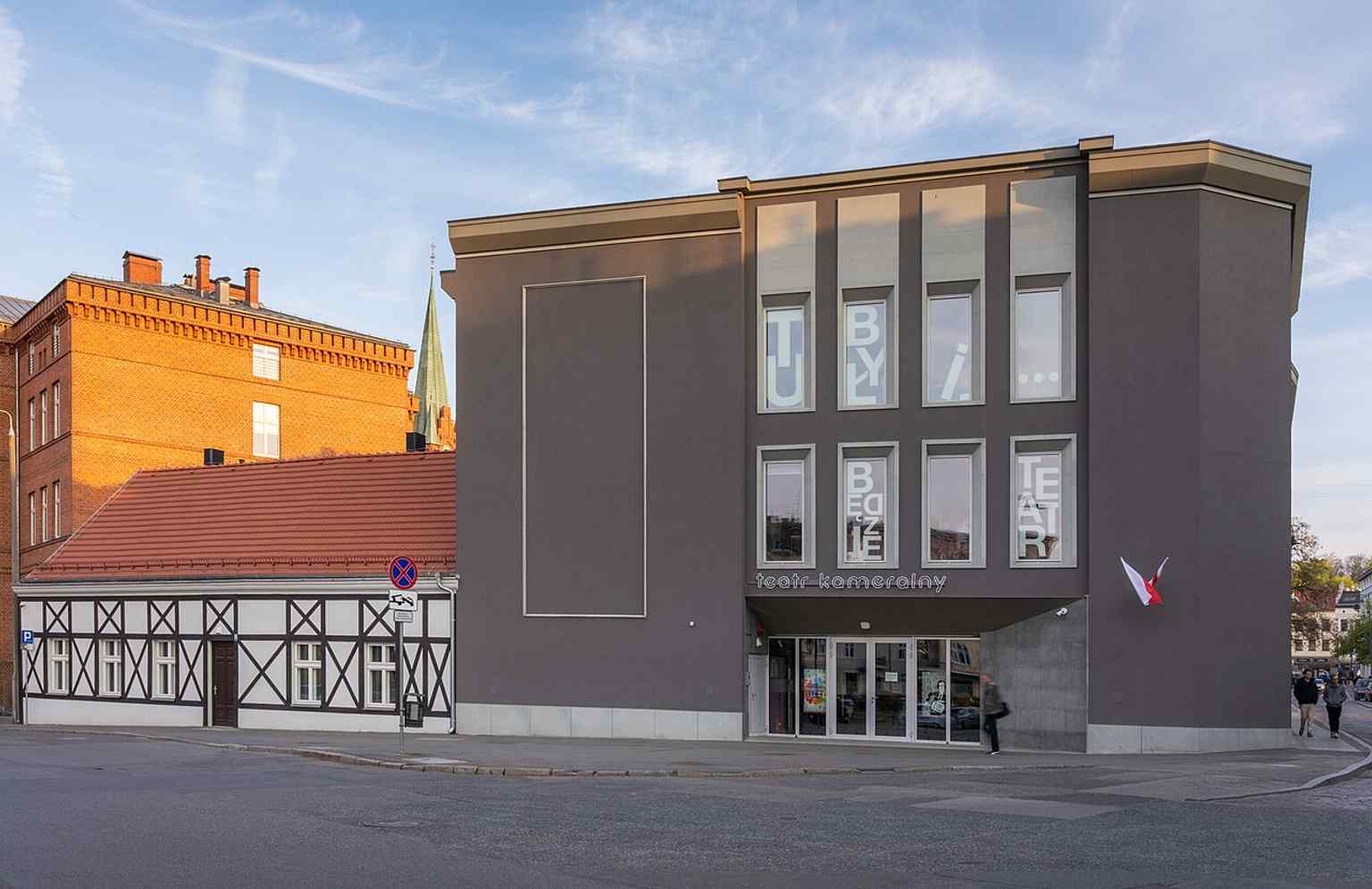
And then there’s performance. At numbers fourteen and sixteen, a restaurant and entertainment complex grew into a major social venue after Jacob Wichert expanded it, and in eighteen ninety-seven Karl Bergner added a banquet hall for six hundred people. After the Second World War, when the municipal theatre was gone, artists adapted this building for stage work. Later it became the Chamber Theatre, a home for experimental productions until fire rules shut it down in nineteen eighty-eight. If you want, check the before-and-after image in the app; it’s a neat little proof that Grodzka keeps reviving its cultural heart.
If you glance at the historic Fish Market photo on your screen, you’ll catch the trading life that once pressed right up against this river edge.
Grodzka feels less like one street and more like the whole city told in one long breath.
Take your time here, and when you’re ready, we can drift on toward the old castle site.