
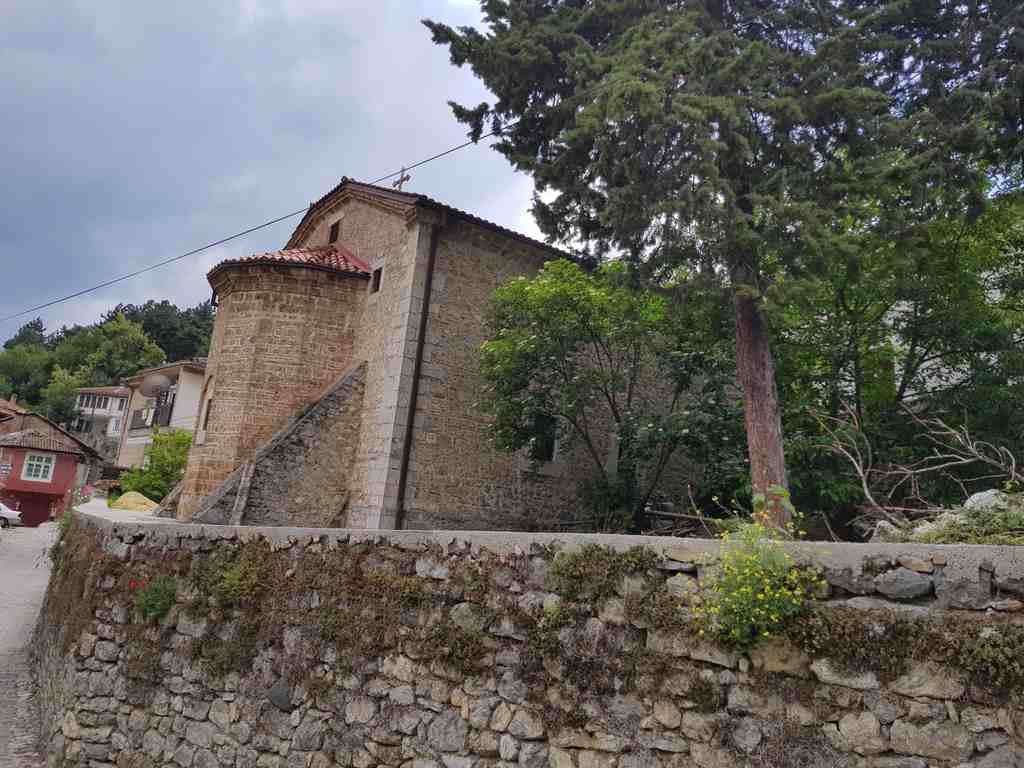
Looking to your right, you will spot a sturdy church built from textured tufa stone, featuring a striking seven-sided rounded apse and a sloping tiled roof. It looks quiet now, but the ground beneath this building holds secrets that go back a millennium. This is the Church of the Great Sorcerers, also known as the Holy Physicians, Saints Kuzman and Damjan.
What you are looking at is actually an 1830s reconstruction, but the roots here dig much deeper. Back in the eleventh century, the original church was built on this very spot by Archbishop Theodoulos the First. He was a powerful religious leader from Asia Minor, appointed by the Byzantine Empress herself in 1056 to build new temples and anchor the Orthodox faith right after the fall of the local empire.
But Theodoulos did not build it alone. He had help from a mysterious financial backer, a man known in the ancient records as Jovan Antsa. Historians have been arguing over this guy for years. Was he a local Slavic nobleman from the prominent Bandzhov family? Or was he a wealthy Byzantine aristocrat? Nobody really knows. His true identity is lost to the ages, but his name lives on, a perfect symbol of the different cultures that constantly blended and clashed on these ancient streets.
The church you see today has some pretty wild details inside, too. Back in 1850, when wealthy local merchants funded a renovation, they hired painters to decorate the iconostasis, which is the ornate wooden wall separating the sanctuary from the main church space. Usually, artists paint solemn biblical scenes on the base of this wall. But these painters did something completely rebellious. They painted everyday, secular Balkan city houses with little balconies and windows. The rich merchants funding the project basically wanted to see their own fancy modern lifestyles reflected right in the sacred space.
There is also a bit of an empty space here today. The original Royal Doors, the grand wooden gates for the center of that altar dating back to the sixteenth century, are missing. Do not worry, they were not stolen or destroyed. In a modern move to protect cultural heritage, those spectacular carved doors were permanently relocated to another church in town to fill an empty gap on their altar. It secured the survival of the artwork, but it left this sanctuary without its greatest medieval treasure.
It just goes to show how these ancient structures quietly adapt, trading pieces and rebuilding their walls to survive whatever history throws at them. Now, let us keep walking. Our next stop is just a short three minute stroll away, the monumental Cathedral of Saint Sophia. Let us head over.




