

Ohrid Audio Tour: Echoes of Faith, Legends, and Living Stone
Stone domes over Lake Ohrid hide a city that has survived crowns, coups, and quiet betrayals. Even a small church wall can feel like a coded message. This self guided audio tour leads through Ohrid and beyond the postcard, from the Church of St. Nicholas Sofia to the Church of the Great Sorcerers and on toward Karađulevci. Hear the stories most visitors miss, where politics, rebellion, scandal, and forgotten devotion still echo. What decision in Ohrid turned a holy doorway into a spark for conflict, and who paid the price? Why do whispers cling to the Church of the Great Sorcerers long after the candles go out? Which oddly specific mark in Karađulevci was treated like evidence in a local mystery? Follow narrow lanes, sharp turns, and sudden viewpoints. Feel the tension beneath the stone, and watch Ohrid rearrange itself into a living drama. Press play and chase the message hidden in the walls.
Tour preview
About this tour
- scheduleDuration 120–140 minsGo at your own pace
- straighten5.3 km walking routeFollow the guided path
- location_onLocationOhrid, North Macedonia
- wifi_offWorks offlineDownload once, use anywhere
- all_inclusiveLifetime accessReplay anytime, forever
- location_onStarts at Robevi family house
Stops on this tour
lock_open 3 free previews · 10 unlock with purchase
Look right in front of you at that striking building rising from a solid stone base into a bright white facade, defined by its dark, grid-patterned wooden windows and jutting,…Read moreShow less
Open dedicated page →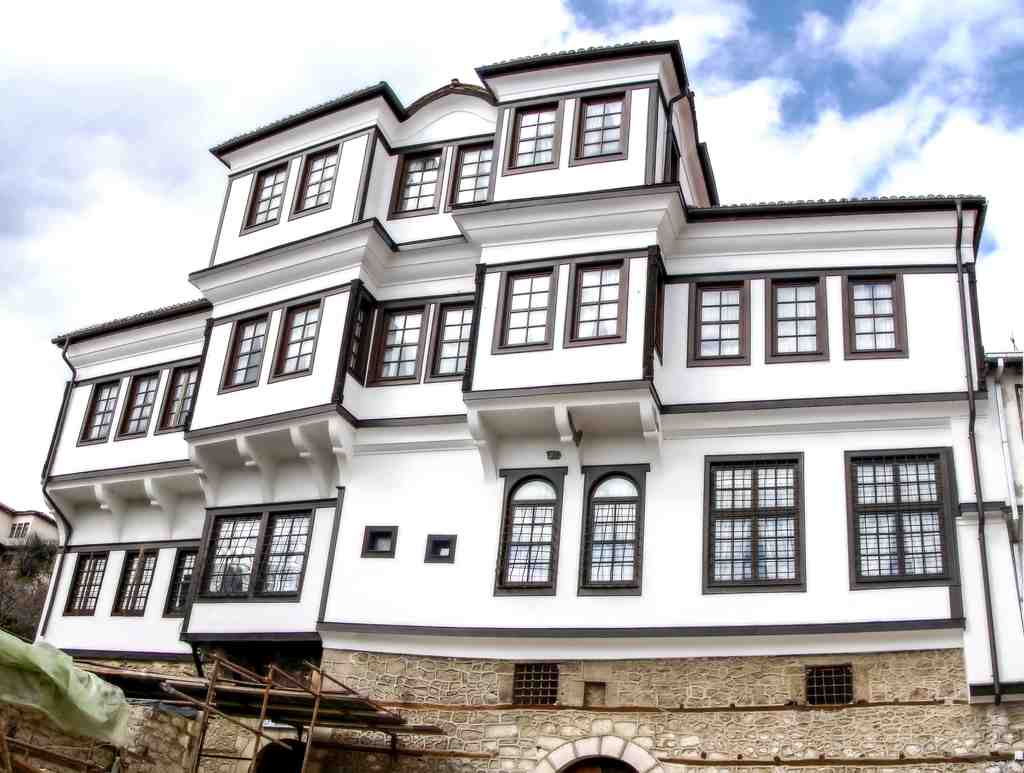
Robevi family housePhoto: Silfiriel, Wikimedia Commons, CC BY-SA 3.0. Cropped & resized. Look right in front of you at that striking building rising from a solid stone base into a bright white facade, defined by its dark, grid-patterned wooden windows and jutting, multi-tiered upper floors.
The Robev brothers, Angele and Anastas, were titans of trade whose vast merchant empire stretched all the way from Istanbul to Vienna and Leipzig. Their incredible wealth allowed them to build a magnificent family mansion right here in 1827.
But when you have that much money, people notice. Actually, it wasn't a laughing matter for them. In January 1861, a notorious regional criminal named Dzeladin Bey, often recorded in history as Husref-Bey, targeted their opulent home. He intentionally set the property ablaze, a devastating act that burned the original structure straight to the ground.
But this city has a habit of surviving its scars. Instead of being defeated by the ashes, the family brought in master builder Todor Petkov between 1863 and 1864 to reconstruct an even grander mansion. They built their legacy back from the ground up, turning a devastating loss into the ultimate architectural status symbol. It stands today as a profound testament to how culture and heritage can weather the storms of destruction.
The new place was designed as a twin-brotherly mansion, split right down the middle. Dr. Konstantin lived in the left wing, while Anastas's kids took the right. To make sure both sides were spectacular, the family sparked a bizarre artistic rivalry. Petkov's team worked on the left, while a separate group of master carvers from Debar took the right. The catch... they were strictly forbidden from seeing each other's work. Because of this blind competition, the intricately carved ceilings and built-in cupboards in the left wing have a completely different ornamental style than those in the right. The upper quarters still feature a shirvan, which is a traditional enclosed wooden balcony typical of Ottoman-era Ohrid, where the family proudly entertained their guests.
But the drama did not end there. Decades later, occupying soldiers completely stripped the left wing of its irreplaceable woodcarved elements. Family member Angele Robev fiercely protested the looting, but his official complaints were entirely ignored. The stolen masterpieces were reportedly carted off to the city of Niš in Serbia and vanished without a trace.
Eventually, the house transitioned from a private residence to a public museum, officially nationalized by the state in 1953. It now holds incredible archaeological treasures. Take a glance at your app to see one of its most famous pieces. That is a fragmented torso of the goddess Isis from the second century BC, an artifact so significant it is actually printed on the Macedonian ten-denar bank note.
As you walk to our next stop, think about what else might be buried beneath our feet, as we dive deeper into the older, more mysterious layers of this ancient city. We are heading just a two-minute walk away to the Church of St. Nicholas Virgin Mary Chelnitsa. Oh, and if you want to explore the inside of the Robevi House yourself, it is open Tuesday through Sunday from nine in the morning until three in the afternoon.
Look to your left for a striking stone building with a rustic terracotta tiled roof, featuring a square bell tower built from layered stone and red brick with narrow arched…Read moreShow less
Open dedicated page →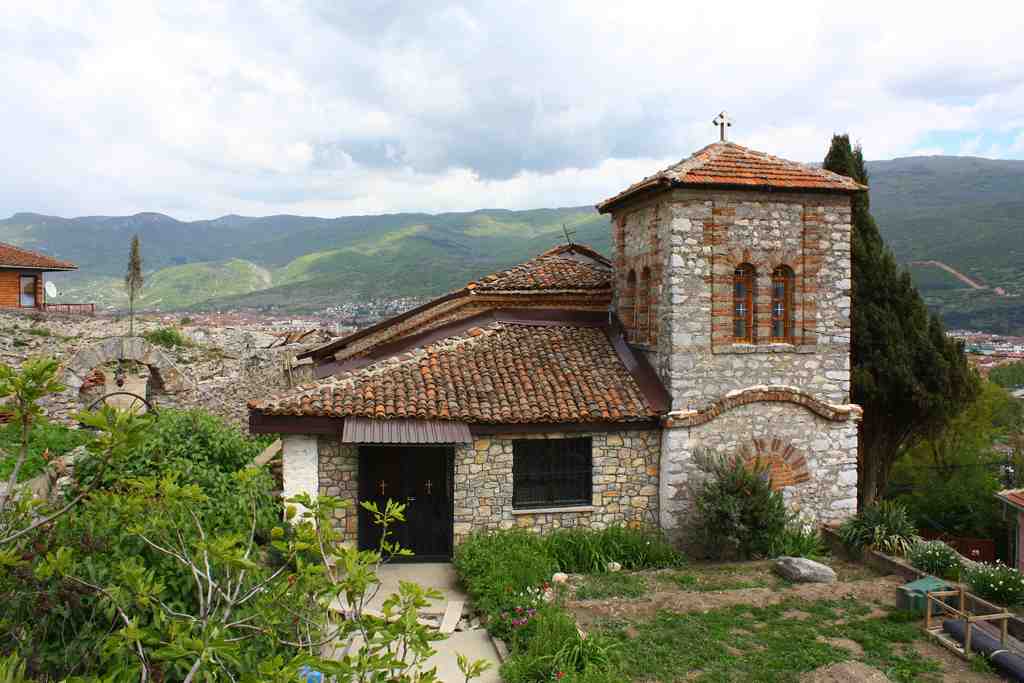
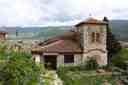
Church of St. Nicholas "Virgin Mary Chelnitsa" - OhridPhoto: Rašo, Wikimedia Commons, CC BY-SA 3.0. Cropped & resized. Look to your left for a striking stone building with a rustic terracotta tiled roof, featuring a square bell tower built from layered stone and red brick with narrow arched windows. It is wild how a simple blocked up archway can prove that local legends have the power to permanently reshape a city's physical architecture. For centuries, the shift from Byzantine Christian rule to the Ottoman Empire meant a constant, uneasy dance of clash and coexistence. The old Christian locals and the new Ottoman rulers lived side by side, but power dynamics were always bubbling just under the surface. You can feel that tension right here where the church leans against the old city walls.
There used to be a gate right here called the Chelna gate. It had a deep unwritten rule. An icon of the Virgin Mary and Jesus hung above the entrance, and anyone passing through had to dismount their horse and take off their hat out of respect. Well, one day a high ranking Ottoman official, a pasha, rode up. He was not about to bow to a Christian image. He stubbornly tried to ride his horse right through. But the animal inexplicably panicked, reared up on its hind legs, and threw the proud pasha right into the dirt. Humiliated and furious, the pasha took a petty revenge. He ordered the gate to be bricked up solid forever. That single tantrum split the local neighborhoods apart, completely ruining the easiest walking route through the city. Turkish guards were posted here, stopping regular church services for a long time.
But the sacred space endured. The church itself, known as Virgin Mary Chelnitsa, is completely unique in Macedonia because of its two naves, which are the main central halls where the congregation gathers. The second nave and that bell tower were added in the nineteenth century, when the famous painter Dicho Zograf left his mark with a grand fresco. But beneath your feet is a hidden early Christian crypt, proving people have prayed against these walls for centuries before the medieval church was even built. As we head toward our next stop, the Kara Bey Taushanli Mosque, which is about an eighteen minute walk from here, think about all those buried layers of imperial influence shifting beneath your feet.
Up ahead is a white stucco building sitting quietly behind a green wrought-iron fence, featuring a small hexagonal tiled canopy resting on green pillars. This is the Kara Bey…Read moreShow less
Open dedicated page →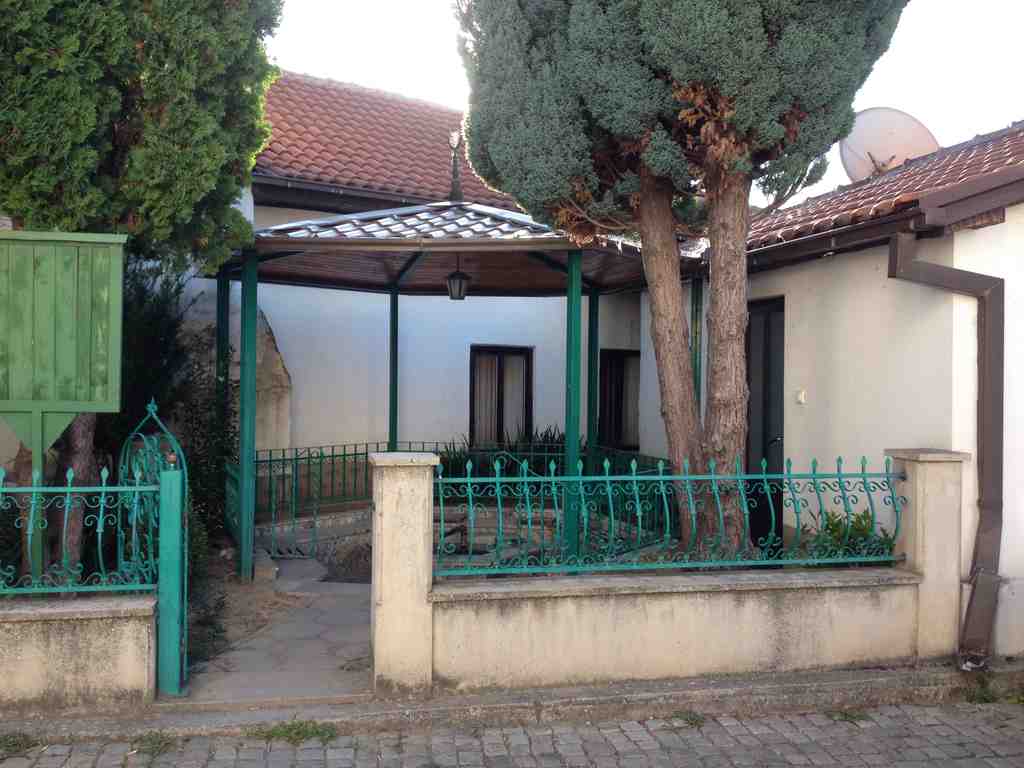
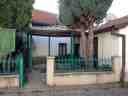
Kara Bey Taushanli MosquePhoto: Alboholic, Wikimedia Commons, CC BY-SA 4.0. Cropped & resized. Up ahead is a white stucco building sitting quietly behind a green wrought-iron fence, featuring a small hexagonal tiled canopy resting on green pillars. This is the Kara Bey Taushanli Mosque. It is a quiet survivor from the seventeenth century, standing as a testament to an era when the cultural fabric of this city was being woven by new hands.
Enter Evliya Celebi. He was a famous Ottoman traveler and chronicler, a man who wandered the vast empire taking detailed notes on everything he saw. He actually documented this exact spot in his 1662 travelogue, which is basically a historical travel diary capturing a changing world.
Interestingly, there is no founder's inscription on this mosque... no carved stone bragging about the wealthy patron who paid to build it. It just quietly belongs to the community, lending its name to the Kara Bey neighborhood right here on Dame Gruev street. While massive empires rise and fade away, unassuming places of faith like this just keep holding their ground, hiding their histories in plain sight.
Let's head toward the town square, where an ancient living monument is waiting for us, just an eleven-minute walk away.
Show 10 more stopsShow fewer stopsexpand_moreexpand_less
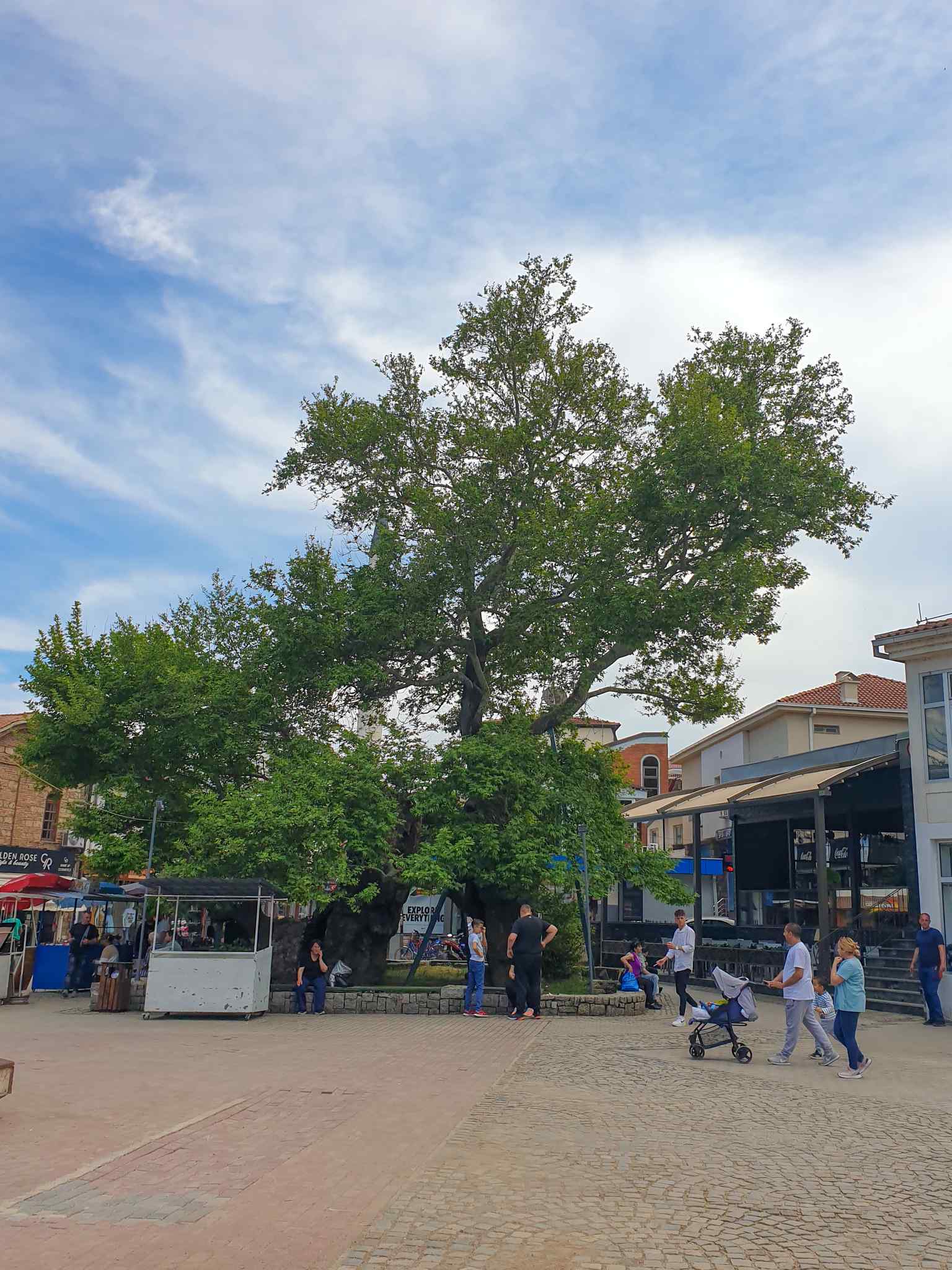
The Ohrid plane tree stands as a gnarled wooden giant with a massive, dark base featuring a distinct hollowed-out opening and thick branches casting a wide canopy. Legend has it…Read moreShow less
Open dedicated page →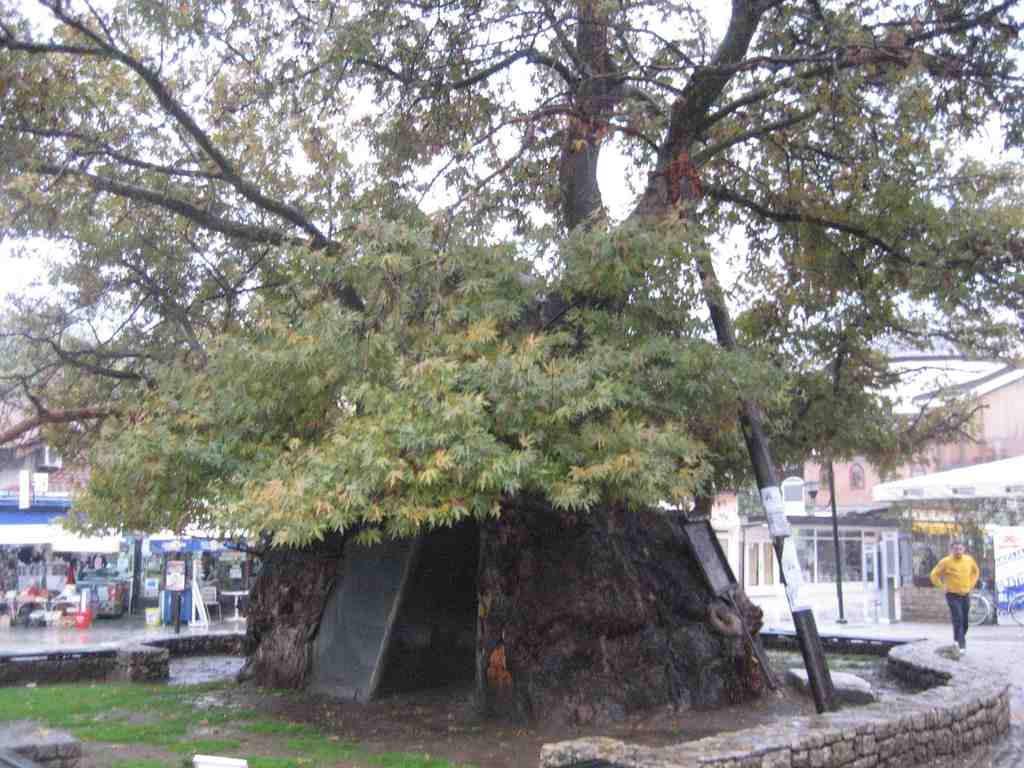
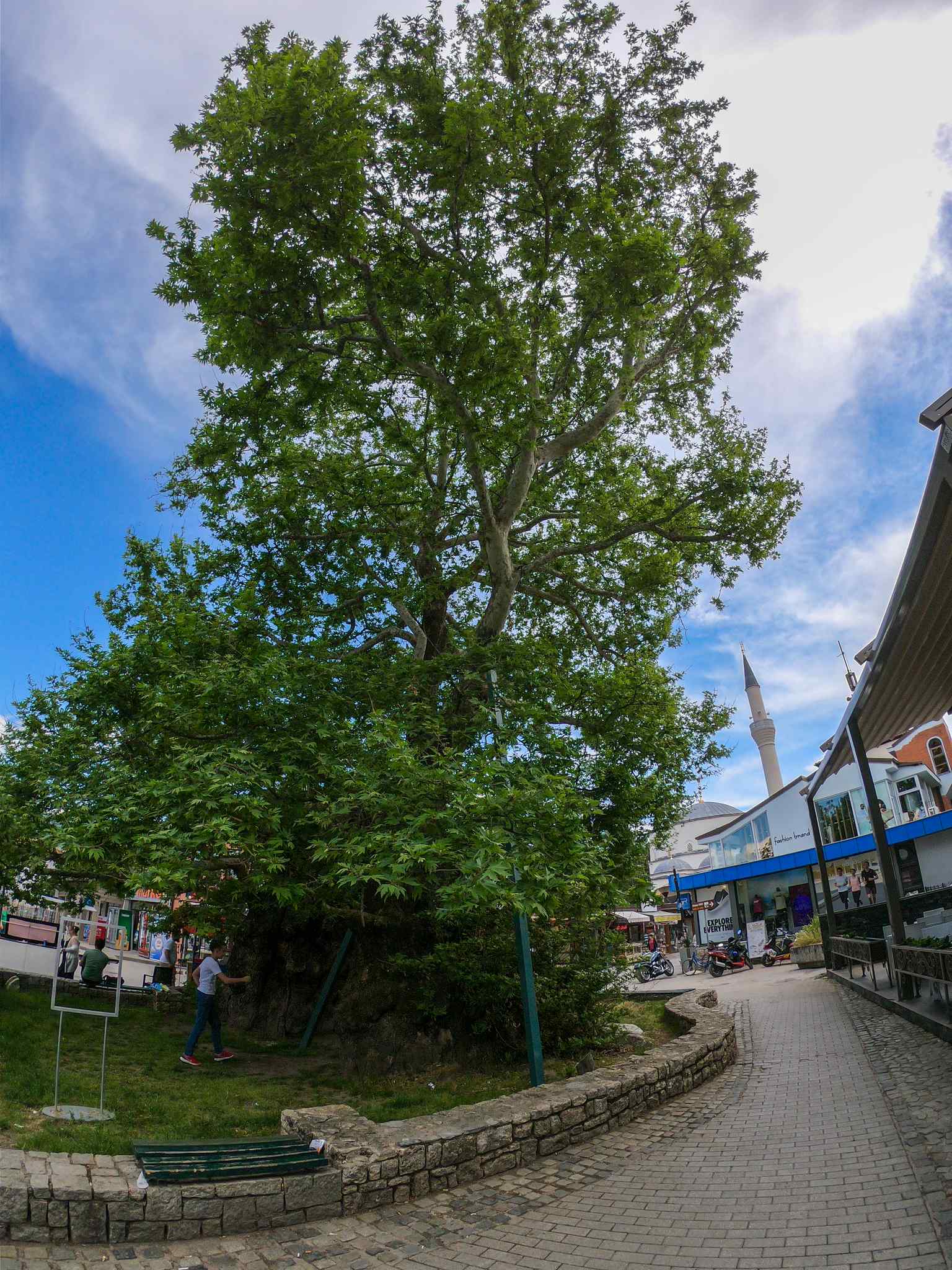
Ohrid plane treePhoto: Modzzak, Wikimedia Commons, Public domain. Cropped & resized. The Ohrid plane tree stands as a gnarled wooden giant with a massive, dark base featuring a distinct hollowed-out opening and thick branches casting a wide canopy. Legend has it that Saint Clement of Ohrid, the famous medieval scholar, planted this very tree in the ninth century. That is quite the origin story. Science puts its true age closer to seven hundred years, but either way, it has watched empires wash over this land, keeping hidden histories locked deep within its rings.
Step right up to that massive, eighteen meter tall trunk. Can you picture the sheer size of the hollow space inside, once buzzing with the metallic snip of a busy barber and the rich aroma of coffee? This trunk is over three meters wide and was entirely hollow in the center. It actually housed a functional barbershop and a small coffee house. Locals proudly called it the only cafe in a tree in the Balkans. Take a look at your screen to see the unbelievable scale of that hollow interior.
Look into the hollow base of the Ohrid plane tree, once so spacious it housed a cafe and even a small barber shop, a unique "cafe in a tree" in the Balkans.Photo: Liridon, Wikimedia Commons, CC BY-SA 4.0. Cropped & resized. But underneath all that delightful charm, the roots tap into a much heavier past. During Ottoman rule, this central square was the designated stage for public executions. Authorities forced crowds to gather right beneath these massive branches to witness the grim events. Some locals claim the space still carries a heavy, lingering charge, as if the souls from centuries ago remain tethered to the wood.
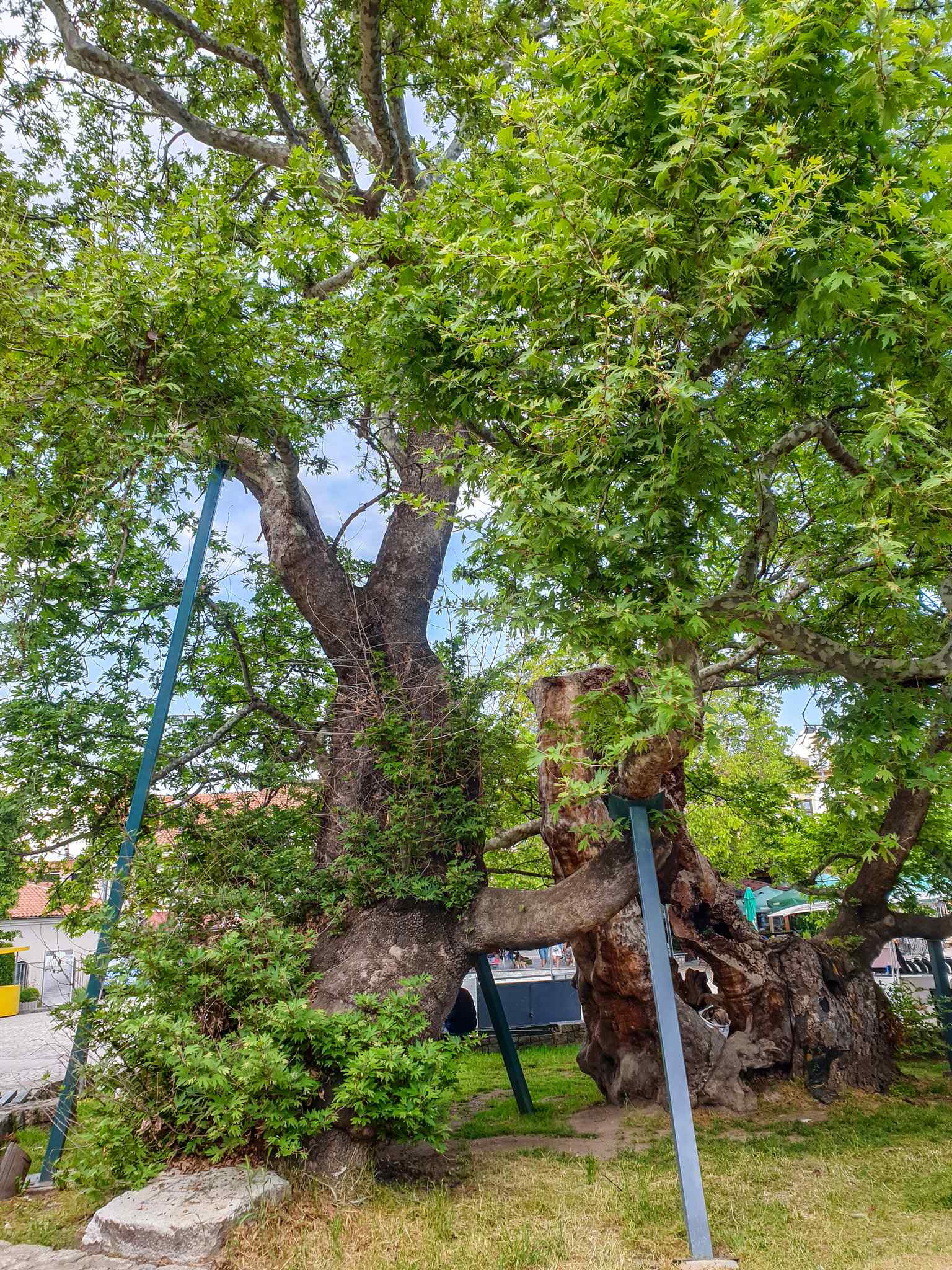
Nature has not been kind either. After a brutal storm snapped a massive branch, a botched repair job with fake bark left the tree looking so unnatural that locals jokingly nicknamed it Robocop. Finally, a major rescue mission in two thousand twenty revealed the core was completely rotten. To save it, experts cleared the decay and braced the heavy canopy with steel support pillars. You can spot those structural lifesavers if you glance at the app.
The heavy crown of the tree is now mechanically secured by these four support pillars, a crucial part of the 2020 revitalization project to ensure its stability and longevity.Photo: Liridon, Wikimedia Commons, CC BY-SA 4.0. Cropped & resized. Since this living monument is open twenty four hours a day, it is always ready to share its shade. Now, catch sight of the nearby Tekke, an old Islamic gathering lodge for Sufi dervishes. That beautiful spot sets the stage for the tale of a spiritual stranger, waiting for us at Zeynel Abedin Pasha, just a one minute walk away.
The majestic Ohrid plane tree stands as a central landmark in Kruševo Republic Square, a significant meeting point for locals for centuries.Photo: Liridon, Wikimedia Commons, CC BY-SA 4.0. Cropped & resized. 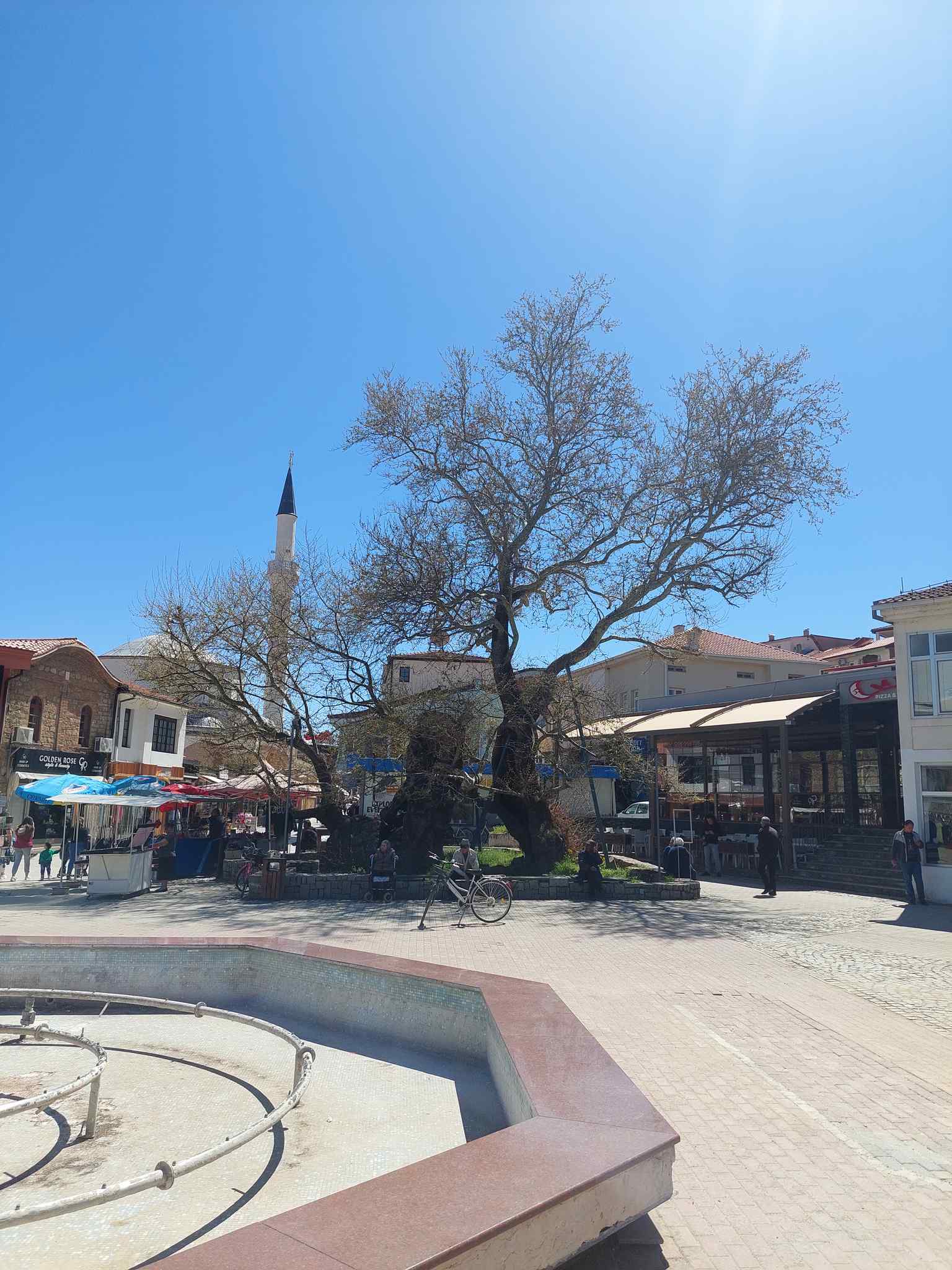
This view inside the hollow trunk reveals the extensive restoration work from 2020, where rotten parts were removed and structural supports were added to save the tree.Photo: Луната1999, Wikimedia Commons, CC BY-SA 4.0. Cropped & resized. 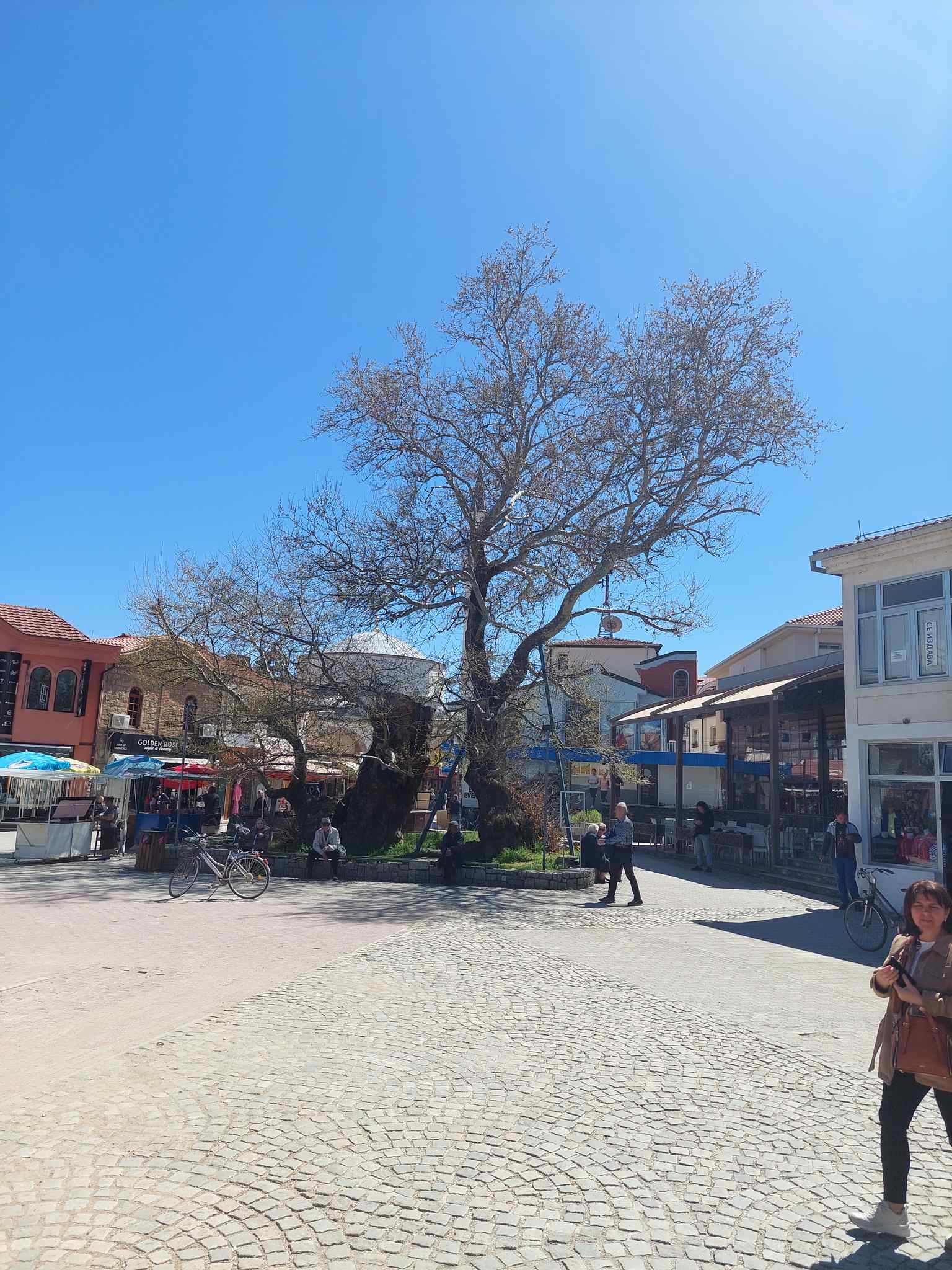
After decades of damage, the tree's interior was found to be completely rotten, requiring these drastic measures and support pillars to prevent its collapse.Photo: Луната1999, Wikimedia Commons, CC BY-SA 4.0. Cropped & resized. 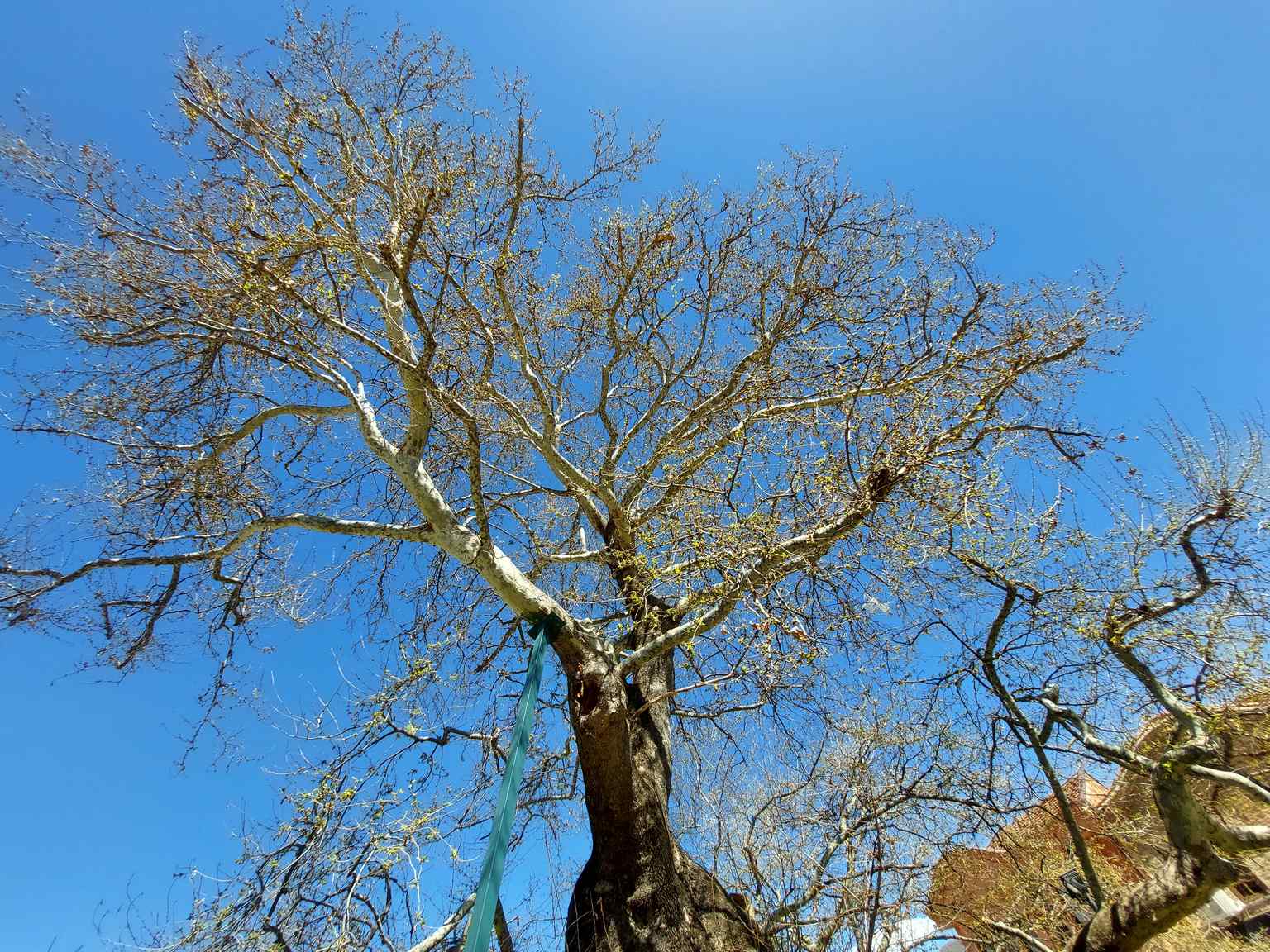
The plane tree is located on "Sveti Kliment Ohridski" street, opposite Dzheljo's Magaza, a key part of Ohrid's vibrant marketplace and social life.Photo: Луната1999, Wikimedia Commons, CC BY-SA 4.0. Cropped & resized. 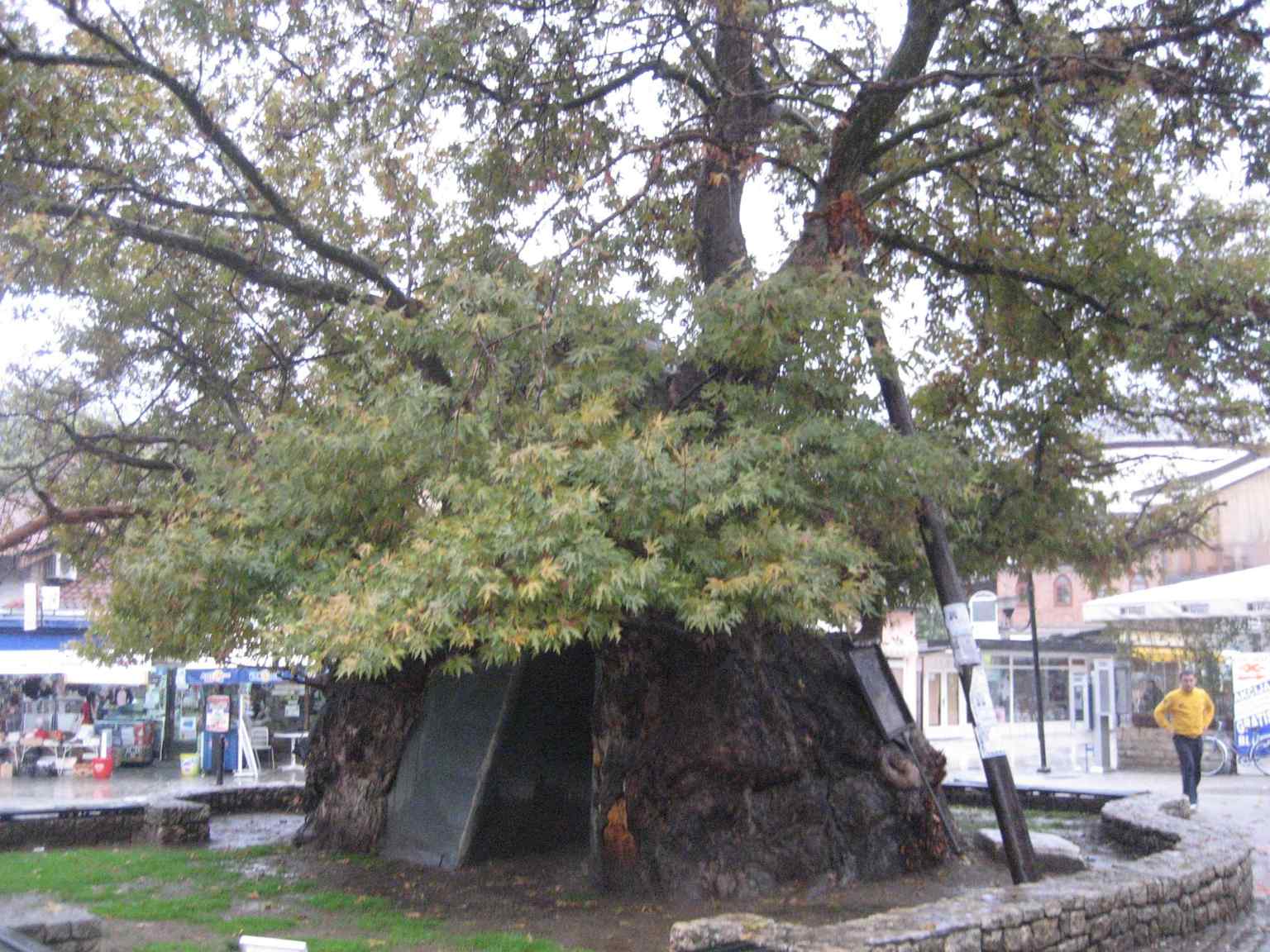
This perspective highlights the impressive crown of the Ohrid plane tree, whose age is estimated by experts to be around 700 years, making it one of the oldest living witnesses of history in the region.Photo: Modzzak, Wikimedia Commons, Public domain. Cropped & resized. 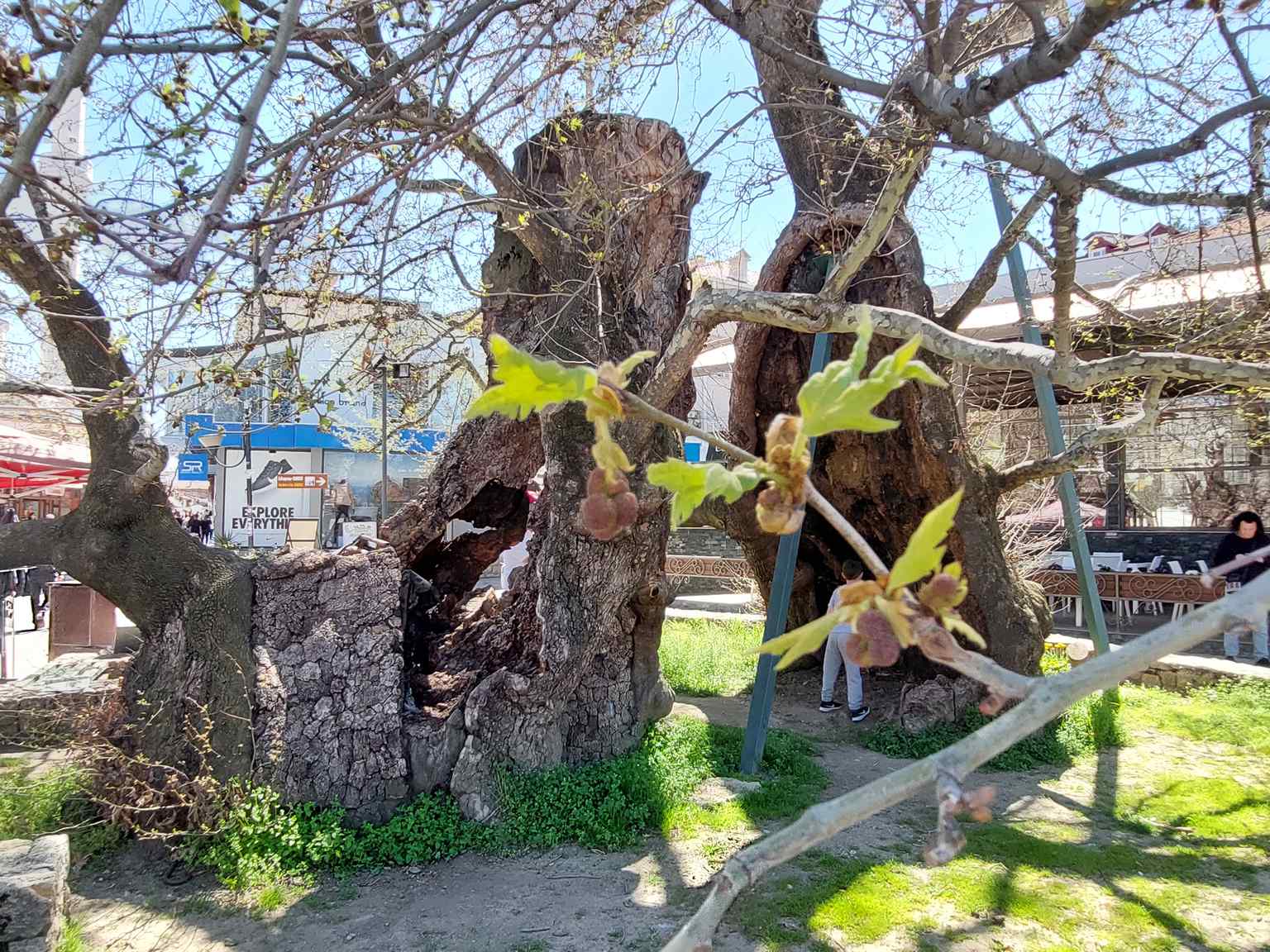
The Ohrid plane tree, towering at an impressive 18 meters, has long cast a deep shade, making it a natural gathering spot and a monument of nature in Macedonia.Photo: Луната1999, Wikimedia Commons, CC BY-SA 4.0. Cropped & resized. 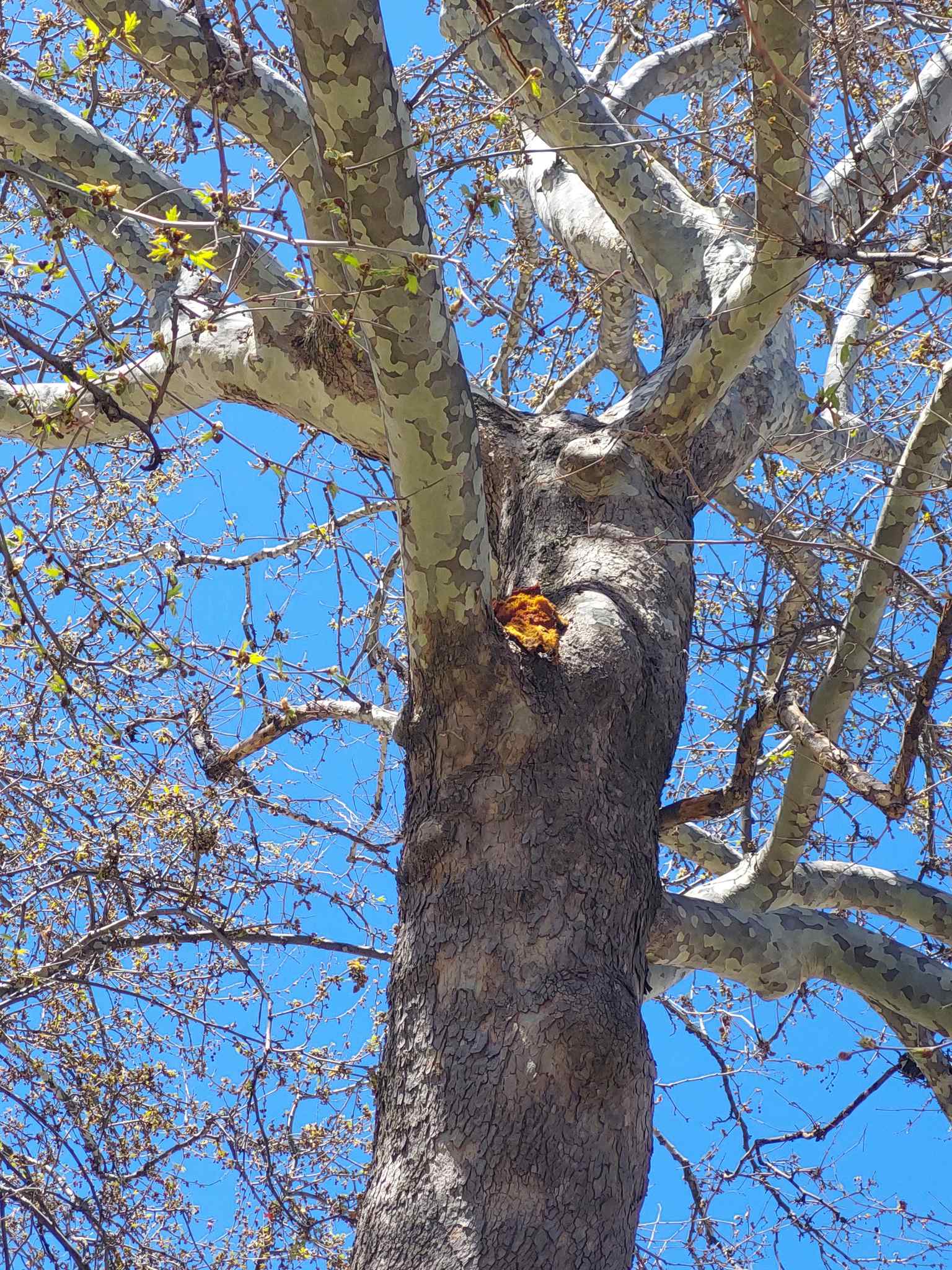
The gnarled bark and massive base speak to the plane tree's centuries of existence, enduring both natural disasters and a dark past as a site for public executions during Ottoman rule.Photo: Луната1999, Wikimedia Commons, CC BY-SA 4.0. Cropped & resized. 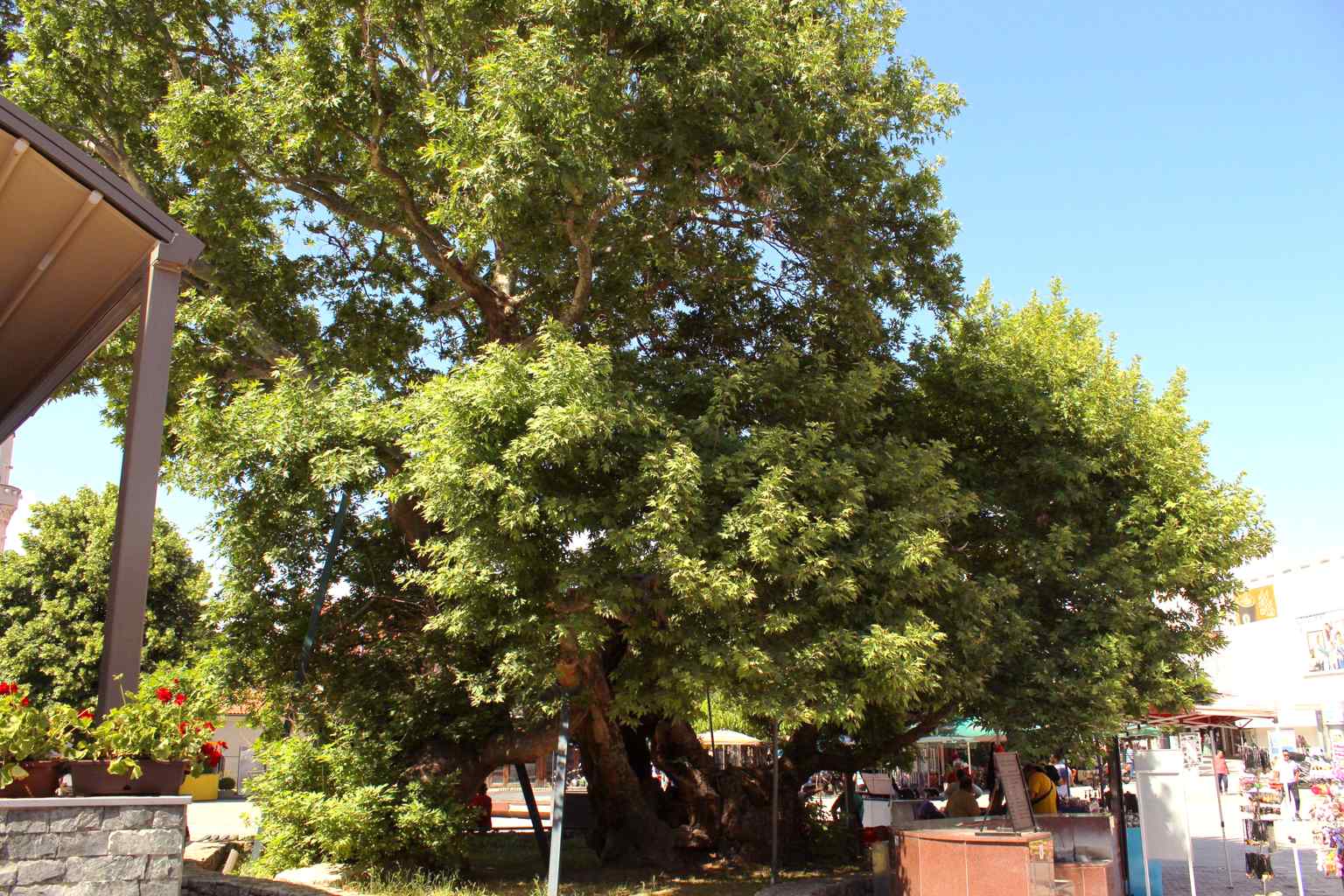
Located on the busy "Sveti Kliment Ohridski" bazaar street, the plane tree has historically served as a central meeting place, where agreements were made and stories shared.Photo: Ena.balena, Wikimedia Commons, CC BY-SA 4.0. Cropped & resized. 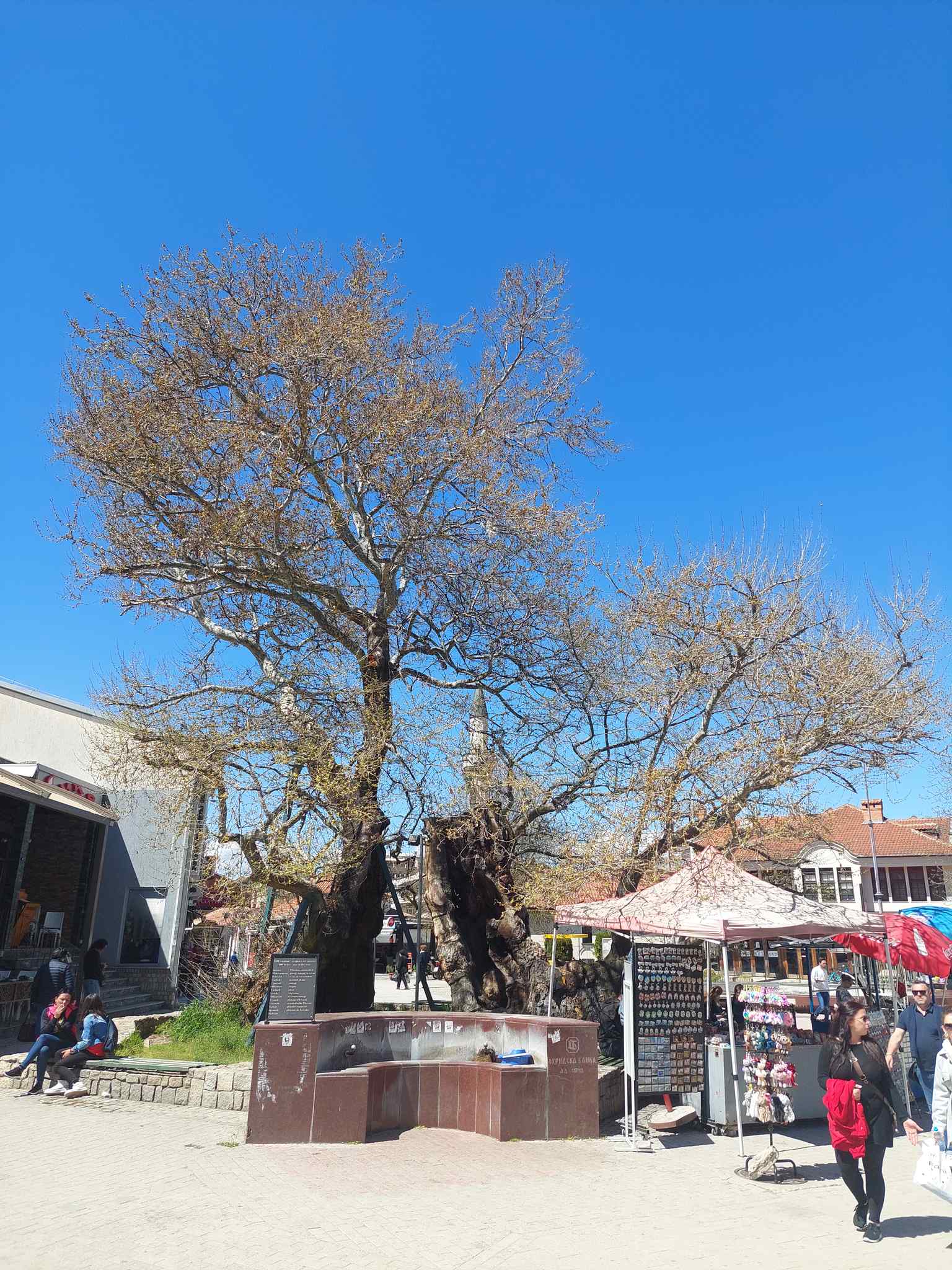
The towering canopy of the plane tree, proclaimed a natural monument of Macedonia, offers deep shade, a welcome respite in the bustling city of Ohrid.Photo: Луната1999, Wikimedia Commons, CC BY-SA 4.0. Cropped & resized. Look to your right and you will spot a low, white-washed building topped with a multi-sided terracotta roof and marked by distinct arched windows with green iron grates. This is…Read moreShow less
Open dedicated page →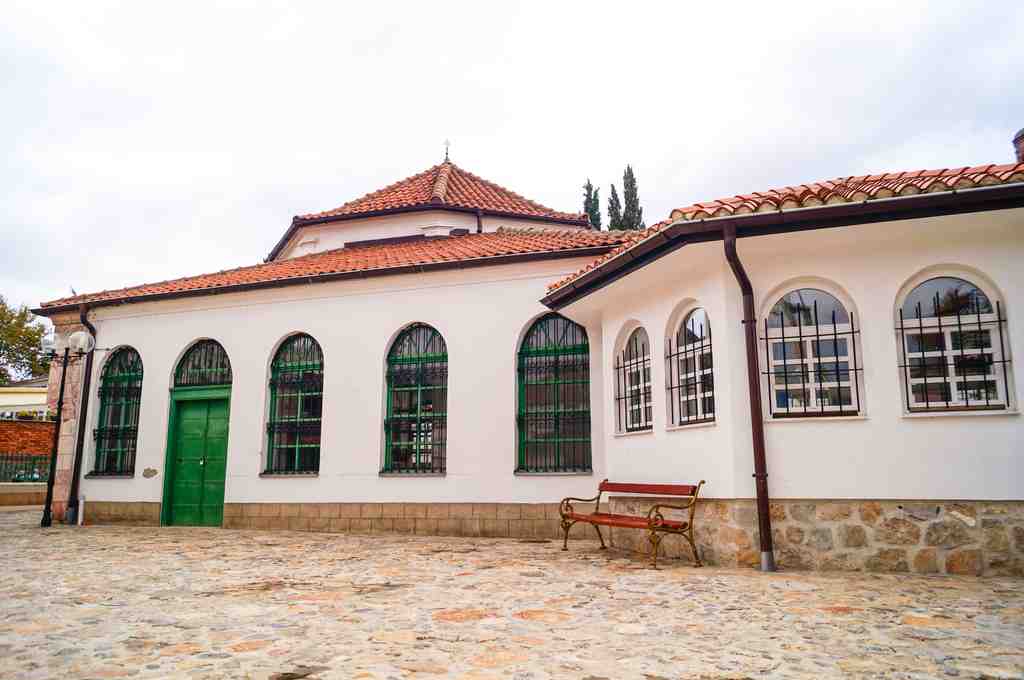
"Zeynel Abedin Pasha"Photo: Silfiriel, Wikimedia Commons, CC BY-SA 3.0. Cropped & resized. Look to your right and you will spot a low, white-washed building topped with a multi-sided terracotta roof and marked by distinct arched windows with green iron grates. This is the Zeynel Abedin Pasha complex, a place where layers of faith and history have quietly stacked up over the centuries.
At its heart, this is a tekke, which is a spiritual lodge or gathering place for Sufi dervishes, practitioners of a mystical branch of Islam. But getting this place off the ground was a serious uphill battle. Back in 1766, a spiritual traveler named Pir Mehmed Hayati arrived here all the way from Bukhara in Central Asia. You can imagine the scene. A stranger walks into town with completely unfamiliar ideas about devotion and life. The locals were highly skeptical. They looked at him as an outsider and practically shut him out.
But Hayati was incredibly stubborn, in the best way possible. Instead of packing his bags, he managed to secure a ferman, which is an official imperial decree directly from the Sultan in Istanbul. With that undeniable piece of authority in hand, he had the absolute legal right to build his tekke right next to the existing mosque. Over time, his gentle persistence completely won over the people of Ohrid. He even sealed his acceptance into the local high society by marrying his daughter to the son of the city's mufti, the chief Islamic legal authority. Talk about turning your critics into family.
What really gets me is how unbreakable the traditions became here. For nearly three hundred years, the doors of this lodge literally never closed, with daily rituals pausing only for major holidays. They even practiced a hardcore spiritual boot camp called erbain. This was a forty-day isolation retreat where beds were strictly forbidden. A dervish would sit in a simple corner with nothing but a bowl, a wooden spoon, and a cup of water, enduring absolute physical deprivation to reach a higher spiritual plane.
Inside the founder's tomb, there is a three-hundred-year-old Ottoman sancak, a ceremonial standard or flag, quietly guarding the legacy of a man who refused to be turned away. It is wild to think about what survives when you hold your ground and let the world shift around you.
Let us keep moving toward the gentle slopes up ahead. We are heading over to our next stop, the Haji Hamza Mosque, which is just a two-minute walk away.
Just up the hill on your left is a simple, square white building perched above a stone retaining wall, marked by an arched brick doorway and a slender, white minaret with a dark,…Read moreShow less
Open dedicated page →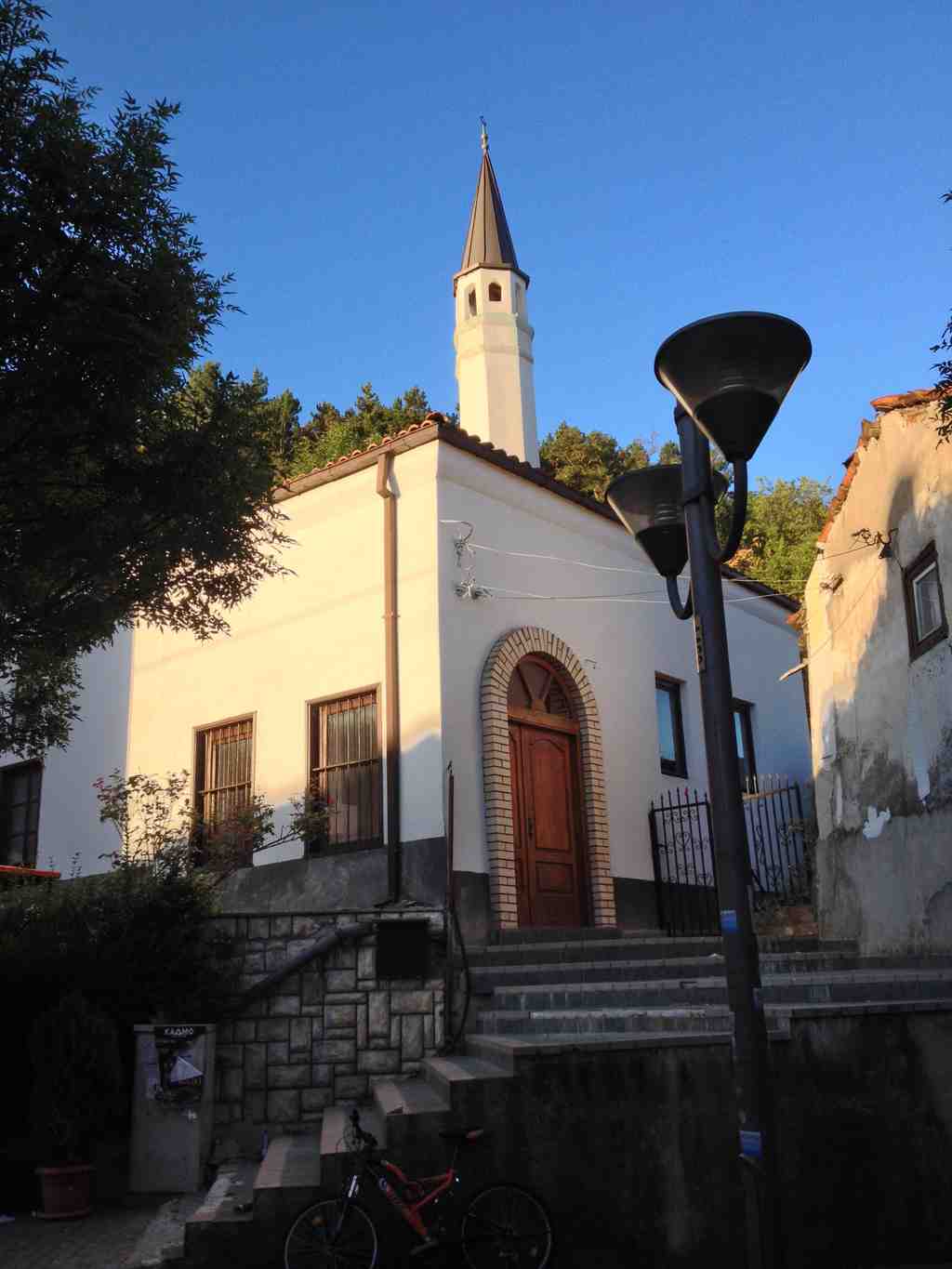
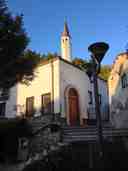
Haji Hamza MosquePhoto: Alboholic, Wikimedia Commons, CC BY-SA 4.0. Cropped & resized. Just up the hill on your left is a simple, square white building perched above a stone retaining wall, marked by an arched brick doorway and a slender, white minaret with a dark, pointed roof. You are looking at the Haji Hamza Mosque.
This spot rests right on the northeast slope of Deboj Hill, a commanding natural rise that has anchored the physical and cultural landscape of the city for centuries. Sitting securely here at the start of the old bazaar, this building has worn a few different hats over the years. Back in the sixteenth century, it began its life as both a mosque and a madrasa, which is a traditional Islamic school for scholars. But as the generations rolled by, the space evolved into a tekke. When that transition happened, they built the minaret you see today, along with a tomb and a courtyard fountain.
If you look closely at that minaret, you might notice an architectural quirk. Almost all Ottoman minarets feature a classic wrap-around balcony, where the muezzin steps outside to sing the daily calls to prayer. But not this one. It rises from a square base, shifts into an octagonal body, and closes off completely at the top like a little watchtower. Because of this, the muezzin never stepped out onto a ledge. He just sang his vibrant calls directly through those narrow upper windows.
This place also holds a rather baffling modern mystery. In 1972, a visiting historian documented a precious marble plaque kept safely inside the prayer hall, carved with the original name of the madrasa. But somewhere along the line during later twentieth-century renovations, that heavy stone slab completely vanished. To this day, nobody knows who walked off with it or where it ended up.
Despite losing literal pieces of its past, the mosque itself held its ground. When the Balkan Wars swept through, many Ottoman buildings crumbled, but Haji Hamza dug its foundations into the hillside and quietly survived the shifting tides of power, eventually reopening fully restored in 2018.
Let us keep heading up the slope of this ancient hill, where we are going to find a structure built entirely from a local leader's grief, as we make our way toward the Clock Tower, just a nine-minute walk from here.
On your left, you will see a twelve-meter tall, square stone base topped with a wooden upper section holding a classic white clock face. Take a glance at your screen to see the…Read moreShow less
Open dedicated page →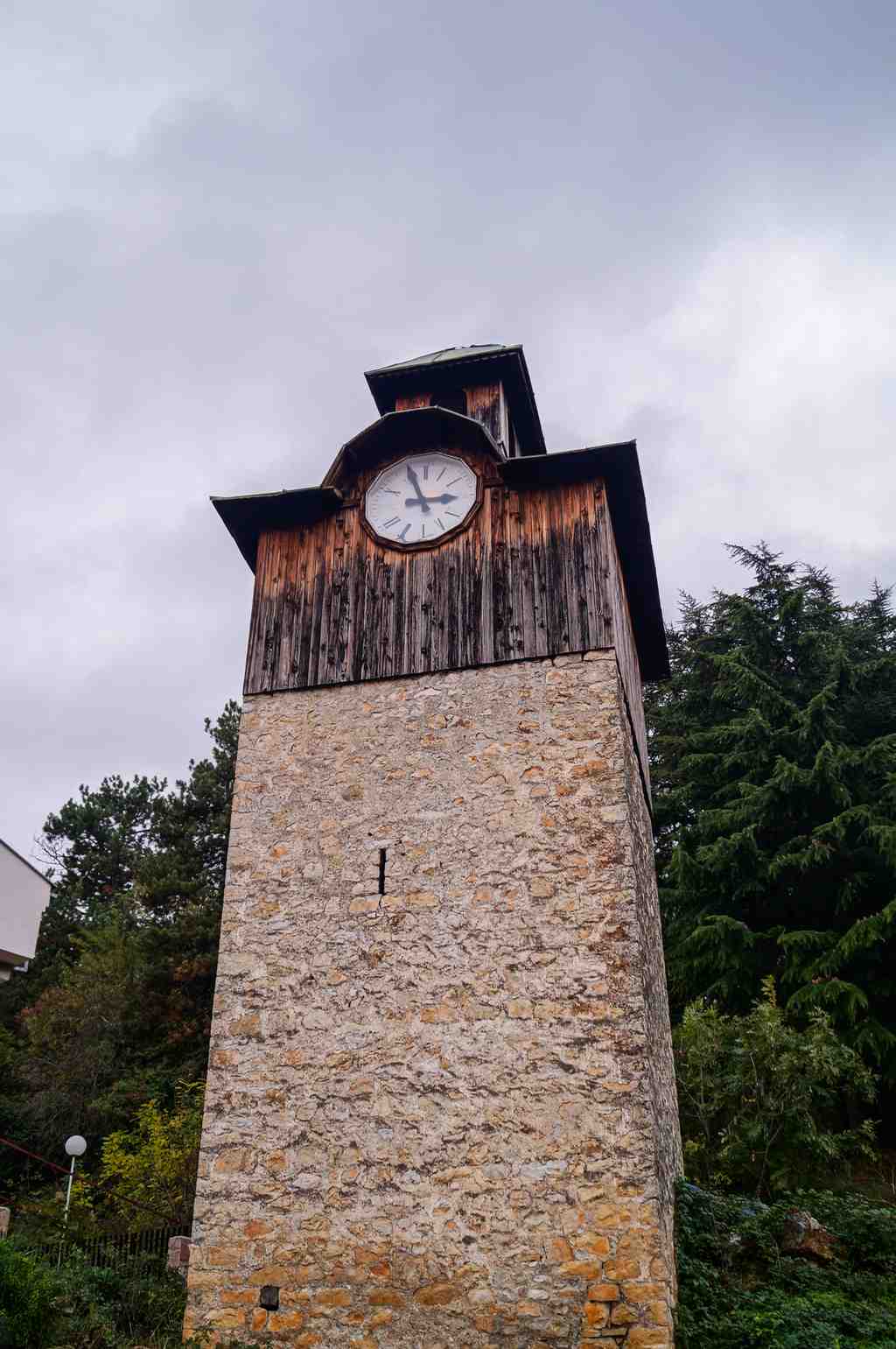
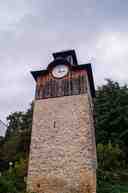
Clock TowerPhoto: Silfiriel, Wikimedia Commons, CC BY-SA 3.0. Cropped & resized. On your left, you will see a twelve-meter tall, square stone base topped with a wooden upper section holding a classic white clock face. Take a glance at your screen to see the rugged, unadorned stone up close. This tower went up in 1726, right during the Ottoman Empire's Tulip Era, a time famous for extravagant, highly decorated architecture. Yet this structure is completely stripped back.
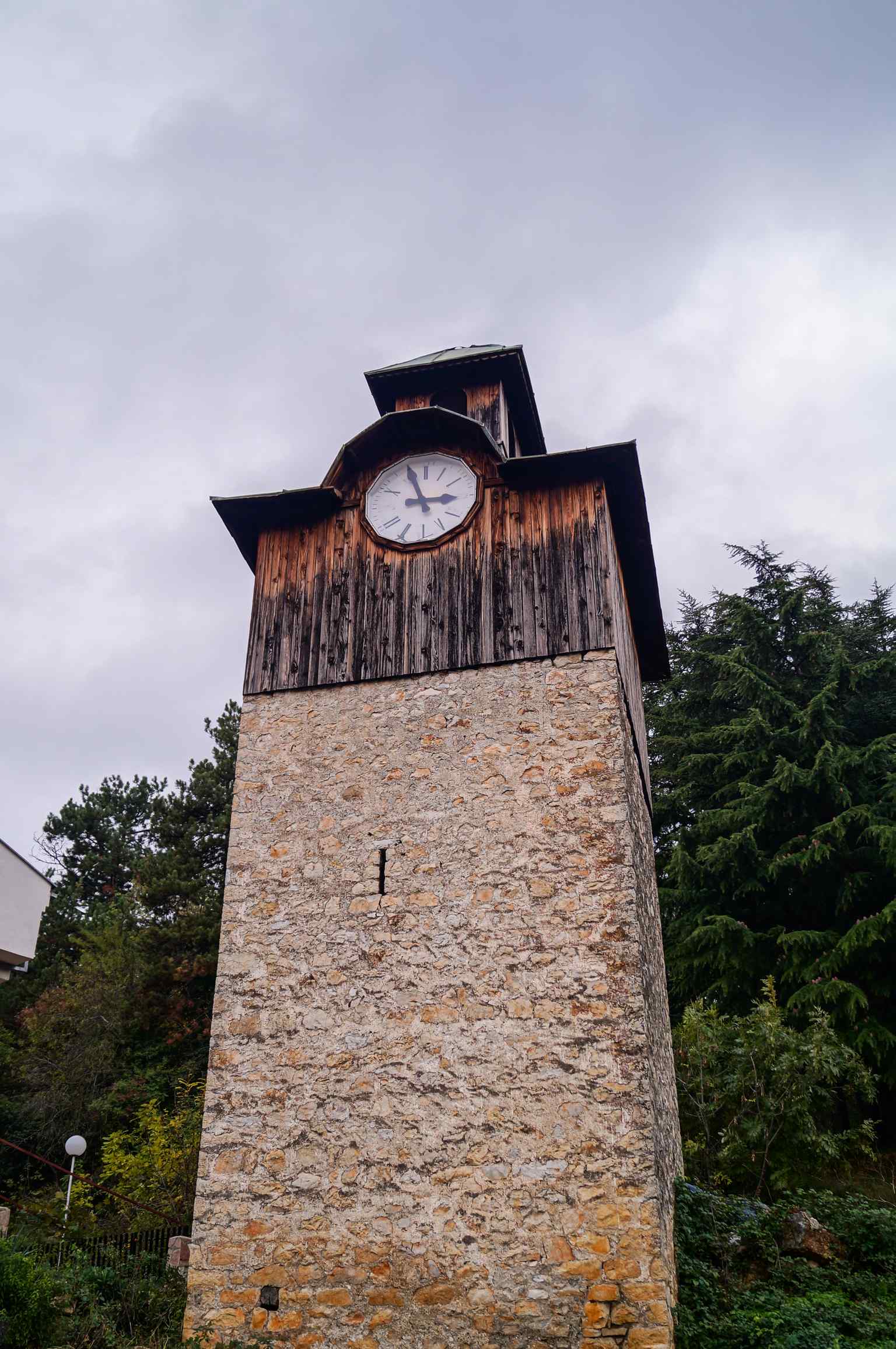
This image shows the modest stone form of the Clock Tower, constructed in 1726 as a gift to the citizens after the bey's daughter was miraculously cured.Photo: Silfiriel, Wikimedia Commons, CC BY-SA 3.0. Cropped & resized. The story goes that a local bey, a provincial Ottoman governor named Suleyman-aga, had a daughter who fell desperately ill. As she lay fading, she found a strange, peaceful comfort in the simple sound of a ticking clock. When a local herbalist miraculously brought her back from the brink, the overjoyed father did not throw a lavish party. Instead, he built this tower. Public clocks were incredibly rare and expensive back then. He wanted that steady heartbeat of time to ring out over Deboj Hill, offering the same comfort to anyone lying awake in the dark.
Originally, it ran on an ala turca system, an old lunar calendar mechanism driven by heavy weights, which paced the daily prayers. If you check out the second picture on your app, you can spot narrow slits in the lower stone. Those are loopholes for rifles. Since this neighborhood was outside the main city walls, the tower had to double as a guardhouse.
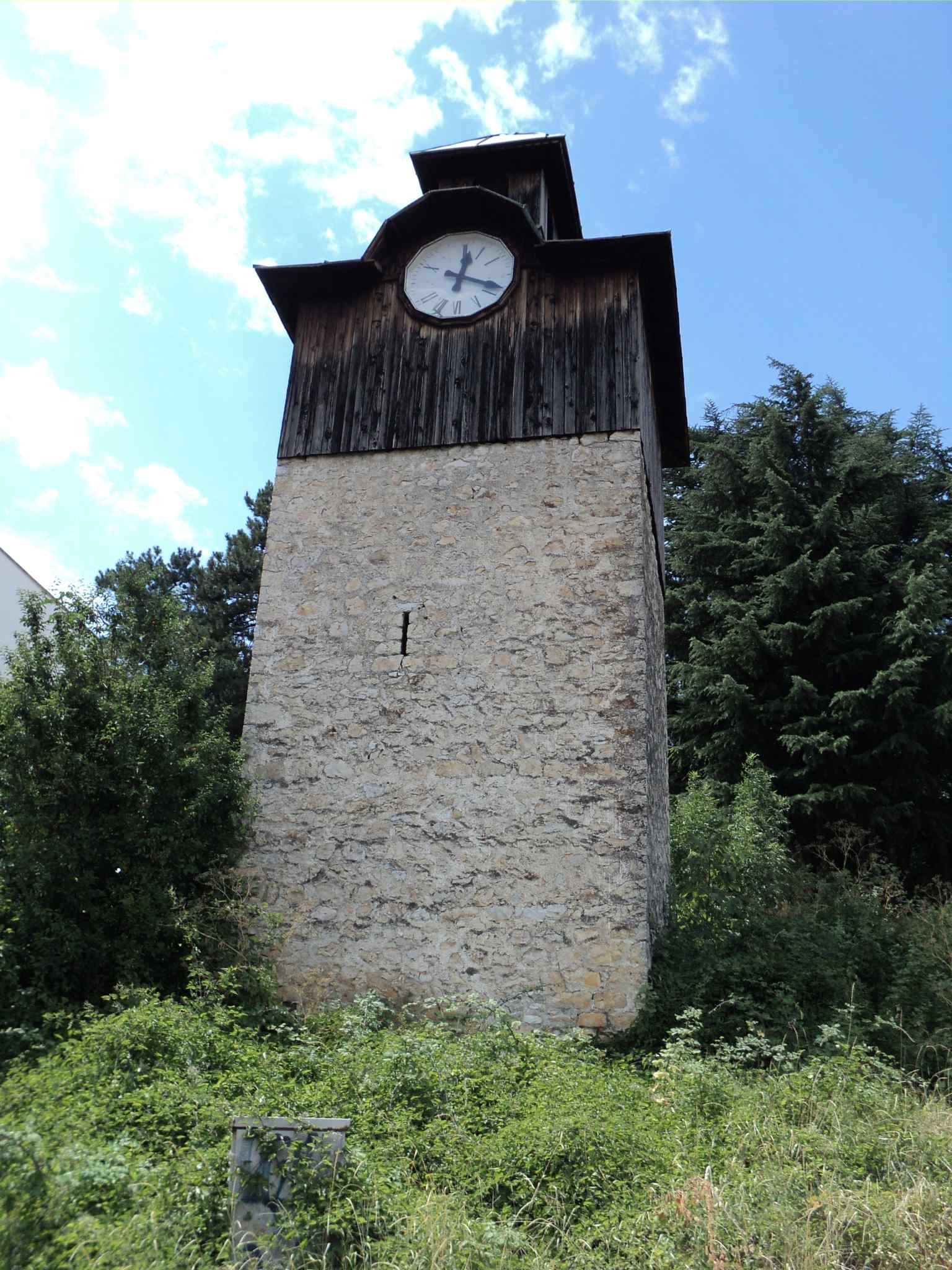
Standing 12 meters tall, the Ohrid Clock Tower is located near the City Market and historically served a dual purpose as both a public clock and a guardhouse for the Mesokastro residents.Photo: Flammard, Wikimedia Commons, CC BY-SA 3.0. Cropped & resized. The original clock was violently dismantled during the Second World War, and the building survived a fire in the sixties. But a city is only as strong as the people who remember it. A new Czech mechanism was later donated, and today, a dedicated local guy voluntarily maintains it, adjusting the gears by hand so the heartbeat keeps going. You can come by to see it anytime, since the exterior is open twenty-four hours a day, all week.
Listen to the quiet around the tower for a second. If you had the wealth of an empire, what monument would you build to comfort someone you loved?
Let us leave the Ottoman era behind and see how this city holds onto its fragile memories. The Institute for Protection of Cultural Monuments and National Museum is a nine-minute walk from here.
The Institute for Protection of Cultural Monuments and National Museum is right over on your left, identifiable by a permanent architectural emblem showcasing a dark, dome-shaped…Read moreShow less
Open dedicated page →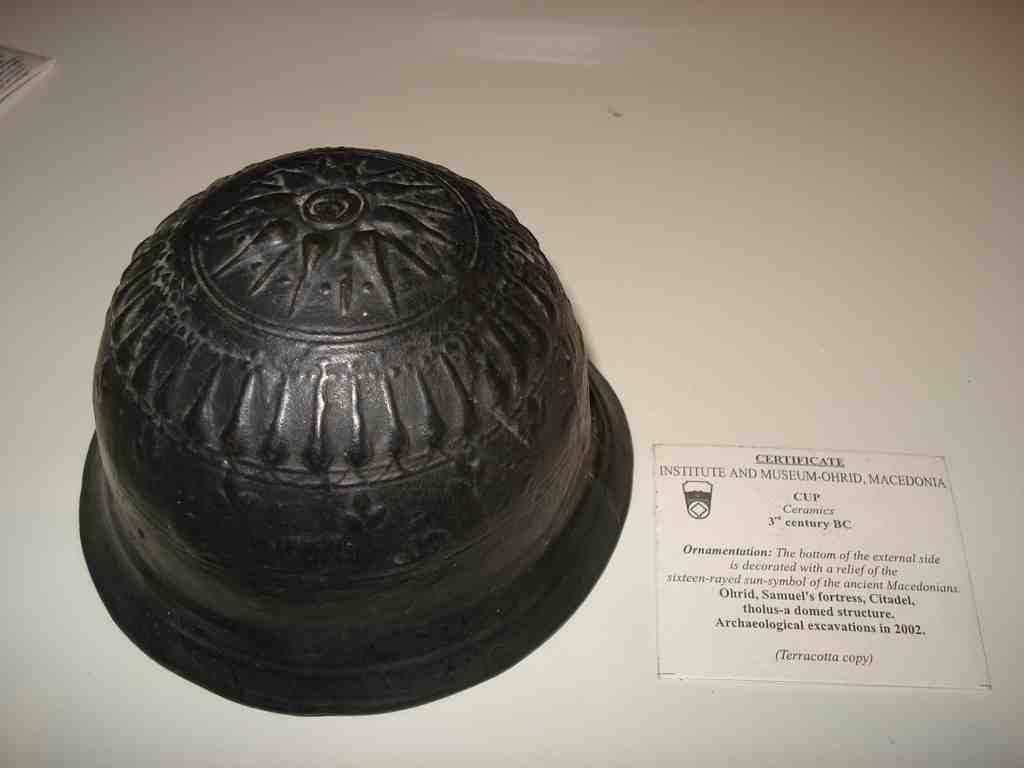
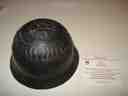
Institute for Protection of Cultural Monuments and National MuseumPhoto: Vbb-sk-mk, Wikimedia Commons, Public domain. Cropped & resized. The Institute for Protection of Cultural Monuments and National Museum is right over on your left, identifiable by a permanent architectural emblem showcasing a dark, dome-shaped ceramic cup with a striking sixteen-rayed sun relief. When we were at the Robevi family house earlier, we saw how deeply this city cares about piecing its broken fragments back together, a stubborn survival instinct that runs right through the veins of this very institution.
Long before places like the Louvre even existed, Ohrid had its own version of a museum. Starting way back in 1516, a nearby church safely held the treasury of the local Archbishopric, which is just a term for the headquarters of a high-ranking bishop. For centuries, that collection survived the endless tug-of-war of foreign empires trying to claim this land.
Then, in 1916, researchers digging through the archives made a massive discovery. They finally unearthed the official, original 1516 seal of that ancient general museum. It was an absolute triumph for the locals, a tangible piece of proof validating their long, proud cultural identity.
But they barely had a moment to celebrate. That exact same year, the army of the Bulgarian monarchy occupied the city during the chaos of World War One, aggressively plundering the treasury and carting its most precious valuables off to Sofia. It was a devastating blow to the community, and that incredibly rare 1516 museum seal is still separated from Ohrid today, sitting controversially in a foreign church museum.
Despite that heartbreak, the people here never stopped protecting their past. After the second World War, a local writer named Dimche Malenko put out a desperate, public call asking citizens to donate whatever historical artifacts they had. And the response was incredible. Families brought out hundreds of cherished heirlooms and antiquities they had kept completely hidden from occupying armies for generations. It was this massive act of community defiance that allowed the modern museum to officially open its doors.
The folks working here today even dive into the lake, doing risky underwater archaeology to pull Bronze Age settlements back to the surface.
If you want to check it out inside, they are open weekdays from seven thirty in the morning to three thirty in the afternoon, but are closed on weekends. For now, turn your attention upward toward the grand churches keeping watch over the city, and let us take a two minute walk up the path toward the Church of the Great Sorcerers.
Looking to your right, you will spot a sturdy church built from textured tufa stone, featuring a striking seven-sided rounded apse and a sloping tiled roof. It looks quiet now,…Read moreShow less
Open dedicated page →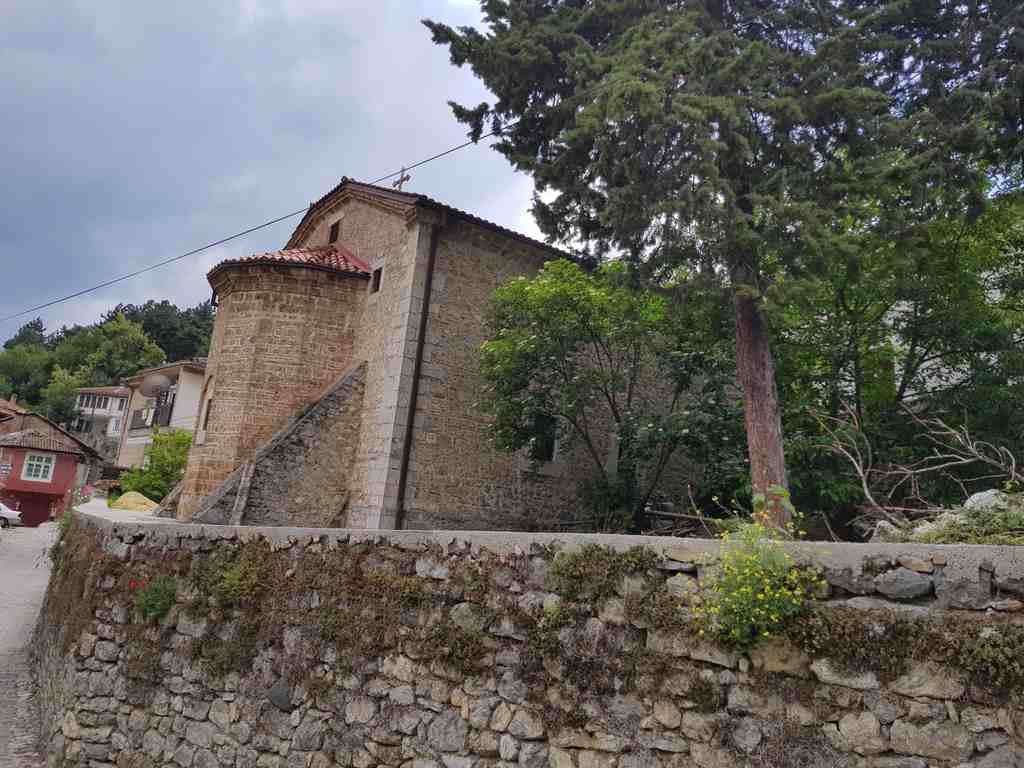
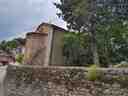
Church of the Great SorcerersPhoto: Rašo, Wikimedia Commons, CC BY-SA 4.0. Cropped & resized. Looking to your right, you will spot a sturdy church built from textured tufa stone, featuring a striking seven-sided rounded apse and a sloping tiled roof. It looks quiet now, but the ground beneath this building holds secrets that go back a millennium. This is the Church of the Great Sorcerers, also known as the Holy Physicians, Saints Kuzman and Damjan.
What you are looking at is actually an 1830s reconstruction, but the roots here dig much deeper. Back in the eleventh century, the original church was built on this very spot by Archbishop Theodoulos the First. He was a powerful religious leader from Asia Minor, appointed by the Byzantine Empress herself in 1056 to build new temples and anchor the Orthodox faith right after the fall of the local empire.
But Theodoulos did not build it alone. He had help from a mysterious financial backer, a man known in the ancient records as Jovan Antsa. Historians have been arguing over this guy for years. Was he a local Slavic nobleman from the prominent Bandzhov family? Or was he a wealthy Byzantine aristocrat? Nobody really knows. His true identity is lost to the ages, but his name lives on, a perfect symbol of the different cultures that constantly blended and clashed on these ancient streets.
The church you see today has some pretty wild details inside, too. Back in 1850, when wealthy local merchants funded a renovation, they hired painters to decorate the iconostasis, which is the ornate wooden wall separating the sanctuary from the main church space. Usually, artists paint solemn biblical scenes on the base of this wall. But these painters did something completely rebellious. They painted everyday, secular Balkan city houses with little balconies and windows. The rich merchants funding the project basically wanted to see their own fancy modern lifestyles reflected right in the sacred space.
There is also a bit of an empty space here today. The original Royal Doors, the grand wooden gates for the center of that altar dating back to the sixteenth century, are missing. Do not worry, they were not stolen or destroyed. In a modern move to protect cultural heritage, those spectacular carved doors were permanently relocated to another church in town to fill an empty gap on their altar. It secured the survival of the artwork, but it left this sanctuary without its greatest medieval treasure.
It just goes to show how these ancient structures quietly adapt, trading pieces and rebuilding their walls to survive whatever history throws at them. Now, let us keep walking. Our next stop is just a short three minute stroll away, the monumental Cathedral of Saint Sophia. Let us head over.
On your left is a massive stone structure defined by a sprawling, multi-level terracotta roof and a striking octagonal domed tower rising on the right side. This is the Church of…Read moreShow less
Open dedicated page →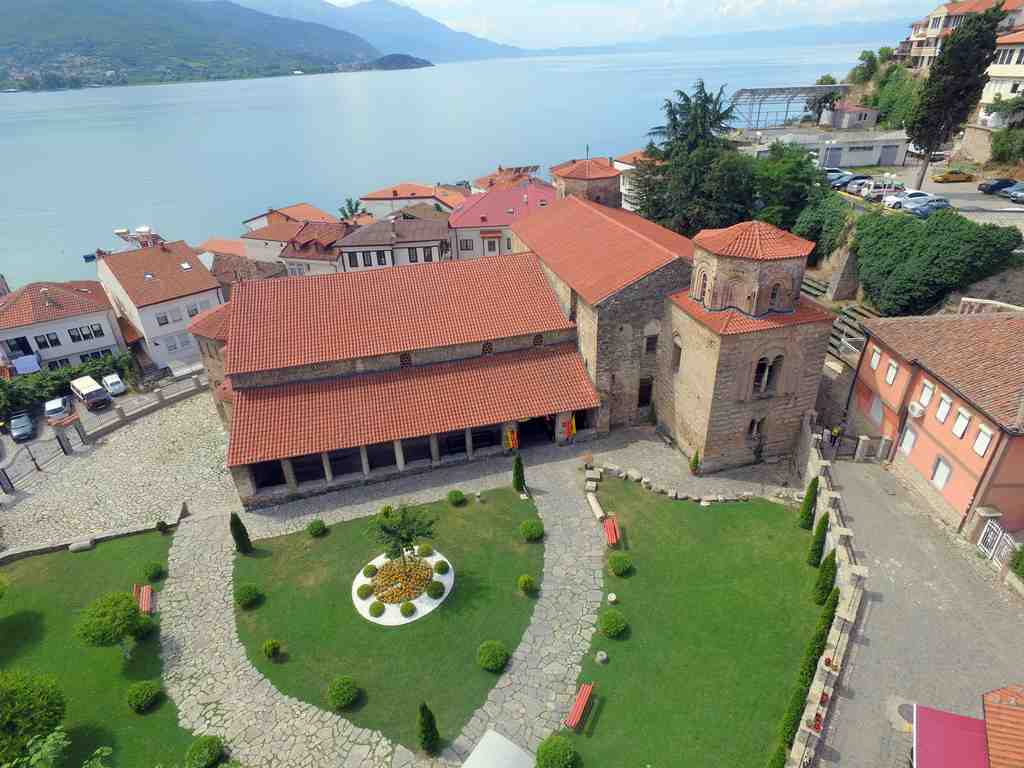
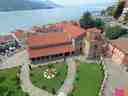
Church of St. Nicholas Sofia, OhridPhoto: Bojan Trenchevski, Wikimedia Commons, CC BY-SA 4.0. Cropped & resized. On your left is a massive stone structure defined by a sprawling, multi-level terracotta roof and a striking octagonal domed tower rising on the right side. This is the Church of Saint Sophia. It is one of the largest medieval churches in the region, a true heavyweight of history. Take a glance at your screen to appreciate the sheer footprint of this cathedral from above. Notice that long colonnade in the front. That is an external narthex, basically a grand entrance porch, added in the fourteenth century by Archbishop Gregory.
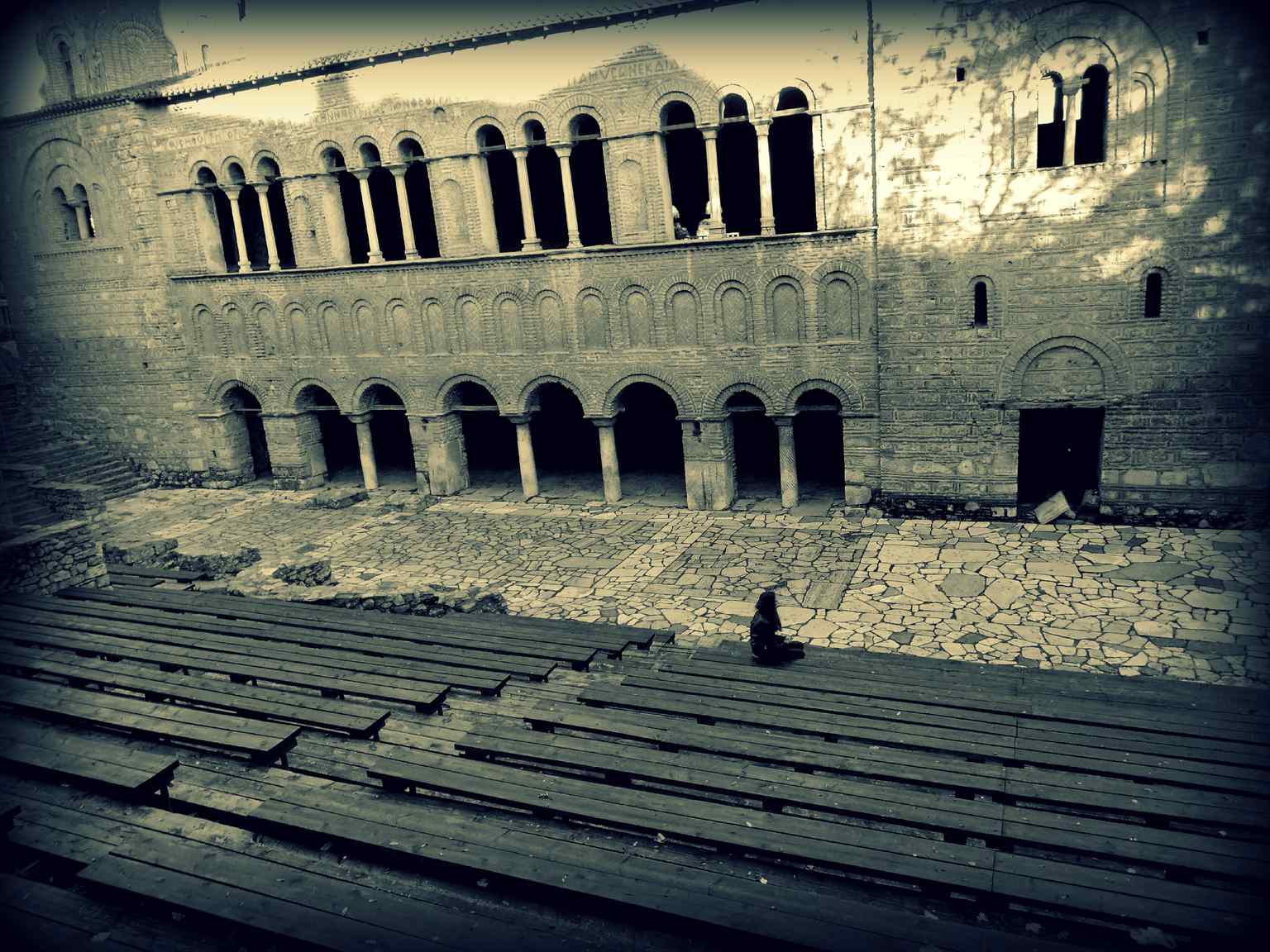
This image captures the exterior of the Church of St. Sophia in Ohrid, one of the largest and most significant medieval churches in the region, known for its unique architecture and historical importance, once serving as the Archbischopric's see.Photo: Vericamit, Wikimedia Commons, CC BY-SA 4.0. Cropped & resized. But the real magic happens inside those thick stone walls. The master builders of the eleventh century achieved absolute Acoustic Perfection here, shaping the interior vaulting so precisely that a single voice can fill the entire space with crystal clear resonance. It is the kind of sound quality modern engineers still chase. In August of 1961, the legendary opera singer Ana Lipša-Tofović stood under these vaults and sang works by Mozart and Beethoven. She later said she felt something almost mythical, something Orphic, in the air that night. That performance birthed the famous Ohrid Summer festival. Decades later, the celebrated Croatian pianist Ivo Pogorelić was so blown away by the acoustics that he called them perfect. The nave, the main central hall of the church, was too intimate to fit his massive crowds, so he actually had to schedule a second concert just to accommodate everyone.
The survival of this space is a story of incredible luck and resilience. In the late fifteenth century, the church was converted into a mosque. The grand dome was leveled, and the magnificent eleventh century frescoes, which are massive religious murals painted directly into the wet wall plaster, were completely smothered in thick, white lime. It sounds like a tragedy, right? Well, that plaster turned out to be a miracle. It acted as a perfect protective shell, sealing the vibrant colors of the Byzantine masters away from centuries of candle smoke, dampness, and destruction.
When restorers finally removed that plaster in the early 1950s, the process was highly emotional. As young conservators worked high up on wooden scaffolding, slowly chipping away the lime, they would sing to pass the time. Their voices bounced off the newly uncovered saints, creating strange, overlapping echoes. It was such a powerful scene that it inspired the famous poem, The Angel of Saint Sophia.
But they almost never got the chance to uncover them. During the Balkan Wars in 1912, this ancient, sacred masterpiece was bizarrely used as a weapons depot. One careless spark could have blown a thousand years of history right off the map.
Inside, those rescued paintings hold a brilliant piece of diplomatic history. The original patron, Archbishop Leo, commissioned a massive artwork of six Roman Popes standing alongside the leaders of the Eastern Church. He did this right before the Great Schism of 1054, making a desperate, beautiful plea for unity just as the Christian world was splitting in half.
If you want to experience the acoustics yourself, the doors are generally open from nine in the morning until six in the evening most days, though they close at four on Saturdays. For now, let us keep moving toward the cliffside, leaving the grand, massive scale of this cathedral behind for something a bit more dramatically isolated on an eight minute walk to our next stop.
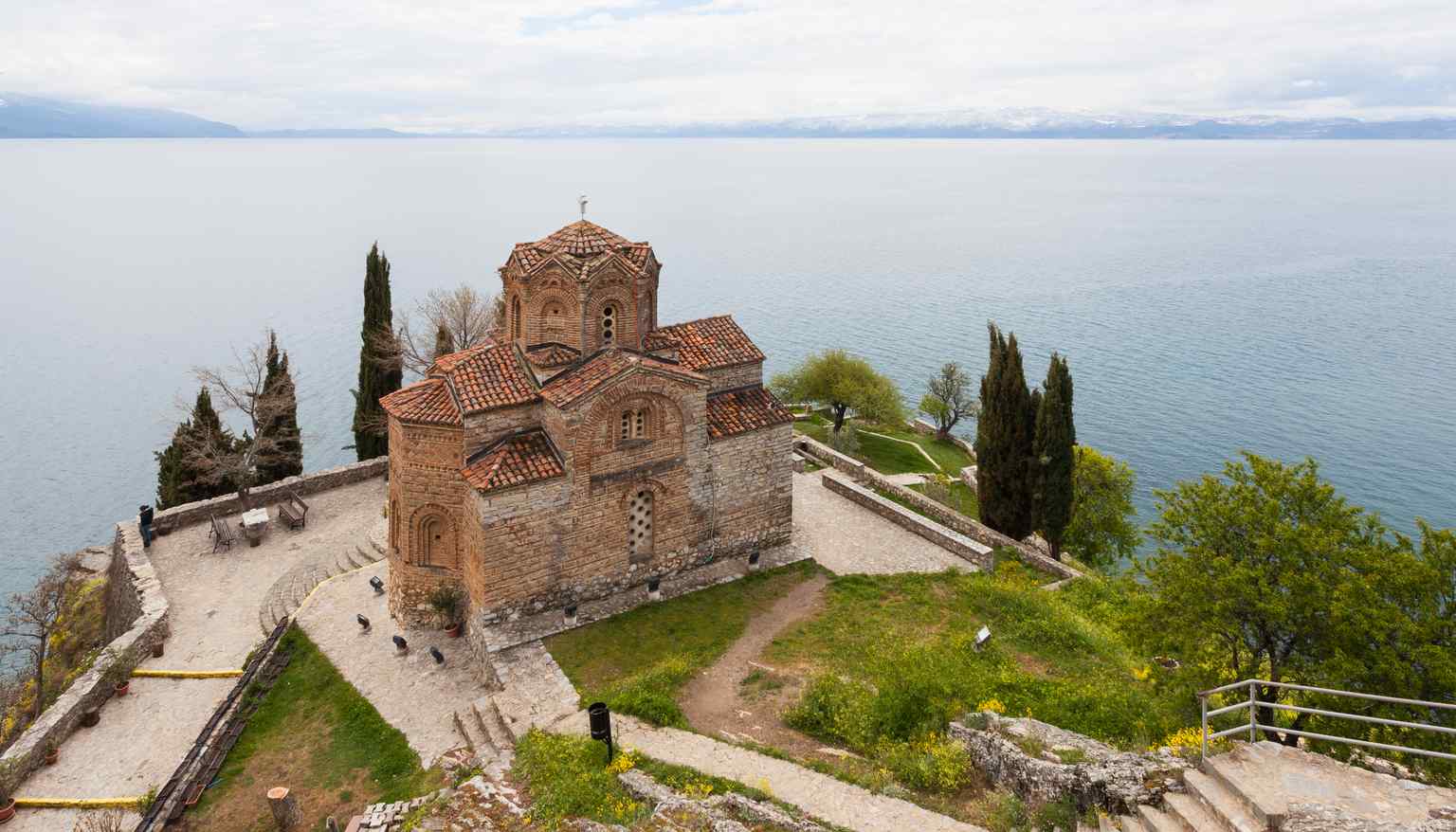
Perched on a plunging cliff to your left is a magnificent structure of layered stone and brick, topped with an octagonal dome and a bright red tile roof. This is Saint John at…Read moreShow less
Open dedicated page →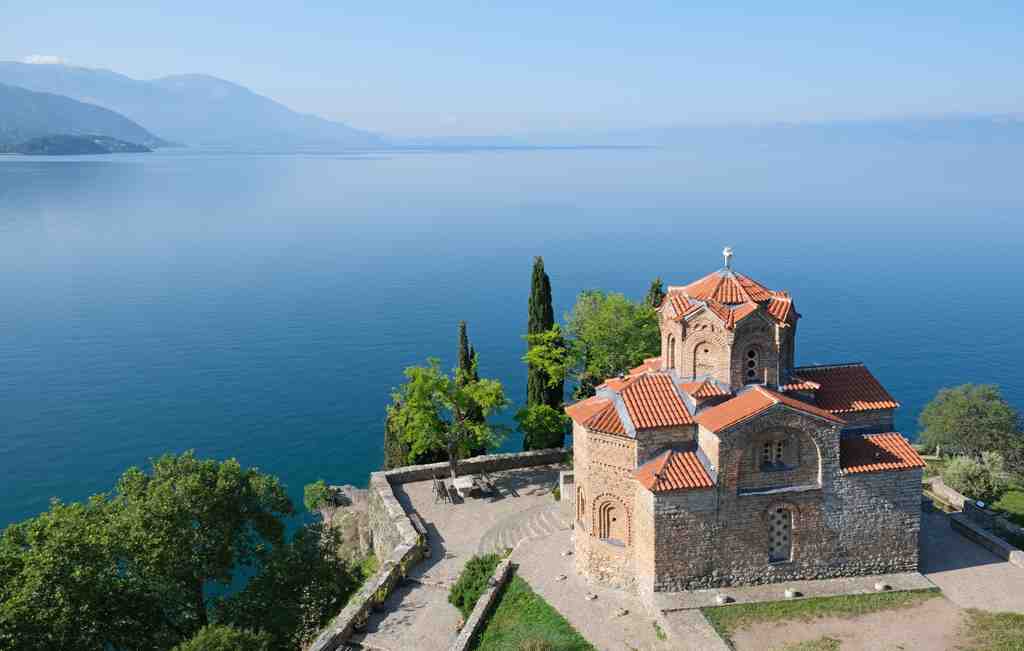
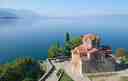
Church of St. Nicholas Jovan Kaneo" - OhridPhoto: kallerna, Wikimedia Commons, CC BY-SA 4.0. Cropped & resized. Perched on a plunging cliff to your left is a magnificent structure of layered stone and brick, topped with an octagonal dome and a bright red tile roof. This is Saint John at Kaneo, and its very name comes from the Latin word for silvery, capturing the way the lake waters catch the light at the base of the rock.
It looks so peaceful now, but do not let that fool you. This tiny, picturesque sanctuary was once the epicenter of a massive geopolitical earthquake. Back in the thirteenth century, the mighty Byzantine Empire was fractured after the fall of Constantinople. Everyone was scrambling for power. In the middle of this chaos, the head of the local church, an Archbishop named Demetrios, made a daring move. He brought a powerful ruler, Theodore Komnenos Doukas, right here to this cliff edge. Standing before the altar of this very church, the Archbishop boldly crowned him Emperor of Thessalonica. It was a direct act of defiance against rival powers, transforming this modest stone chapel into the beating heart of imperial ambition.
The people who built this stage for empires remain a mystery, but they left behind clues. If you check out the second picture on your screen, you can see the unique zigzag pattern along the edge of the dome, an architectural feature heavily inspired by medieval Armenian churches. It suggests the master builders traveled here from the far East, leaving a permanent mark of their homeland on the Balkans.
Observe the church's unique zigzag roofline on the dome, an architectural feature reminiscent of medieval Armenian churches that suggests Eastern influence in its design.Photo: Diego Delso, Wikimedia Commons, CC BY-SA 3.0. Cropped & resized. This place outlasted the emperors who tried to claim it. It survived periods of glory, gradual decay under Ottoman rule, and even complete abandonment between the seventeenth and nineteenth centuries. You can take a quick glance at your screen to see a photo of the church from nineteen seventy seven, showing its rugged silhouette before modern restorations replaced the lost arches.
Despite sitting empty for so long, the walls inside still hold brilliant frescoes. These ancient images silently unite the city's greatest figures, placing the third century missionary Saint Erasmus right next to tenth and thirteenth century leaders. It is a powerful visual message that, no matter what flag flew over the city, the deep roots of the people could not be erased. Today, this resilient little building has even achieved global fame as a stunning visual symbol in the Oscar nominated film Before the Rain.
Now... let us trace those deep roots back to their source. We are heading to the final resting place of Ohrid's greatest spiritual father, just a seven minute walk away at the Church of Saints Clement and Panteleimon.
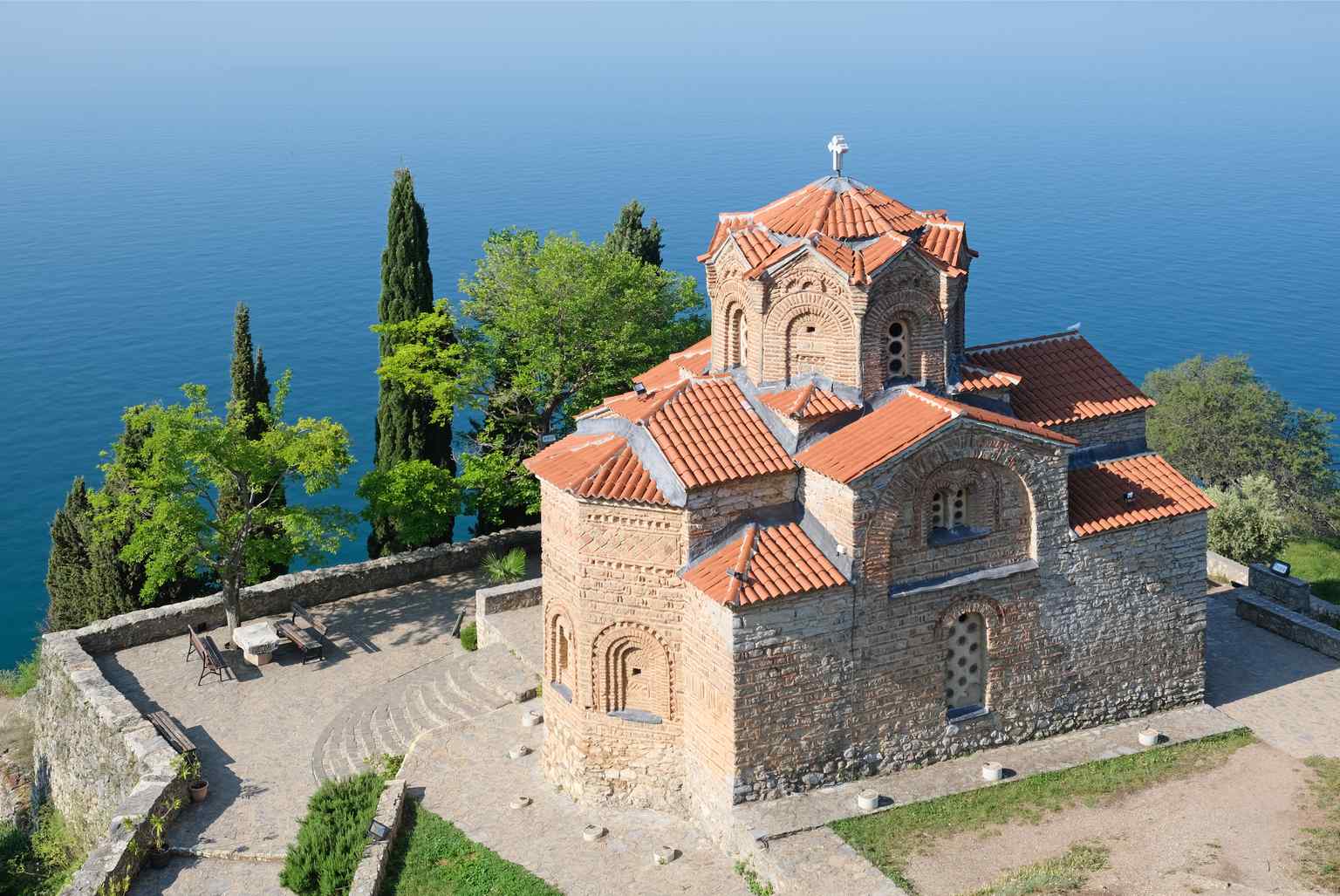
This iconic view of St. John Kaneo, perched dramatically above Lake Ohrid, gained worldwide recognition as a key location in the Oscar-nominated film "Before the Rain".Photo: kallerna, Wikimedia Commons, CC BY-SA 4.0. Cropped & resized. 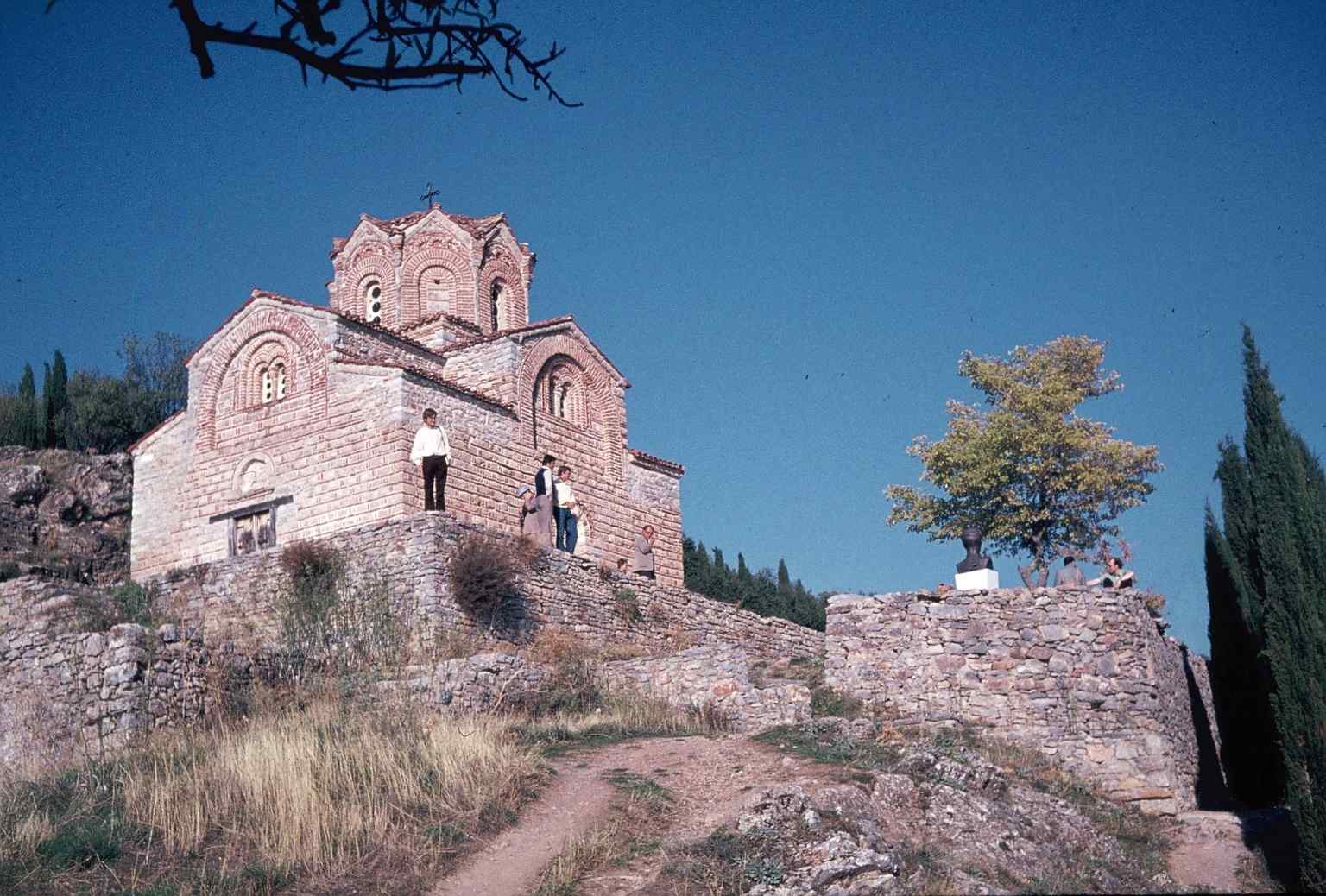
This photograph from 1977 offers a rare historical glimpse of St. John Kaneo, hinting at the long period of abandonment between the 17th and 19th centuries before modern restorations.Photo: Bärbel Miemietz, Wikimedia Commons, CC BY-SA 4.0. Cropped & resized. 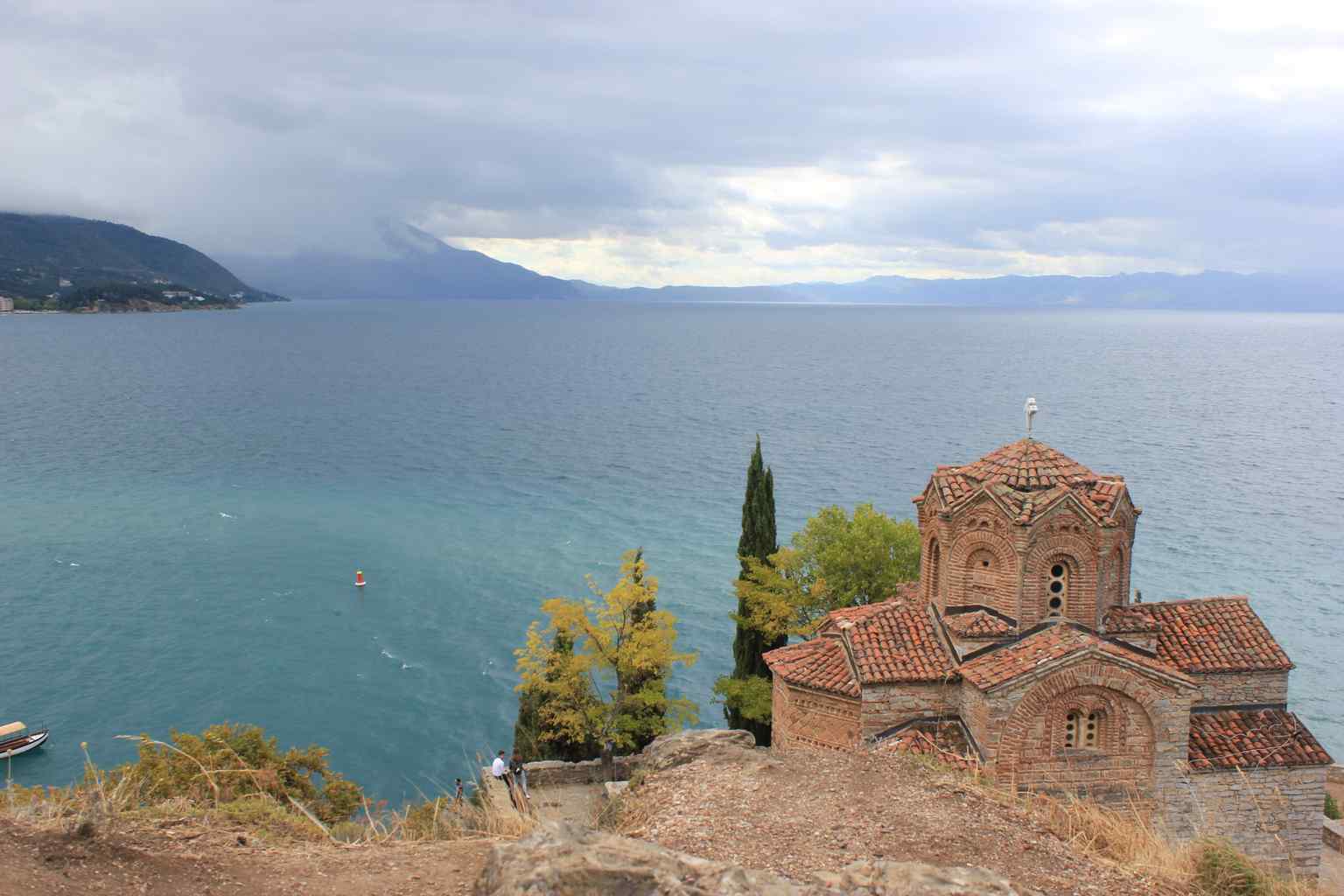
Perched dramatically on a rocky hill above Lake Ohrid, the church's name "Kaneo" is thought to derive from the Latin for "silvery," referencing the lake's shimmering waters below.Photo: Julian Nyča, Wikimedia Commons, CC BY-SA 3.0. Cropped & resized. To your right stands a striking structure of pale stone and banded red brick, shaped by multiple terracotta-tiled domes and anchored by a tall arched bell tower. That is the…Read moreShow less
Open dedicated page →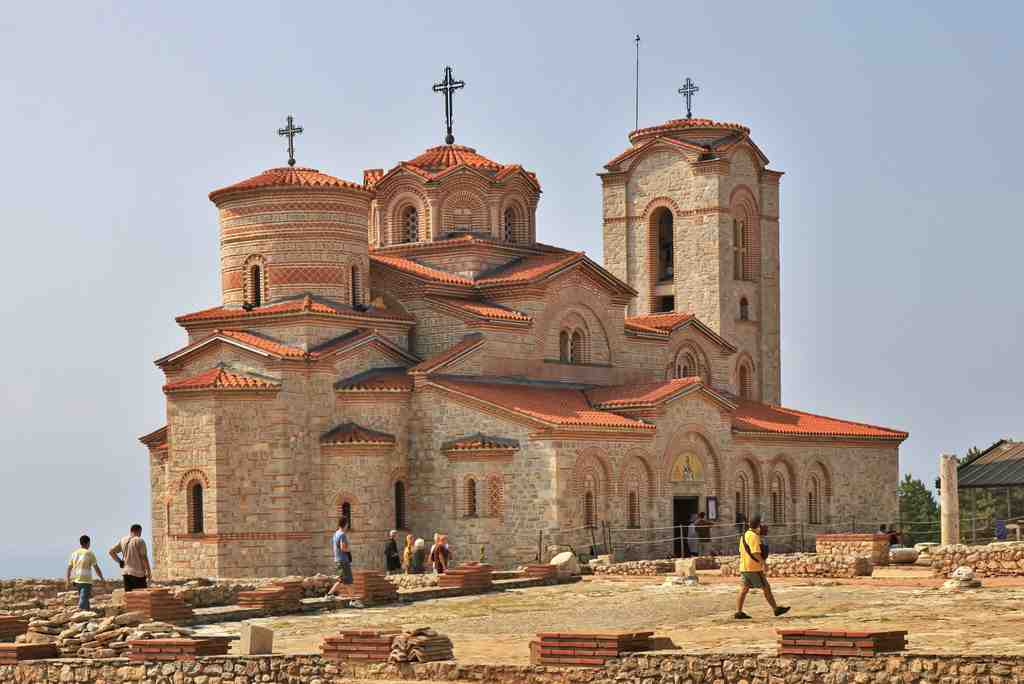
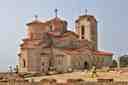
Church of Saints Clement and PanteleimonPhoto: Marcin Konsek, Wikimedia Commons, CC BY-SA 4.0. Cropped & resized. To your right stands a striking structure of pale stone and banded red brick, shaped by multiple terracotta-tiled domes and anchored by a tall arched bell tower.
That is the Church of Saints Clement and Panteleimon. Now, to really understand the soul of this place, we have to talk about Saint Clement of Ohrid. He arrived way back in the ninth century and basically turned this very hill into a massive literary school, teaching his students the Glagolitic alphabet, an early script that was used to translate the Bible into Old Church Slavonic.
When Clement passed away in nine sixteen, he was laid to rest right here, in a tomb he had actually built with his own two hands. And he rested peacefully for hundreds of years. But then came the shift to Ottoman rule. By the fifteenth century, the Ottoman Empire swept in and took over the site.
You can imagine the absolute panic of the local Christian community. Their spiritual father, the patron saint of their city, was in danger of being lost. In a desperate, frantic scramble in the dark, they broke into the tomb, gathered his relics... his holy physical remains... and smuggled them across town in secret. They hid him inside the Church of the Holy Virgin Peribleptos, where he stayed safely sheltered for centuries.
While Clement was away, his original church was turned into a mosque, and later replaced by the Imaret Mosque. If you check your screen, you can see the preserved foundation outlines of that former Islamic structure, which remain today as a permanent physical testimony to its Ottoman past. The site functioned as a soup kitchen for the poor for a long time. It was not until the nineteen forties, right in the looming shadow of World War Two, that an archaeologist dug into the ruined walls of the mosque and astonishingly uncovered the lost foundations of Clement's original Slavic church, including his empty burial crypt.
Fast forward to the year two thousand, and a massive project began to completely rebuild the church by hand using original materials. And then, on August eleventh, two thousand two, something beautiful happened.
After more than five hundred years in hiding, Saint Clement finally made the journey home. In a grand procession, his remains were carried back up this hill. If you look at your screen, you can see his tomb inside the newly rebuilt church, where his relics are now encased in glass directly over the original framework he built himself.
It is an incredible full circle of survival. You can step inside to see the tomb yourself any day of the week from eight in the morning to seven in the evening. Now, let us leave the Middle Ages behind and dig even deeper into the ancient past as we head to our final stop, Karađulevci, which is just a six-minute walk away.
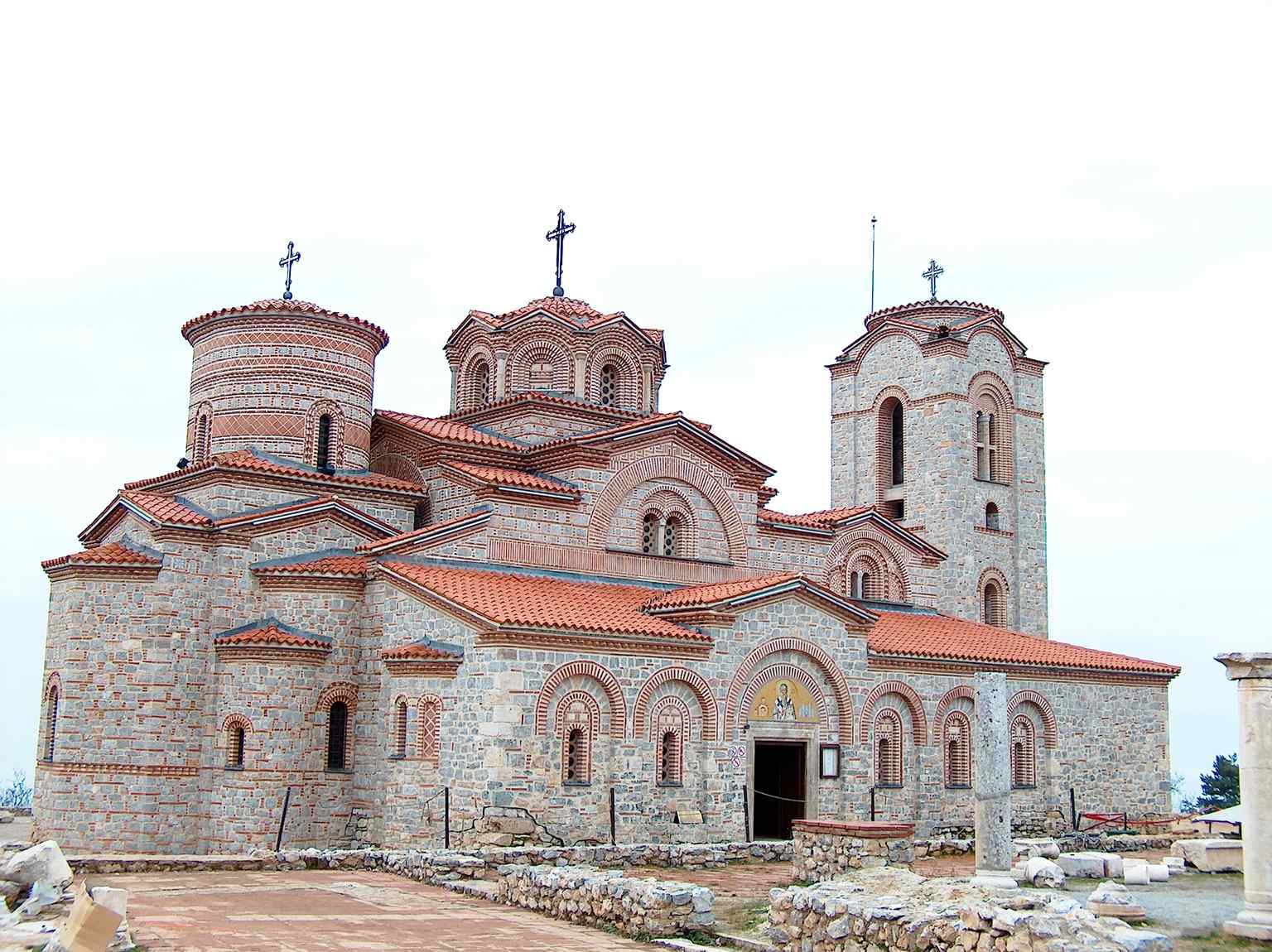
The Church of Saints Clement and Panteleimon, seen here on Plaošnik, is believed to be the site where the first students of the Glagolitic alphabet were taught.Photo: Apcbg, Wikimedia Commons, Public domain. Cropped & resized. 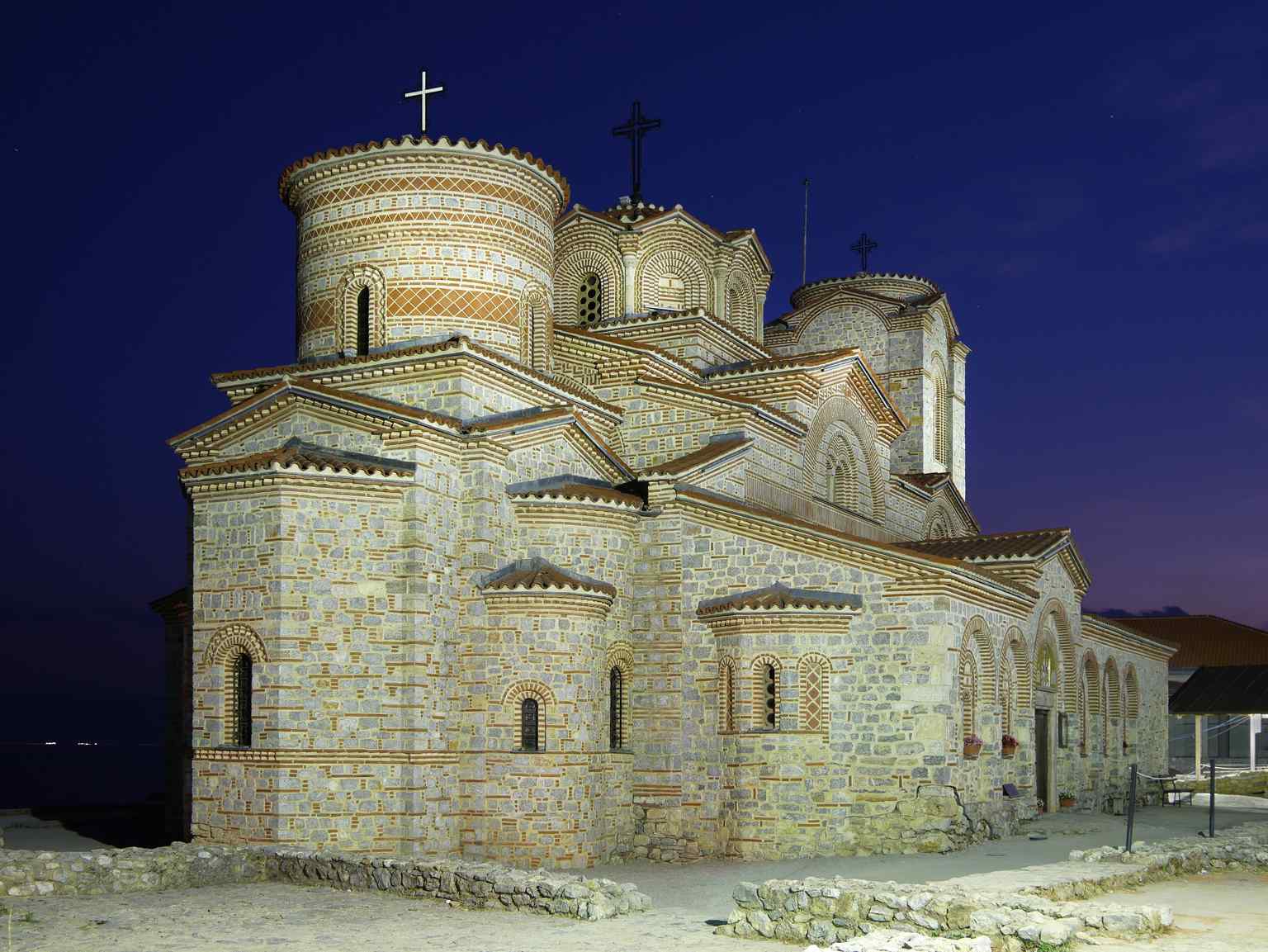
This reconstructed church stands on a hill overlooking Lake Ohrid and was designed by Saint Clement himself to be a literary school, making it Europe's first discontinued university.Photo: Petar Milošević, Wikimedia Commons, CC BY-SA 4.0. Cropped & resized. Straight ahead is a massive wall of rough, uneven stone, where a distinct arched doorway has been completely sealed shut with rubble, just to the left of a small metal pipe poking…Read moreShow less
Open dedicated page →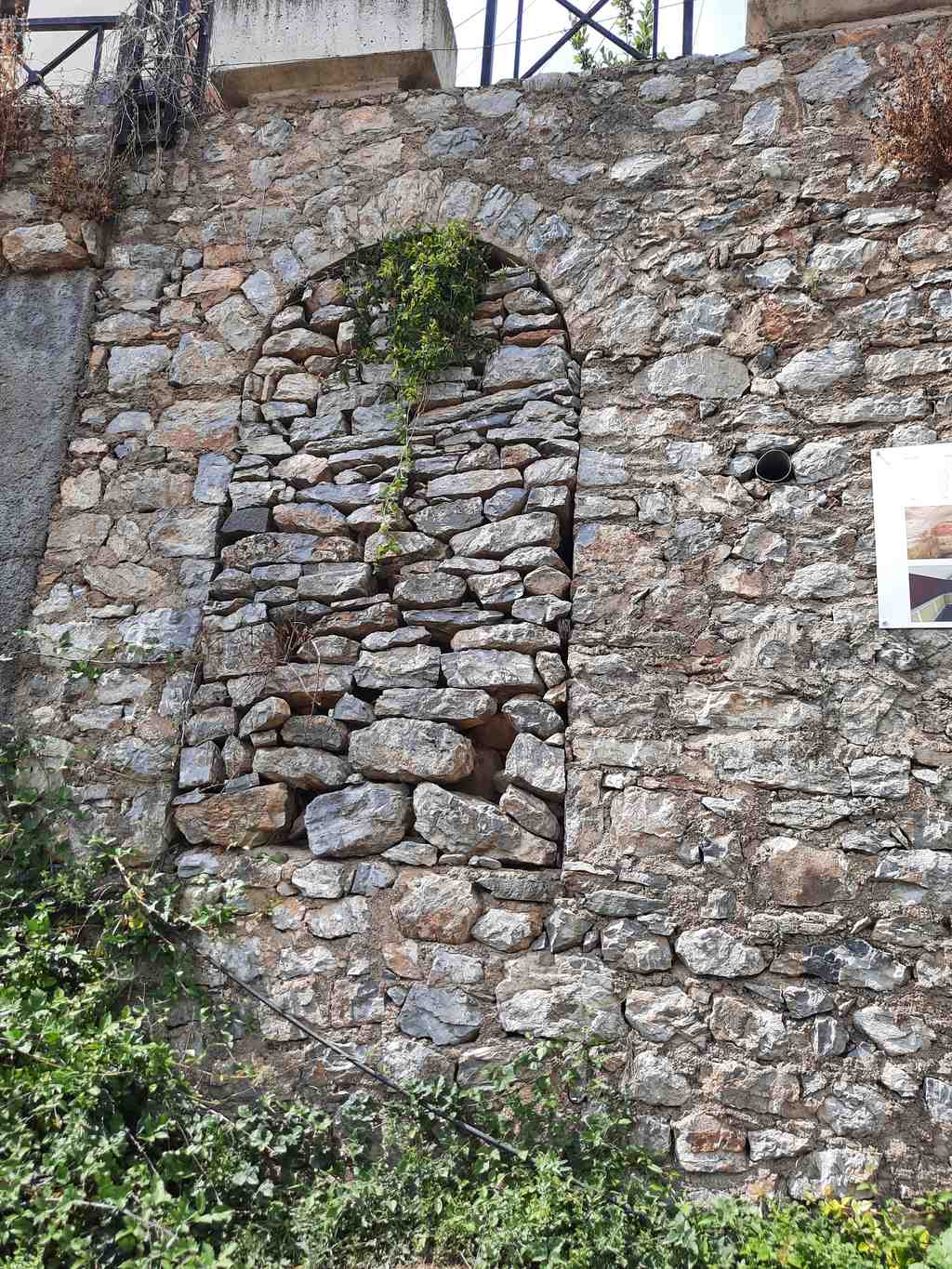
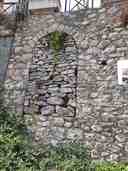
KarađulevciPhoto: Dandarmkd, Wikimedia Commons, CC BY-SA 4.0. Cropped & resized. Straight ahead is a massive wall of rough, uneven stone, where a distinct arched doorway has been completely sealed shut with rubble, just to the left of a small metal pipe poking out of the rock. Deep behind that sealed arch lies Karađulevci, an ancient Macedonian tomb from the fourth or third century BCE. It is the ultimate proof that the stones of Ohrid protect their secrets, hiding them safely out of reach.
Back in eighteen ninety four, a German linguist named Gustav Weigand documented a wild discovery. A local man named Nikola Karadjula had something completely unexpected in his house. Imagine heading down to your cellar and squeezing through a narrow hole that drops straight into a buried ancient street. From there, Weigand entered a dromos, an ancient architectural term for a narrow entrance corridor leading directly into a tomb.
Crawling through a heavy sandstone door, he found himself inside a massive chamber with ceilings three meters high. Check your app to see how heavily guarded this hidden entrance remains. Inside, the ancient walls were coated in brilliant, Pompeian red plaster, painted beautifully to mimic expensive marble. Because it was buried so incredibly deep, it was perfectly insulated from the chaos of falling kingdoms and surface wars above. It is a stunning example of resilience.
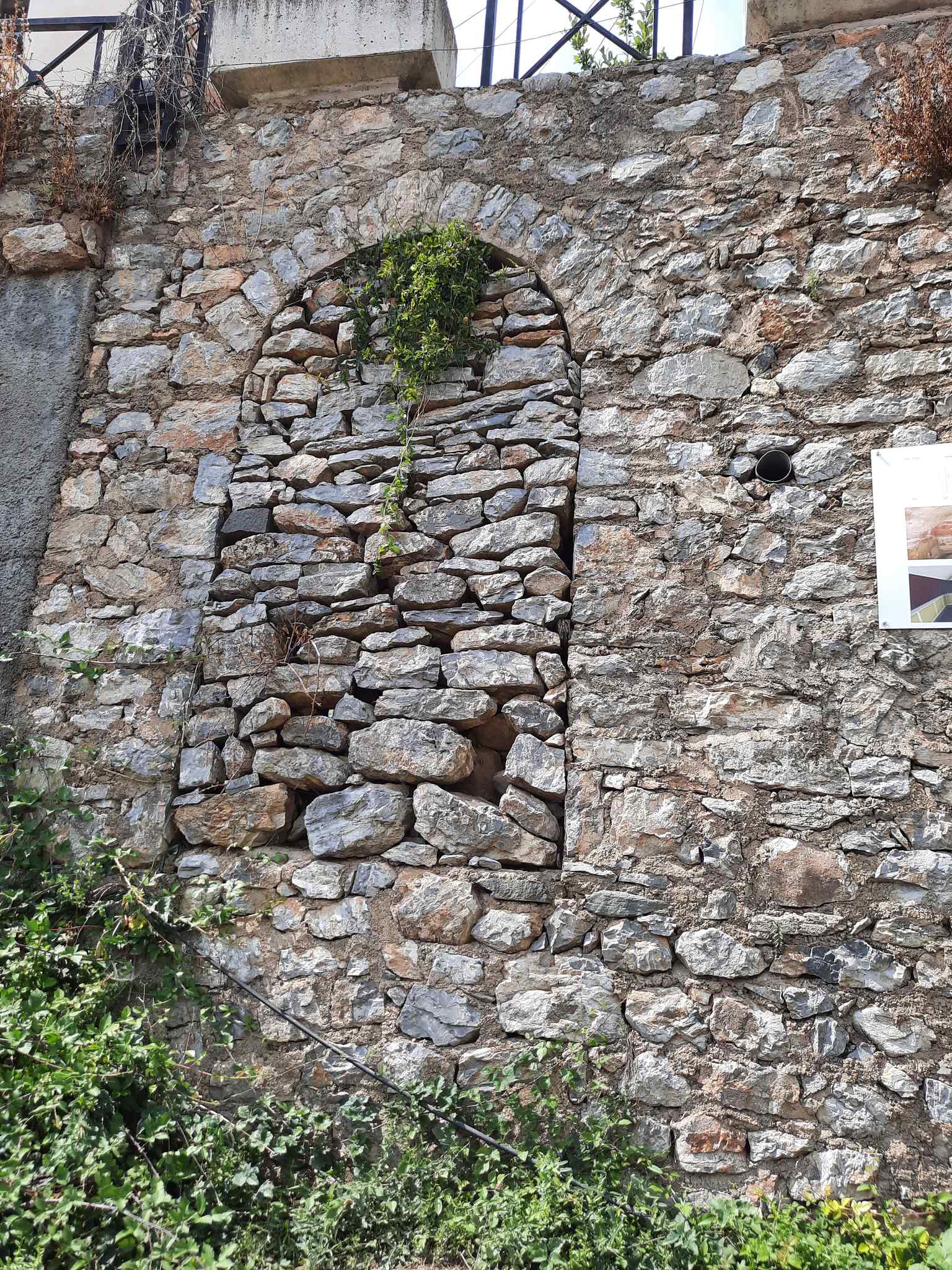
The modern-day closed entrance to the Karađulevci tomb, an archaeological site once mysteriously accessed through a narrow hole in a house basement, as described by Gustav Weigand in 1894.Photo: Dandarmkd, Wikimedia Commons, CC BY-SA 4.0. Cropped & resized. But the stones still hold onto a mystery. When the family originally breached the cellar decades earlier, they supposedly found three heavy chests. Weigand chased every rumor to find them, but failed. Whatever those chests held vanished without a single trace, leaving us to wonder what else this tomb is hiding.
We cannot step inside the real thing, but there is a beautiful connection to the very first place we visited. A team recently mapped the entire tomb and placed a highly detailed three dimensional model right inside the Robevi family house, bringing the hidden depths back to the surface. As our journey together comes to a close, just stand here for a moment before this ancient, unbroken stone. It has guarded the memories of the forgotten for thousands of years, quietly holding the city's true soul right beneath your feet.
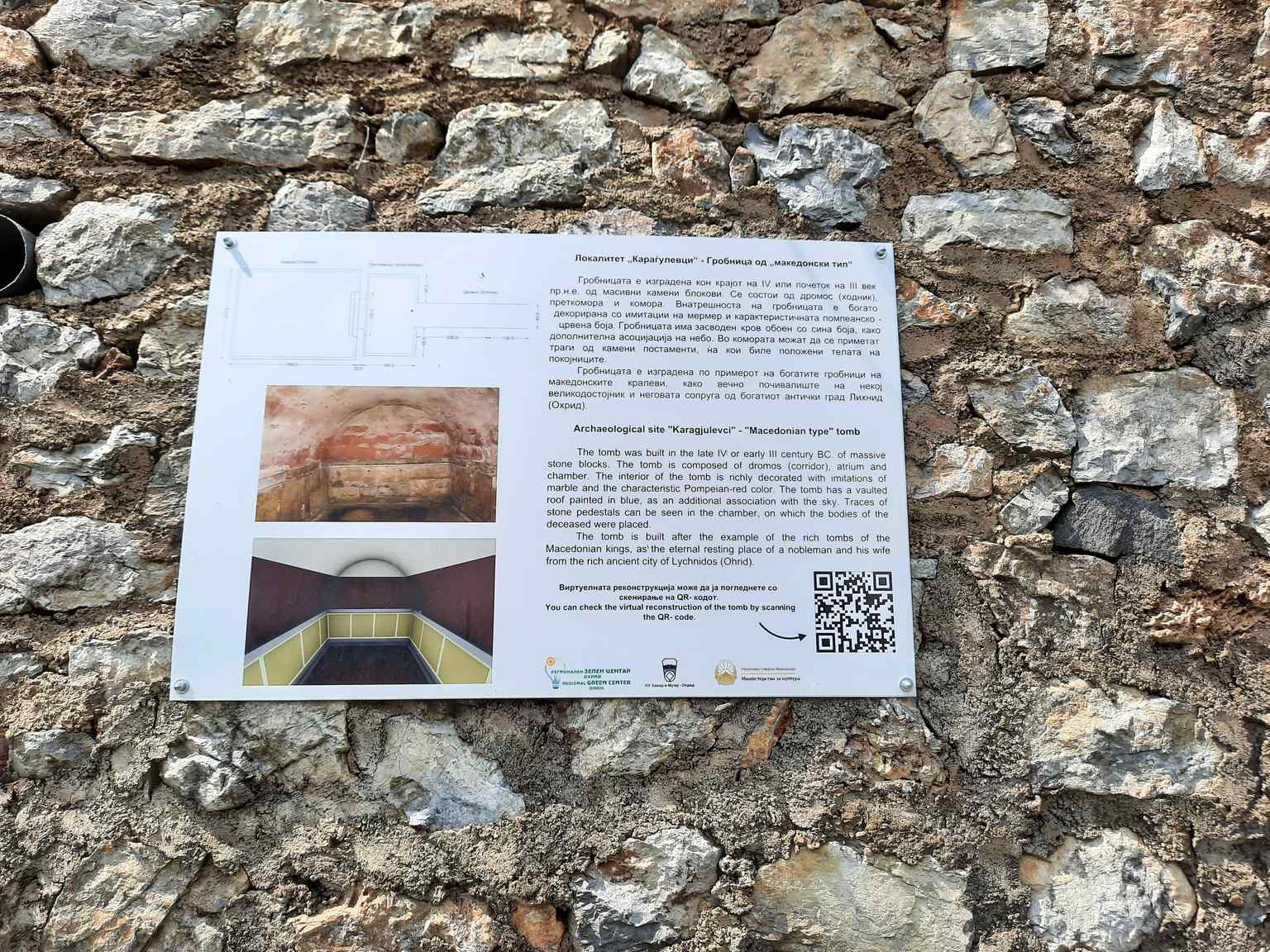
An informational plaque provides key details about the Karađulevci tomb, an ancient Macedonian burial site dating back to the 4th-3rd century BCE, now recognized as a cultural monument.Photo: Dandarmkd, Wikimedia Commons, CC BY-SA 4.0. Cropped & resized.
Frequently asked questions
How do I start the tour?
After purchase, download the AudaTours app and enter your redemption code. The tour will be ready to start immediately - just tap play and follow the GPS-guided route.
Do I need internet during the tour?
No! Download the tour before you start and enjoy it fully offline. Only the chat feature requires internet. We recommend downloading on WiFi to save mobile data.
Is this a guided group tour?
No - this is a self-guided audio tour. You explore independently at your own pace, with audio narration playing through your phone. No tour guide, no group, no schedule.
How long does the tour take?
Most tours take 60–90 minutes to complete, but you control the pace entirely. Pause, skip stops, or take breaks whenever you want.
What if I can't finish the tour today?
No problem! Tours have lifetime access. Pause and resume whenever you like - tomorrow, next week, or next year. Your progress is saved.
What languages are available?
All tours are available in 50+ languages. Select your preferred language when redeeming your code. Note: language cannot be changed after tour generation.
Where do I access the tour after purchase?
Download the free AudaTours app from the App Store or Google Play. Enter your redemption code (sent via email) and the tour will appear in your library, ready to download and start.
If you don't enjoy the tour, we'll refund your purchase. Contact us at [email protected]
Checkout securely with 






%20(13).jpg)
%20(16).jpg)
%20(21).jpg)

%20(38).jpg)
%20(29).jpg)
%2002.png)
%20(02).jpg)


.jpg)
.jpg)
.jpg)