
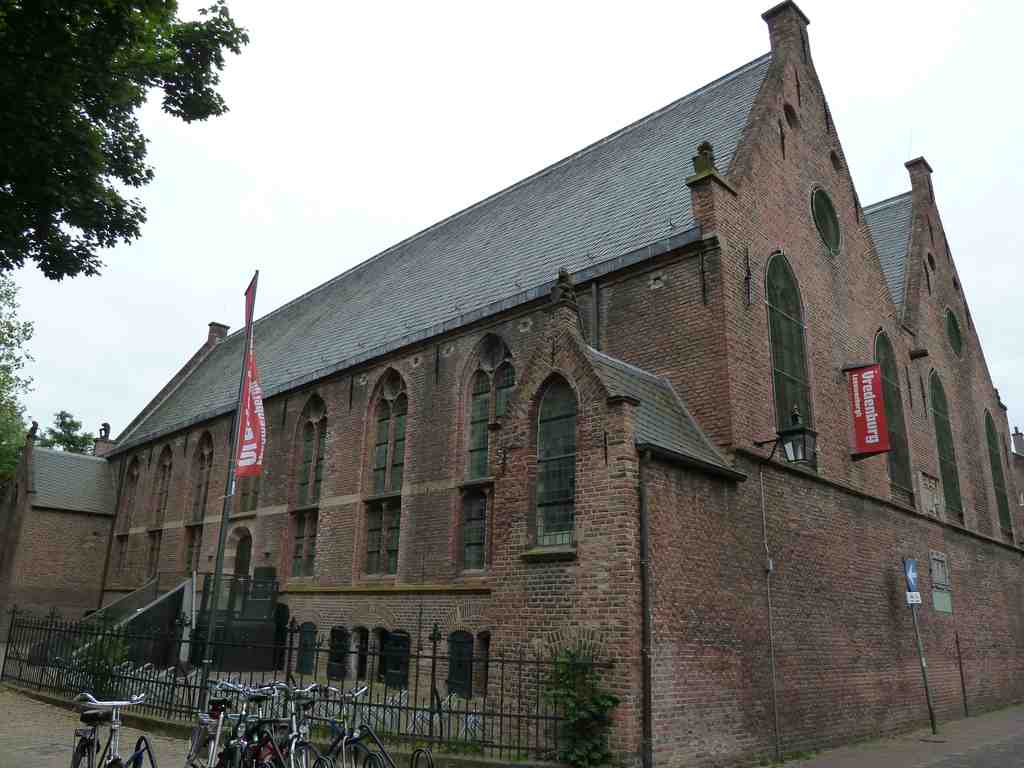
You’re looking for a sturdy, long brick building with steeply pitched roofs and tall, arched windows-keep your eyes to the left behind the row of bikes, and you can’t miss the impressive, fortress-like appearance of the Leeuwenbergh Gasthuis.
Standing here in front of the Leeuwenbergh Gasthuis, imagine Utrecht centuries ago, when people were a bit more concerned with the bubonic plague than with bicycle traffic. In 1567, next to the bustling eastern city wall, Agnes van Leeuwenberch left her fortune for a special cause: the building of a pest house, ready to care for those stricken by the dreaded plague. Now don’t worry-you’re safe! The only thing contagious here these days is beautiful music. But back then, the place would have been filled with the muffled voices of caretakers and the heavy hush of worry.
Not long after it was built, strange as it sounds, there weren’t enough plague victims to fill these vast, echoing halls, so the city changed the building’s role-it became a guest house, then, over the years, it was reborn again and again. Imagine it swarming with soldiers as a barracks, buzzing with academic debate as a university building, and even humming with the odd experiment as a laboratory! For a time, it sheltered aspiring pharmacists-talk about a place with a prescription for change.
Fast forward to 1930. The building gets another new life-this time with a fresh coat of spiritual energy, as the Dutch Protestant Union transforms it into a church under the careful eye of architect G.W. van Heukelom. You can just picture the hammers and saws as it’s renovated for worship, then echoes to the sound of hymns and organ pipes.
Speaking of organs, there’s a twist worthy of a detective novel! The gorgeous Flentrop organ, with its elegant pipes and grand presence, was installed in 1954-but was whisked away in 2018, leading to a dramatic standoff between local heritage lovers and the city. Was the organ part of the historic identity? Should it be returned? The debate, as fiery as a Bach toccata, even reached the halls of government.
By 2020, while the argument about the organ lingers, there’s one thing everyone agrees on-the Leeuwenbergh Gasthuis is now a home for music once more. Whether it’s chamber concerts or acoustically pure recordings, the only thing you’ll catch here is a touch of inspiration. So take a deep breath, look up at those ancient brick walls, and let your imagination play as wildly as the music that once filled this space.


