
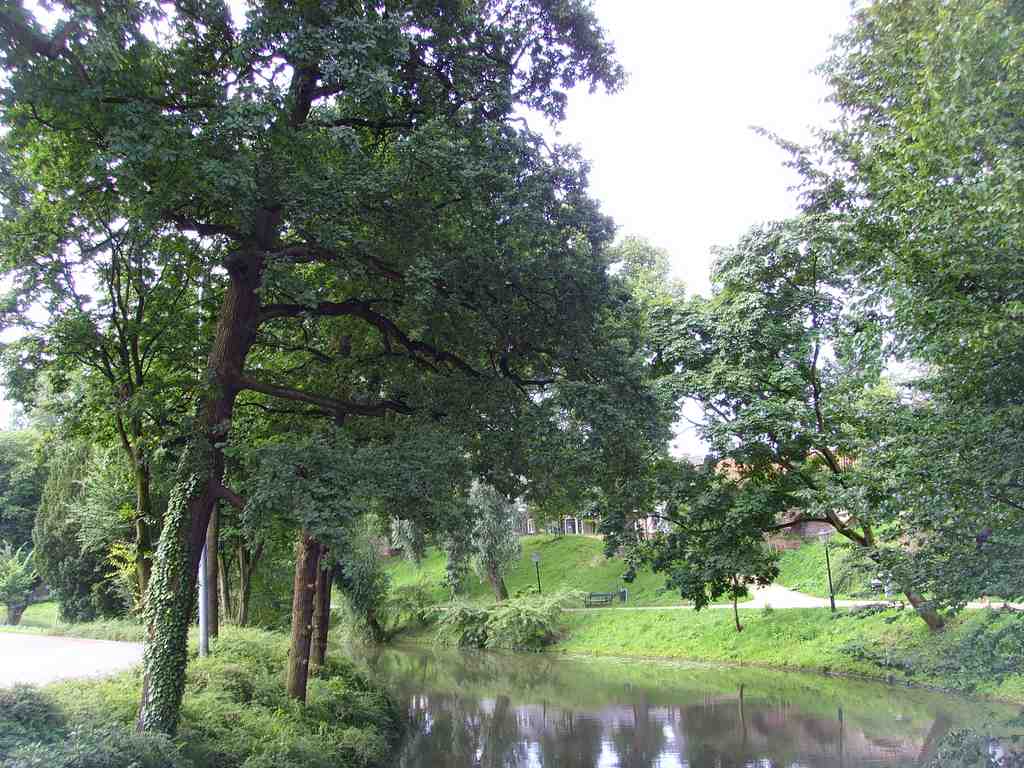
If you look ahead, you’ll see a lush and winding stretch of greenery on both sides of the canal, with tall leafy trees and a tranquil walking path beside the water-welcome to Zocherpark!
Now, take a deep breath-smell that? It's a blend of history, nature, and perhaps a hint of fresh grass (or possibly a jogger’s aftershave). You’re standing at the edge of the beautiful and storied Zocherpark, a green ribbon that wraps around part of Utrecht’s old city like a cozy, leafy scarf. But believe it or not, where you see peaceful benches and gently swaying trees today, there were once huge walls and moats-a fortress meant to keep out invaders rather than welcome picnickers.
Let’s tumble back in time for a moment. Picture this area, from the year 1122 right until deep into the 1500s, packed with impressive walls, guarded gates, and sturdy towers. Soldiers kept watch, keeping Utrecht safe behind thick fortifications. But by the 1600s, these old walls became too polite for war-cannons and new technologies made them nearly useless as defenses. Instead, the space between the city and its fortifications became irresistible for fancy strolls, gardens, and even adorable tea pavilions. Utrecht’s upper-class residents-let’s call them the “castle-crashers”-enjoyed wandering here, showing off their fanciest hats and canes.
Fast forward to the 1800s. The city’s protective layer was looking a little worse for wear, but still stubbornly standing. Then, like a storm sweeping away the old, a new era began. Utrecht’s leaders decided to trade in those crumbling walls and start beautifying the city. So, they called in Jan David Zocher Jr., a landscape architect with such grand ideas that I imagine even his dreams had walking paths. Zocher brought with him a vision inspired by the English landscape style-think meandering lines, soft curves, and scenic bridges all woven around the canal, which he insisted on keeping as a winding, watery “ribbon.” No stuffy symmetry here!
Work began in 1830 near the north side. Imagine the noise and excitement as the old Begijnebolwerk wall started coming down while townsfolk peered over walls and wondered, “Will we really have a park here someday?” (Spoiler alert: Yes, and you’re standing in it!) The green wave rolled south, transforming fortifications into gentle slopes, ditches into dreamy waterways, and rough ground into leafy lawns. The process took over forty years-now that’s what I call slow gardening!
Bastions like Sterrenburg were partly made into sailing routes, and soon children and grown-ups alike could wander for kilometers through this narrow green oasis. Around 1850, Zocher’s son Louis Paul Zocher joined him on the project-turns out, landscape architecture can run in the family! Together they shaped a park that, if it could talk, would tell thousands of stories-and maybe gossip about the hats of passing visitors.
By the time they were done, over a kilometer of city park wrapped the old city center, decked out with benches, grand open spaces, sweeping views, and planted with row after row of proud trees. There’s real magic here: over 250 of the original trees still stand, and more than 600 are older than the average grandparent! Each one is a living witness to writers, musicians, daydreamers, and maybe even a sneaky dog or two playing fetch.
Of course, the park has changed. Not all of Zocher’s grand plans came true (urban development is a tough nut to crack), and in the 20th century, some green was lost to roads and parking. But here’s a twist: in the 21st century, Utrecht began lovingly restoring the park, uncovering its old English style again-and guaranteeing that locals and visitors alike can keep playing, relaxing, and making memories under these ancient leafy boughs.
So, as you walk along the water and listen to the soft rustle of leaves overhead, remember: you’re not just in a park, you’re in one of the oldest public parks in the Netherlands-an official national monument! You’re surrounded by centuries of stories, a touch of British flair, and, if you’re lucky, the cheerful sound of a concert or festival echoing through the open air. Enjoy your stroll-just watch out for low-hanging branches; history can be a little bit sneaky!


