
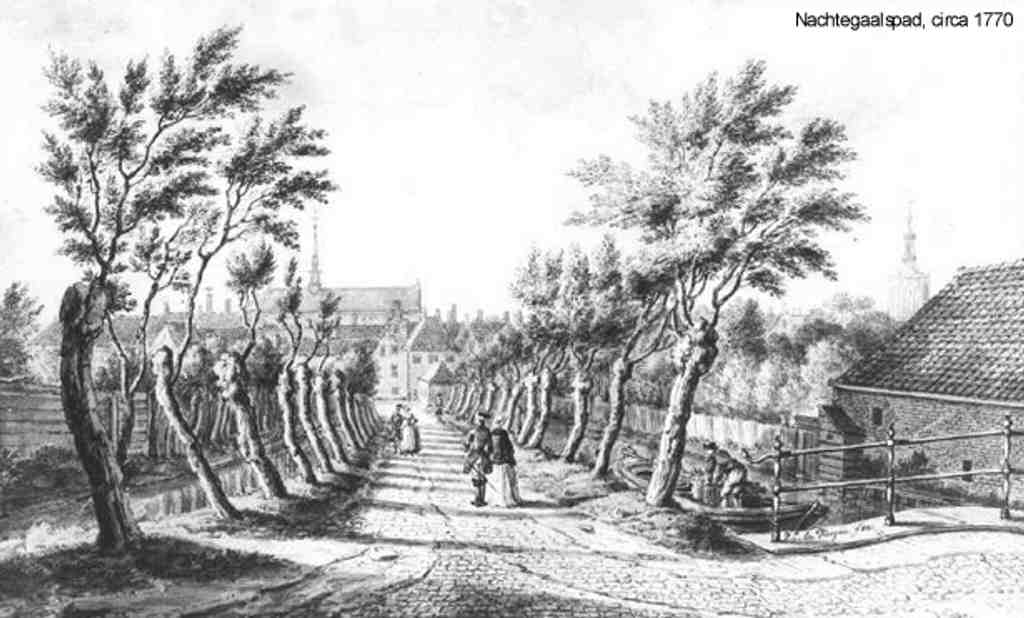
Keep your eyes peeled for a broad, tree-lined street stretching ahead of you, with buildings old and new lining the way-just as you see in the image, where the old path is framed with tall, leaning trees on each side. That’s Parkstraat, which once began its days as a sandy path called the Nachtegaalspad, humming with the song of nightingales and the shuffling of people heading home as far back as 1614.
Imagine standing here centuries ago: instead of the bustle of city life, you would have found yourself on a quiet lane flanked by rows of trees, with a boat-worthy but dead-end canal behind them. The lane was nothing more than a sandy trail, but it already marked an important route, leading all the way from Kloosterkerk right up towards what’s now Mauritskade. Back then, city life would have felt a little sleepy, with the only sounds being the rustling leaves above and maybe the distant clip-clop of horses.
Time didn’t stand still, though! When King William II decided it was time for a bit more grandeur, the area around Parkstraat transformed into the Willemspark, lifting this landscape into something both stately and lively. By 1859, the street itself was split into two-right about where you’re standing, actually! The wider, bolder stretch took on the name Parkstraat, while the narrower bit flirted with the name Kloosterkerkstraat (though that one didn’t stick around long).
Now, here’s a fun tidbit-a dash of urban drama, if you will! In the 18th century, when folks needed to cross the canal between Parkstraat and Alexanderstraat, a smart little drawbridge came to the rescue. It was the lifeline before your options were either the far-off Scheveningseveer crossing, or the Nassaubrug, nicknamed the bridge of Takma after a character from Louis Couperus’ novels. Makes you wonder what stories and secret meetings that bridge might have witnessed in the midnight fog!
As you look along the street now, you’ll see a delightful mix: historic facades sharing space with modern offices, embassies flying their colors, and maybe even a few echoes of the past tucked into corners. For example, to your right at numbers 15-25 once stood the proud offices of the newspaper Het Vaderland, their presses churning out the day’s headlines until 1982. A bit further, on 65A, the stunning Jacobus de Meerderekerk, or Parkstraat Church, still stands tall. On the left, banks like Landry & van Till once bustled with business, while families like the Domhoffs lived just above their shops-a proper upstairs-downstairs, Dutch style!
Speaking of international flair, Parkstraat is now home to embassies from Rwanda, Chile, and a rotating cast-like Thailand, sometimes making a temporary stop at number 83. And if you spot the building on the corner with Mauritskade, that’s where Brazil flies its flag, while at number 99 you’ll find offices handling passports and visas for India.
But what’s a great street without a little excitement? Parkstraat hosted the very first horse-drawn tram in the whole of the Benelux in 1864-the original tram line chugged right down this road to the seaside at Scheveningen, much as Line 1 does today. And the lines kept coming: electric trams, line changes, re-routings-Parkstraat thrummed with the clang and whistle of trams for well over a century. Imagine the rattle of tracks and the bright uniforms of conductors as the world sped up around them.
Now for the part that still gets the locals talking-a real royal tram collision! Picture it: February, 1908. Prince Hendrik himself, possibly daydreaming about royal matters, manages to have a close encounter with tram number 8 at the corner of Oranjestraat. The tram driver pulls off a daring rescue, the prince admits fault, the queen is unharmed-phew! The driver soon finds himself famous, showered with praise and, after a bit of royal intervention, he’s awarded a gold watch, a medal, and even a job at the palace. Talk about being in the right place at the right (tram) time!
So as you stand here, let the breeze hint at the past-the sandy lane, the creak of wooden bridges, the bells of trams and the gossip of embassies. Parkstraat has always had a front-row seat to history, even if it sometimes took a detour on the nightingale’s path.




