
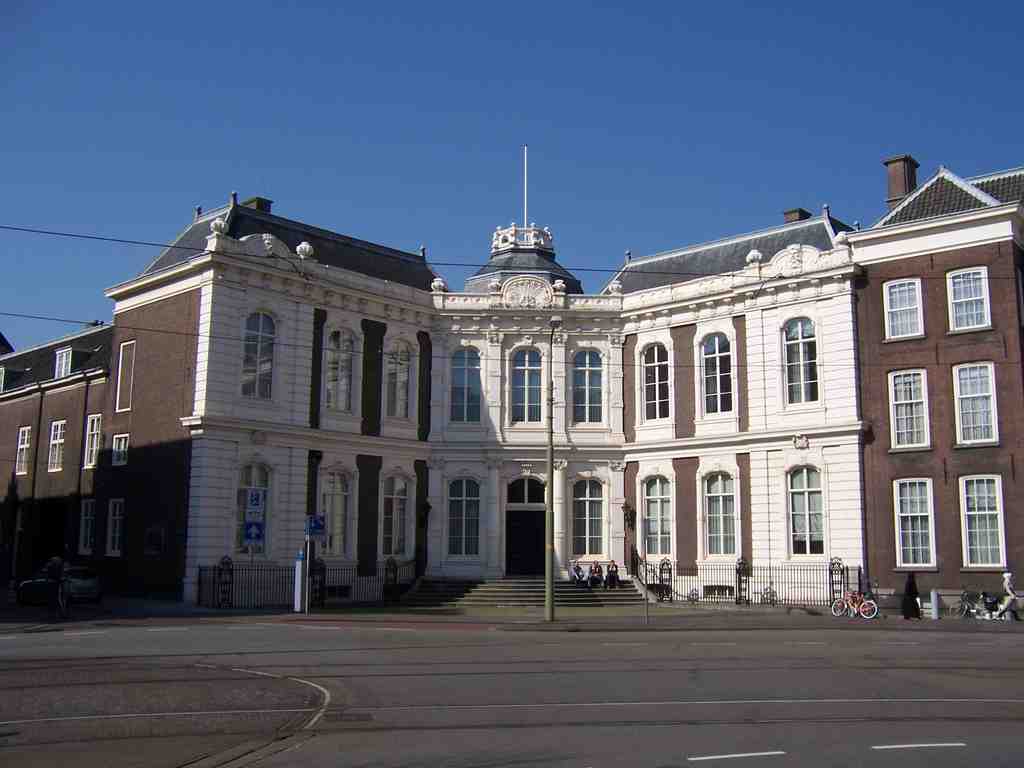
Look for a grand, elegant building ahead with tall white columns, stately arched windows, and a beautiful cupola right above the main entrance-it stands proudly on the corner, almost like it’s striking a royal pose just for you.
Welcome to Kneuterdijk Palace! If these old walls could talk, they’d probably tell you tales of powdered wigs, glittering banquets, and royal whispers floating down these very steps. Built way back in 1716 for Count Johan Hendrik of Wassenaer-Obdam, this place was designed in the flashy Louis XIV style-imagine enough gilded mirrors and ceilings painted with clouds to make any Instagrammer jealous-though back then, you’d need a powdered face and courtly manners to get through the door.
Now picture the early 1800s: handsome Crown Prince William (soon to be King William II) walks through that grand doorway, his arm linked with Queen Anna Paulowna. They called this palace home and decided to mix things up by adding their own touch. William, remembering his Oxford days, had a “Gothic Hall” built-modeled after the great dining hall of Christ Church. Yes, he missed school dinners that much!
Years passed, and their grandson Crown Prince William used this palace too, until his untimely death in 1879. In the 1930s, if you had sharp eyes, you might’ve spotted Princess Juliana popping in now and then. But not every chapter was sparkling; after World War II, the grand ballroom became a courtroom where Dutch war criminals faced justice-a reminder that even fairy tale settings can hold dark secrets.
For a while, the Ministry of Finance shuffled papers here. But don’t worry, after a royal-sized makeover in 2001, the palace regained its dignity and now serves as the headquarters of the Council of State. With its long lineage and a few ghosts from the past (metaphorically speaking-I hope!), this palace is more drama-filled than a Dutch soap opera. And it’s officially a National Heritage Site, so it can keep dazzling passersby like you for centuries more. Ready to stroll on to our next royal chapter?




