
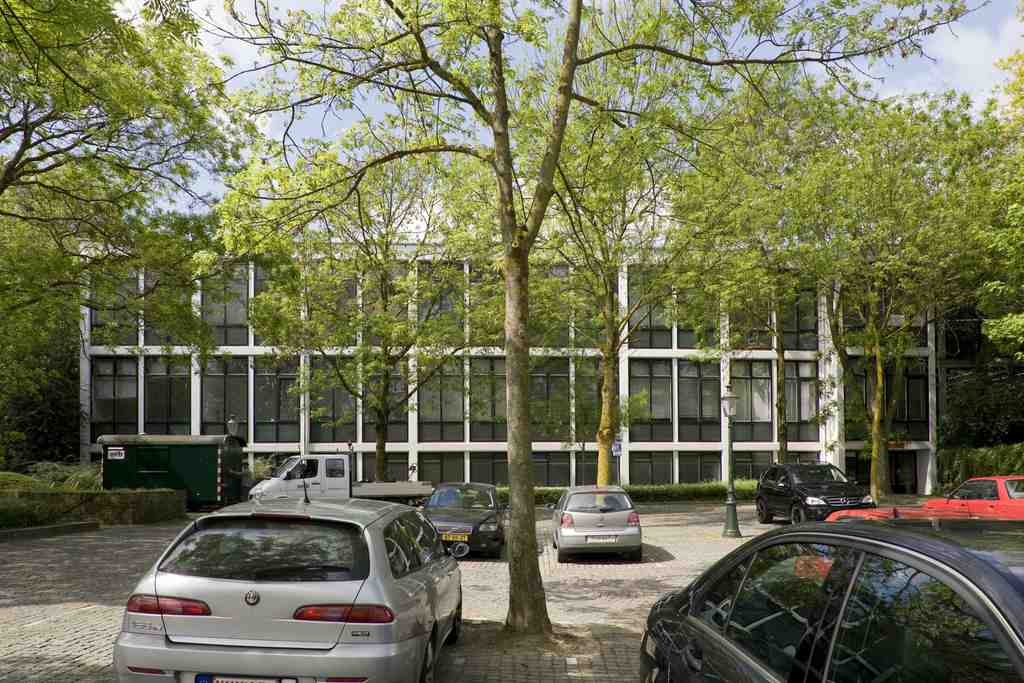
Right in front of you, you'll spot a sleek, rectangular building with a strong grid of white columns and large dark windows-just look through the leafy trees and you'll see its sharp modern lines standing out amidst the older surroundings.
Ah, welcome to the Jan van Eyck Academie-though it goes by a much fancier title these days: the Van Eyck - Multiform Institute for Fine Art, Design, and Reflection. Don’t worry, there won’t be a quiz at the end on the full name! Now, imagine you’re stepping into a place that has always been bubbling with creative energy, occasionally mixed with the smell of paint, the clang of metal, and the click of typewriters-or now, computer keys.
This academy first sprang to life after World War II, but its story actually begins in the late 1920s, when a priest, an architect, and an artist walked into a bar… Actually, they just discussed the sorry state of art in Limburg province, and longed for a place to nurture Catholic creativity in the south of the Netherlands. Their dream didn’t become reality until 1947, when the Saint Bernulphus Foundation finally gathered the right mix of faith and funding to sign the founding charter-on the feast of Saint Servatius, no less!
The early days were a bit like Hogwarts for artists. Students pored over art history, iconography, and philosophy, with a side helping of actual painting and church restoration. The mission: rebuild lost treasures and train artists who could paint a fresco or sculpt a Madonna without breaking a sweat-or straying from Catholic principles. For a while, the academy squeezed into a rather gloomy old convent with one luxury: lots of character (and not very many working lightbulbs).
By the 1960s, it was time to step into the light. Modernist architect Frits Peutz designed the bold white building you see now-a symbol that Maastricht art was ready for the 20th century. The new digs came with all the trimmings: pottery kilns, metal workshops, and even a foundry for bronze. Rumor has it, when the Dutch Minister of Culture opened the new wing, he was practically dazzled by all the shiny, state-of-the-art studios.
But as the decades passed, the world changed-and so did the Jan van Eyck Academie. The strict Catholic focus loosened. Ceramics and stained glass faded from fashion. The school became a playground for experimentation, and boundaries between disciplines blurred into a happy creative mess. The 1970s and ‘80s were a wild time here-one visiting artist even filled the place with round holes and shot laser beams through the air. The artists weren’t just painting anymore: they were staging performances, experimenting with video and audio, and even setting up Maastricht’s first media department.
International artists flocked here, turning English into the everyday language. The school morphed into a buzzing “art factory,” swapping professors for “advising researchers” and students for “Researchers” with a capital R. It’s been a hothouse for experimentation ever since-don’t be surprised if you meet a sculptor talking to a poet, a philosopher arguing with a video artist, and a curator trying to join the food lab to “study the flavor of art.” You never know what sort of “brave new project” is cooking up in one of the creative labs inside.
The Jan van Eyck’s legacy stretches far outside these modern walls. Alumni include acclaimed artists and thinkers-some of whom probably still have paint stains on their jeans. And if you ever wonder what’s behind the scenes today, just know the building has been fully renovated and is now buzzing with artists, designers, writers, scientists, and the occasional dreamer working on the next big thing. So pause a moment, listen to the laughter mixing with the occasional clatter of a sculpture in progress, and take in this home of art, ideas, and a splash of mischief in Maastricht.


