
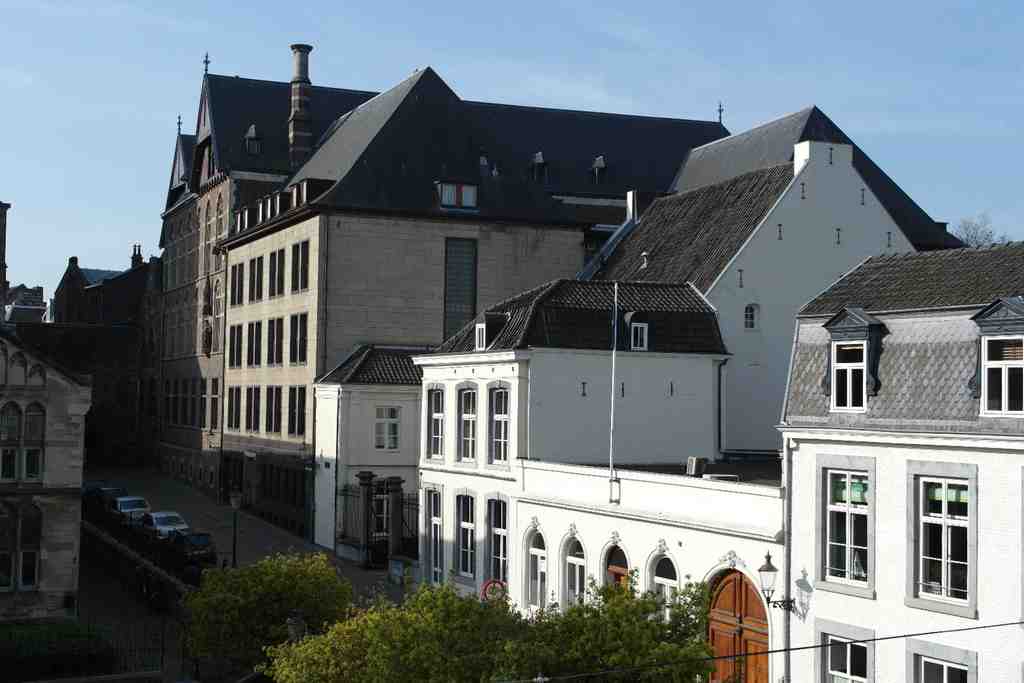
Directly in front of you, you’ll spot a cluster of buildings with pointed rooftops and a mix of light and dark stone walls, stretching along the quiet street-keep your gaze just to the left of the arched wooden door and you’ll see the large, sloping roof and older façades marking the Convent of the Sisters Under the Arches.
Now, let’s step into the world of the Sisters Under the Arches-don’t worry, I won’t make you take vows or anything! Imagine you’re standing here, and instead of the peaceful rustle of leaves, you’re hearing the soft shuffles of habit-clad sisters and the distant peal of church bells. This place wasn’t always just a peaceful oasis in the city; its story sprawls out over layers of Maastricht’s wild and wonderful history.
Long before those nuns arrived, where you stand might have been in the middle of a graveyard-literally! Archaeologists discovered that the late Roman and Merovingian burial ground from the Vrijthof stretched all the way to this garden. No worries, it’s all very peaceful now, and the only spirits you might encounter would probably just want to help tidy up.
Beneath these solid walls lies one of Maastricht’s oldest secrets: a double wall from the 9th to 11th centuries, maybe even part of the old city fortifications. Some parts belonged to the medieval courthouse, called the Hoge Leenzaal. Back in its heyday, the canons in the adjacent St. Servatius used it as their very own legal hangout, with a wooden bridge running between chapel and courtroom-imagine kind of a medieval skywalk, but with more holy relics and less security checks.
Fast-forward to the late 18th century: the French Revolution sweeps through, and suddenly the canons are packing their bags. Their grand buildings sat empty and echoing-until, that is, 1837. Enter Elisabeth Gruyters. With a sense of purpose and, I assume, excellent negotiation skills, she founded the Sisters of Charity and, after bouncing around a few locations, bought up this estate in 1845. That was a bold move for 24 women in those days, but they soon made this labyrinth of historic buildings their home.
As their numbers grew, so did the premises-soon reaching from Sint Servaasklooster to Kommel, enveloping the Refugiehuis of Herckenrode and even swallowing up old schools. Their mission was simple but powerful: care for the sick, the orphaned, and those seeking an education. Their lives weren’t all silent prayers; many sisters spent their days (and nights) working at the hospital just next door at Calvarienberg or teaching classes at the nearby schools. If you think modern multitasking is tough, try doing it in a habit with a full schedule of prayers!
The simple original chapel made way in 1901 for the bold, neo-Gothic church you see today, with its dramatic slate roofs and a Madonna and Child perched over the entry. Don’t bother hunting for a towering spire-it’s not there. The church has high, pointed roofs instead, which are a dream for fans of Gothic drama and anyone afraid of heights.
The convent buildings themselves look like a time travel exhibition: here’s the 12th-century Hoge Leenzaal, built from coal sandstone, while over there you’ve got the Maasland Renaissance-style Proosdij complex with its quirky layers of yellow marl and Namur stone. And oh, if you catch a glimpse inside the Elisabeth Gruytershuis, you might spot a tribute to the founder herself-her room is preserved as a tiny museum.
Of course, the jewel in this cluster is the sprawling cloister garden. Half secret park, half archaeological surprise, and a suntrap on a good day, it’s home to part of Maastricht’s first medieval city wall. This wall zigzags through the garden, some sections studded with archery loopholes and even reinforced where some overambitious medieval archers probably strained the structure a bit too much. There are statues tucked beneath the trees, a Lourdes grotto carved into the old stone, flowerbeds, benches, and a silent bronze of Elisabeth herself.
Even today, the convent is a sanctuary-a home base for sisters from around the world and a retreat for older members. The outside world bustles past, but within these walls, daily life moves to a gentler rhythm, punctuated by music during the Musica Sacra festival and the rare Open Monastery Day, when visitors can peek behind the arches and wonder at all that’s happened right here. It’s easy to see why the place is still called Onder de Bogen-Under the Arches-since, quite literally, centuries of stories haven’t managed to wear the arches or the spirit of hospitality thin.


