
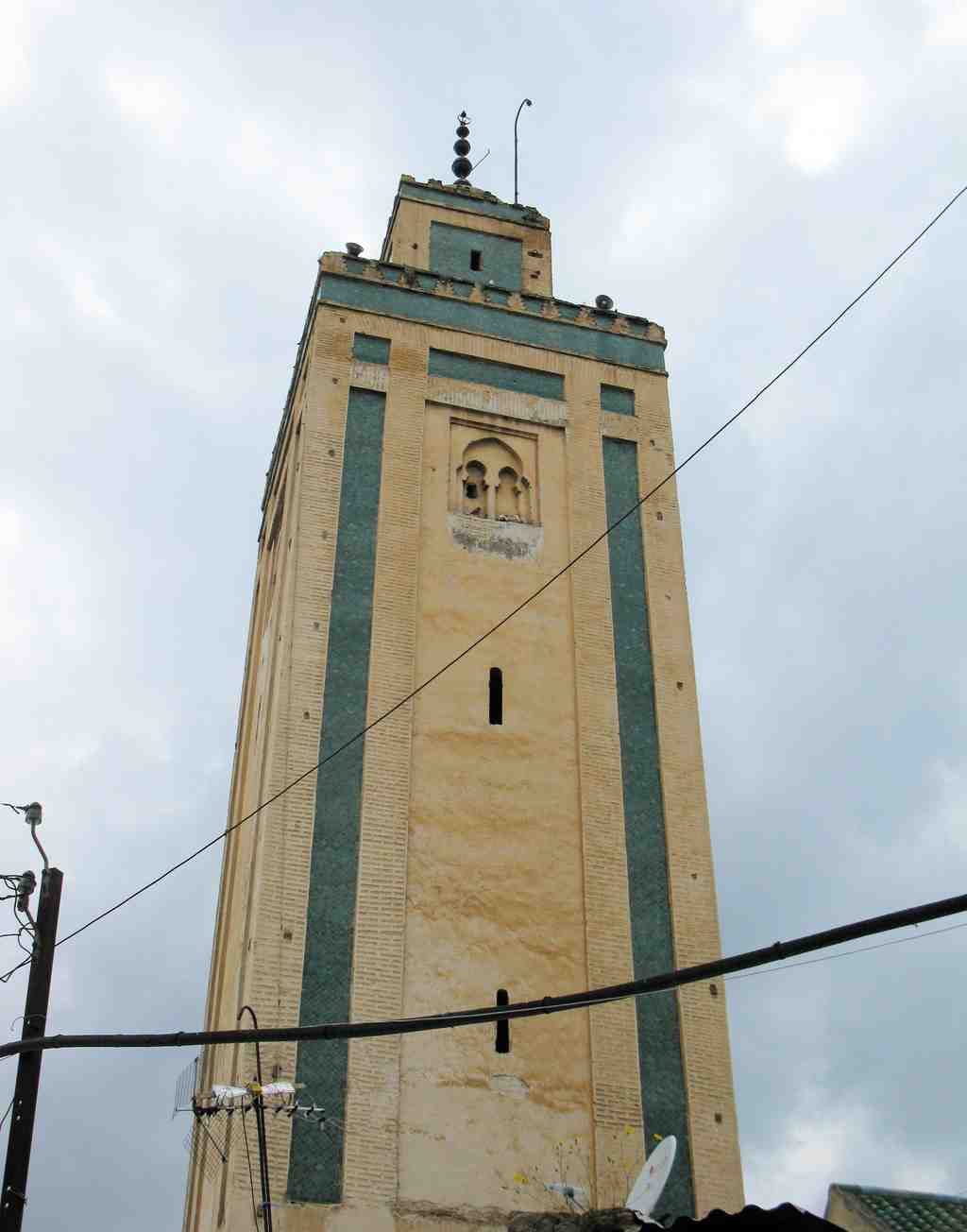
To spot the Moulay Abdallah Mosque, look for a tall, sandy-beige minaret with striking green tile accents and classic Moroccan arches near the top, rising just ahead of you against the sky.
Here you are, standing at the foot of the Moulay Abdallah Mosque-an impressive giant that seems to whisper royal secrets in every gust of wind. Imagine the year is 1729, and the city of Fes el-Jdid is abuzz with the steps of royal guards, traders, and curious townsfolk. Sultan Moulay Abdallah wants to make his mark, so he chooses this very spot, a freed-up stretch of land in the city’s northwestern corner, to build a grand mosque that would also be his eternal home.
This mosque soon became more than just a place of worship. It was where hopeful young minds prepared for life at the famous al-Qarawiyyin University, thanks to a madrasa nearby-sort of like the boot camp for bright scholars. If you take a deep whiff, maybe, just maybe, you’ll get a hint of the old hammam once hidden nearby, the kind of place where stories were swapped and worries washed away.
But here’s the plot twist-after Moulay Abdallah’s time, sultans started getting buried all over Morocco: some in Rabat, others in Marrakesh or Meknes. Yet, the tradition circled back in a surprising turn, when Sultan Youssef, and a handful of other royals-some deposed, some celebrated-returned here for their final rest. Within these walls, two courtyards, a prayer room, and the solemn burial chamber create a peaceful sanctuary. The Moulay Abdallah Mosque stands as both a royal resting ground and a witness to centuries of shifting power and heartfelt prayers, a stage where history’s drama plays out with every era’s arrival and departure. So, as you gaze up at the minaret, you’re looking at a living storybook-tall, proud, and full of unexpected chapters.




