
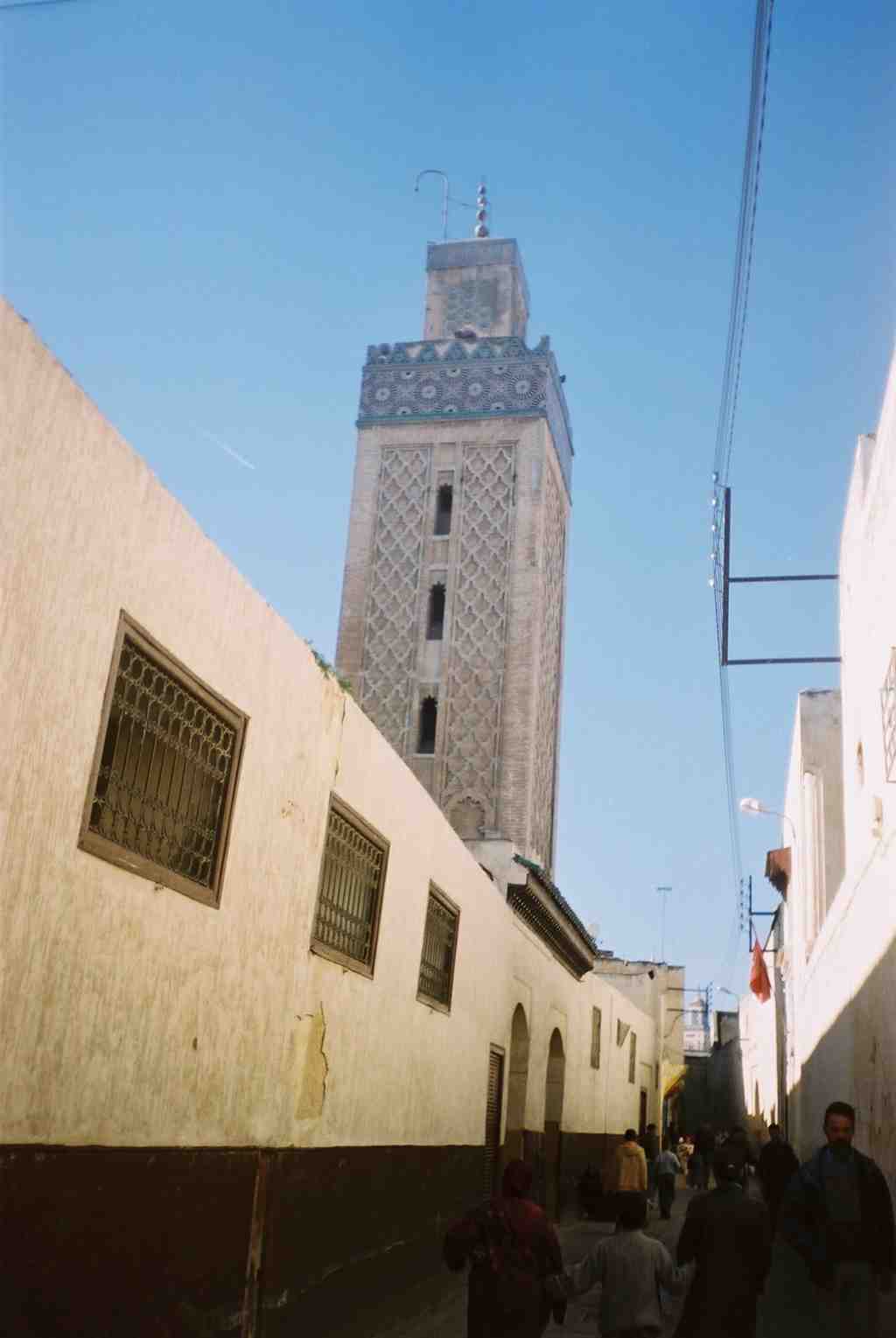
You’ll spot the Great Mosque of Fes el-Jdid by looking up for its striking, square minaret rising right above you, decorated with beautiful lattice patterns and topped with a dazzling band of blue-green mosaic tiles, standing tall at the end of this narrow lane.
Welcome to the Great Mosque of Fes el-Jdid, where the story of an entire royal city begins! Just imagine: it’s the year 1276. The powerful Marinid sultan Abu Yusuf is starting something bold-a brand-new district to rule Morocco. He chooses this very spot for his grand mosque, a sacred heart for the new city of Fes el-Jdid, while Fes el-Bali (that’s “old Fes” for the locals) stays bustling just next door. In those days, the clang of chisels and the grunts of hard-working hands-some say captured Christian prisoners from Spain-filled the air. And wouldn’t you know it, the olives pressed in Meknes helped fund this whole enterprise. Can you smell the scent of rich olive oil in the air? Probably not anymore. Unless someone’s making lunch nearby.
This mosque was no quick project, either. It took a couple of years to finish, and a local legend claims the first Friday sermon echoed through its halls in 1278. The sultan made sure construction was top-notch, even entrusting a craftsman called “Algharnati” to carve the intricate wooden minbar-the preacher’s pulpit-by 1279. By 1280, a grand chandelier hung from the ceiling, so big and heavy you'd need a champion weightlifter just to move it!
As the mosque bustled with scholars and sultans, history rumbled on. In the early 1300s, a new curiosity sprouted up next door-a madrasa, or school, built by Sultan Abu Sa’id, determined to start a learning revolution here. Unfortunately, the most famous teachers and students seemed to have gotten lost and ended up back in Fes el-Bali, leaving Fes el-Jdid's madrasa a bit jealous and later snuggled into the ever-expanding Royal Palace.
But wait-there’s more intrigue nearby! Sultan Abu Inan, a king whose life ended with betrayal and a hasty burial, is said to have been laid to rest right next to the mosque. Well, that was the rumor, anyway. Tombstones here are mysterious, marked with just Qur’anic verses and little else. Maybe the sultans wanted some peace and quiet after those dramatic palace coups.
Though centuries passed and Morocco’s rulers came and went, the mosque got plenty of royal care. Around 1395, another sultan, Abu Faris Abd al-Aziz II, decided to “bling it up”-at least according to the stone inscription out front. Historians still squabble over whether this meant he just redecorated or basically rebuilt the place, but everyone agrees he had good taste in tiles.
Bring your gaze to that superb minaret-22.8 meters tall, with dazzling geometric motifs in every direction. The top is crowned with bronze spheres, shining up in the sun, while the call to prayer used to soar from the summit. The stairs winding inside are for the brave and fit only-imagine winding your way up there five times a day.
Inside, this mosque is even more fascinating. The courtyard sparkles with mosaic floors and water basins, bringing a little oasis to every footstep. Arches frame the prayer hall, and the mihrab glows with carved stucco and stained light, much of it added by new dynasties in the centuries that followed. Even the wooden ceiling and cupola above the prayer hall hide layers of history, with each new ruler leaving their mark.
Don’t rush off just yet-there’s a secret library tucked into the mosque’s western side, once used by spiritual seekers for quiet retreat before scholars swapped solitude for stacks of books. Somewhere below, sultans and princesses lie in hushed tombs, their stories half-vanished into time and whitewash. So as you stand here in the bright morning, surrounded by everyday chatter and footsteps, picture all those centuries of prayers and palace intrigue swirling in the air. And if you ever need to find your way again-just look for that grand old minaret reaching up toward the sky.




