
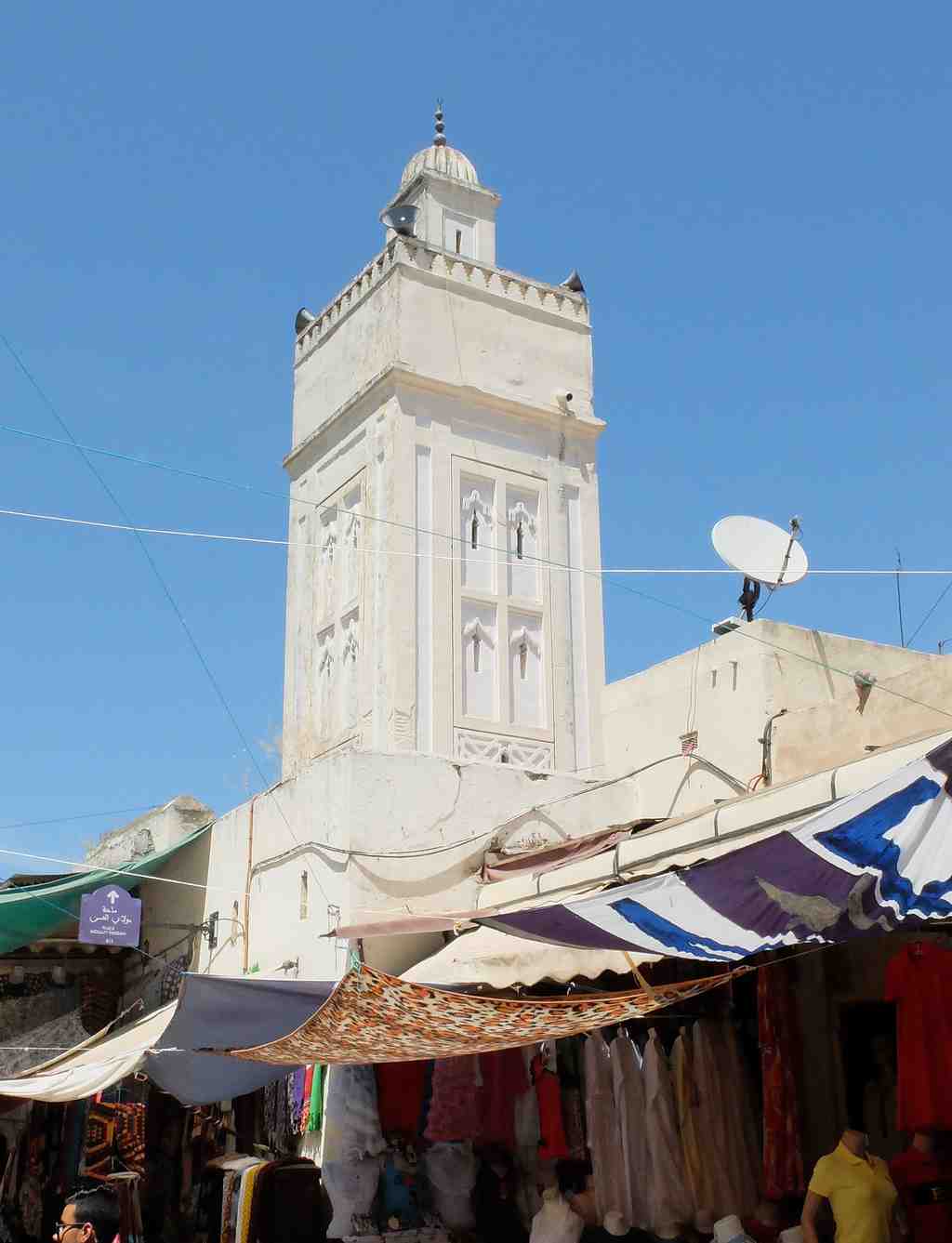
To spot the Al-Beida Mosque, look ahead for a tall, whitewashed minaret with geometric patterns and a cupola rising above a cluster of shops, its simple elegance distinctly standing out against the vivid colors of the market street.
Welcome to the Al-Beida Mosque, which-by the way-translates to “The White Mosque,” though if you think it’s named after a ghost in a sheet, that’s only half the mystery! Imagine you’re here centuries ago, when this street was already buzzing with merchants and storytellers, and the mosque was just a small, humble space tucked near the main road. The original heart of the building sits close to today’s mihrab, where prayers were first whispered by a handful of neighbors. As Fes el-Jdid grew, the little mosque must have felt like a favorite pair of shoes squeezed by growing feet. So, they expanded: a courtyard, wide and bright, wrapped in an arched gallery, with a marble fountain burbling at the center-a cool place for both quiet reflection and juicy neighborhood gossip.
Now, people walking in could rest at the entrance, shaded by a wooden canopy topped with classic green tiles, before sipping from the beautifully mosaiced fountain just outside-truly a spot designed for both peace and a quick water break. Today, you can almost sense the daily rhythm as locals pause here, some drawn by the delicate horseshoe archway dressed in carved stucco, others by the sound of water or the flutter of market stalls nearby.
The mosque wasn’t always as you see it now-its minaret, bold and square, stands behind and just off to the right of the entrance, as if supervising the street’s lively chatter. This minaret, coated in whitewash with simple geometric carvings and just a hint of ornate detail, was added later when more space was desperately needed. Why “White”? Maybe it’s the color of the pristine minaret, or perhaps it once honored a mysterious "white lady," as suggested by clever historians-no one can say for certain, and I wouldn’t advise asking the minaret itself unless you want a very silent reply.
Inside, the courtyard’s zellij tiles and marble sparkle in the Moroccan sun, guiding visitors through the arched gallery to the main prayer hall-less grand only because it’s the oldest bit. Even the ablutions room is full of surprises, with a rectangular basin and seven tiny side rooms, once a vital stop for worshippers fresh from the street.
Every piece of this mosque, from the smallest carved arch to the minaret’s gentle watch, connects lively present-day Fes with centuries of expansion, whispers of history, and a fair bit of whitewashing-both literal and maybe, just maybe, a little mysterious.




