
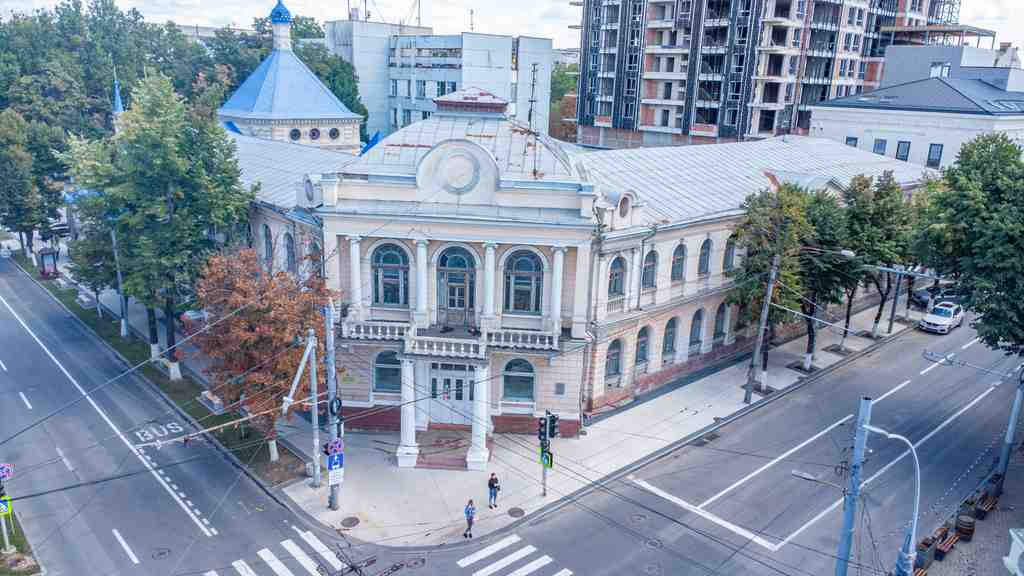
On your right, look for the pale masonry building that wraps the corner in an angular shape, with rusticated stonework at street level and a chamfered entrance marked by columns and a balcony.
This building carries a very specific ambition: to give girls a serious education in a city that had long reserved that promise for boys. The story began on the eighth of March, eighteen sixty-four, when Liubovi Alexandrovna Beliugova founded a private girls' gymnasium - a full secondary school, not just a finishing school. After that first chapter, the school changed in eighteen seventy-one from a private institution into a public one under the Bessarabian zemstvo, the elected provincial council of the Russian Empire.
One of the strongest voices here was Matilda Lazo, who led the school from eighteen seventy-two to eighteen eighty-five. She fought for girls to study at the same level as boys, and she succeeded in opening an eighth class with a pedagogical profile, which meant girls could train as future teachers. That sounds simple now... but at the time, it was a direct claim on public life.
In March of eighteen eighty, the zemstvo bought this empty corner plot at what were then Gubernială and Podoliei Streets. On the twenty-fourth of May, eighteen eighty-one, they laid the foundation stone. G-F Lonsky drew the project and budget, and the architect Kurkovsky supervised the work until completion on the third of August, eighteen eighty-two.
The architecture makes that ambition visible. The main entrance sits on the cut corner, almost like the building turns toward the city and introduces itself. Two Doric columns - the plain, sturdy classical kind - hold the balcony above. Higher up, a loggia, an open recessed gallery, stands behind four Ionic columns with their curled capitals. Across the facade, you can spot round-arched windows, pilasters between them, and keystones above the arches. The ground floor looks heavier because of its rustication, those deep-cut blocks that give it weight, while the upper floor is smoother and more refined. It is disciplined, orderly, and confident... exactly the image a modern school wanted.
History did not leave it alone. During the First World War, the building served as a military infirmary in nineteen fifteen during the school break. Then, in nineteen seventeen and nineteen eighteen, White Guard troops from the Odessa military district occupied it, and lessons stopped altogether.
Later, the school became the Commercial Girls' Lyceum. In May of nineteen twenty, Queen Maria and Princess Elisabeta visited, and not long after, officials allowed the institution to carry the name Regina Maria on its frontispiece. After another wartime rupture, staff and pupils evacuated to Craiova under director Elena Apostol. Then came new names, new systems, and new rulers: Moldavian Secondary School Number One, then a mixed school after merging with a boys' school in nineteen fifty-three, then a Soviet-era renaming for Grigori Kotovski.
Today, the building belongs to the Gheorghe Asachi Lyceum, and it remains protected as a monument of national importance. A restoration project won approval in two thousand eighteen, a reminder that Chișinău still sees this place as worth repairing, not just remembering.
This former gymnasium matters because it turned education into a public argument about who deserved a future.
Take one more look at the facade, and when you're ready, we can continue on to Doctor Tumarkin's former hydrotherapy clinic.




