
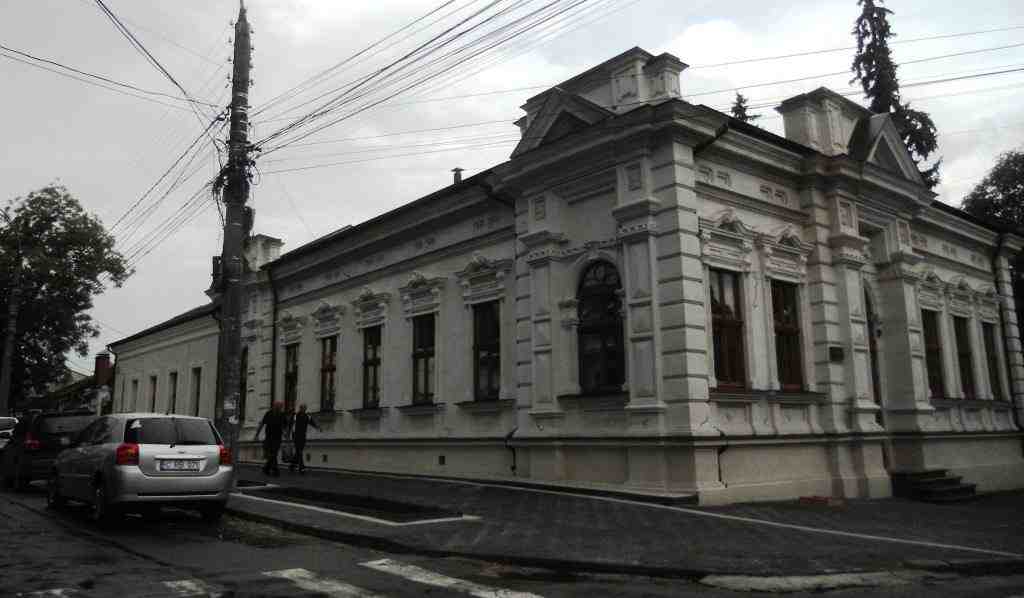
Look for the pale masonry corner villa, low and rectangular, with an arched central bay and two winged stone dragons tucked above the former entrance.
This place carries two histories at once... the story of a private home, and the story of a medical experiment in modern life. In eighteen seventy-eight, a provincial secretary named Nicolai Ivanovich Kushkovski bought this plot at public auction from the city authorities. Over the next years, from eighteen seventy-nine to eighteen ninety-four, he shaped the corner with a one-story house over a basement, modest in scale but carefully arranged with six rooms.
Then, in eighteen ninety-seven, Doctor Lazar Tumarkin stepped in and changed the meaning of the site. Between eighteen ninety-eight and nineteen oh two, he built a hydrotherapy clinic here. Hydrotherapy simply means treatment with water: baths, showers, pressure, temperature, all used as medicine. At the turn of the century, that felt strikingly modern. Water promised discipline, recovery, and scientific control over the body. People considered Tumarkin’s clinic one of the most developed in the southern Russian Empire, which tells you how ambitious this address once was. By nineteen oh three, the recorded owners were Matei and Lazar Tumarkin.
The villa in front still hints at that ambition. Its design mixes styles in an eclectic way, borrowing from classical architecture and layering on ornament. You can see wall sections that push slightly forward, triangular crowns above some windows, and those remarkable winged dragons in stone above the former grand entrance. The entrance itself no longer functions as it once did; it was replaced by a window. That small change says a great deal. Buildings survive, but they rarely remain pure.
And this one changed again and again. The clinic building in the courtyard went through reconstruction in the interwar years, which altered both its structure and its main facade. The property also suffered destruction during the Second World War. Later restorations reshaped the villa in an Art Nouveau style, the curving early twentieth-century style, even though that differed sharply from the original design. In the nineteen nineties, another expansion damaged the old clinic further: workers removed decorative stonework and added a heavy roof level, with false brackets that made the facade feel strained rather than graceful.
Today the whole complex stands protected as a monument of national importance, part of Chisinau’s historic core, and restoration work on the villa resumed in two thousand fourteen under official heritage approval.
What you see, then, is not one frozen moment, but a layered record of care, damage, fashion, and repair.
Here, medicine and memory share the same walls.
Take one more look at those dragons, and when you’re ready, we can continue to the next stop.




