
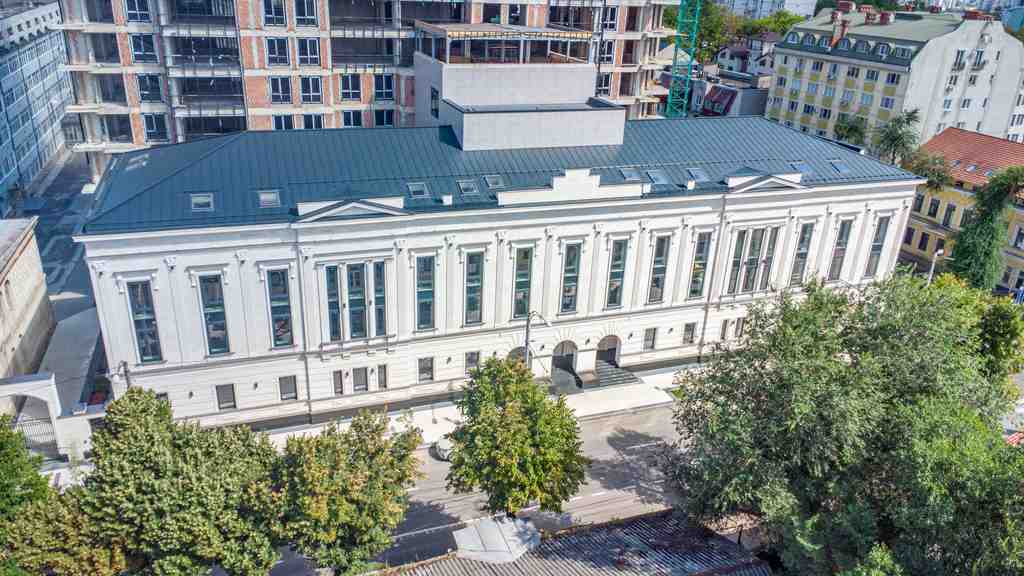
On your right, look for a two-story masonry mansion with a projecting central section, a triangular pediment, and a stone parapet lined with balusters.
This is the Rîșcanu-Derojinschi Urban Mansion, one of Chișinău’s nationally significant architectural monuments, standing here on București Street in the historic center. It carries the dignity of a noble house... and the scars of a long political life.
In the eighteen seventies, Gheorghe Rîșcanu-Derojinschi, the marshal of the Bessarabian nobility, commissioned architect Alexandru Bernardazzi to design it. He and his wife Ecaterina lived here; she came from an influential family, the daughter of the boyar Alexandru Russo and Zoia Catargi. Bernardazzi gave them a house meant to impress. The façade was symmetrical, with a central section that pushed forward slightly - architects call that a projection - crowned by a triangular pediment. The main entrance faced București Street through an arched loggia, a covered porch with open arches, supported by heavy pillars and reached by broad steps. Above the ground floor’s carved, block-like finish, the upper level carried baroque-style window frames, Corinthian pilasters - flat decorative columns - and a cornice edged with small tooth-like details.
After Bessarabia united with Romania, the family sold the house in nineteen twenty to a wealthy Jewish buyer named Kogan for one million five hundred thousand lei, a fortune at the time, roughly the value of several million in today’s money. Then power changed again. In nineteen fifty-five, Soviet authorities reshaped the mansion, adding a wing with an amphitheater-style hall for meetings of the Presidium of the Supreme Soviet of the Moldavian Soviet Socialist Republic. Later, the Society “Știința,” the Philharmonic administration, the Foreign Ministry’s diplomatic service, and the Chamber of Commerce all passed through these rooms.
The hardest chapter came in the twenty-first century. After a controversial sale in two thousand ten, developers stripped out the interior walls and inserted concrete pillars while planning a massive hotel beside and behind the old structure. What survives most clearly now is the outer shell... a beautiful façade still arguing for memory.
This mansion reminds Chișinău how easily heritage can be preserved in name and altered in substance.
Take a last look, and when you’re ready, we can continue to the next stop.




