
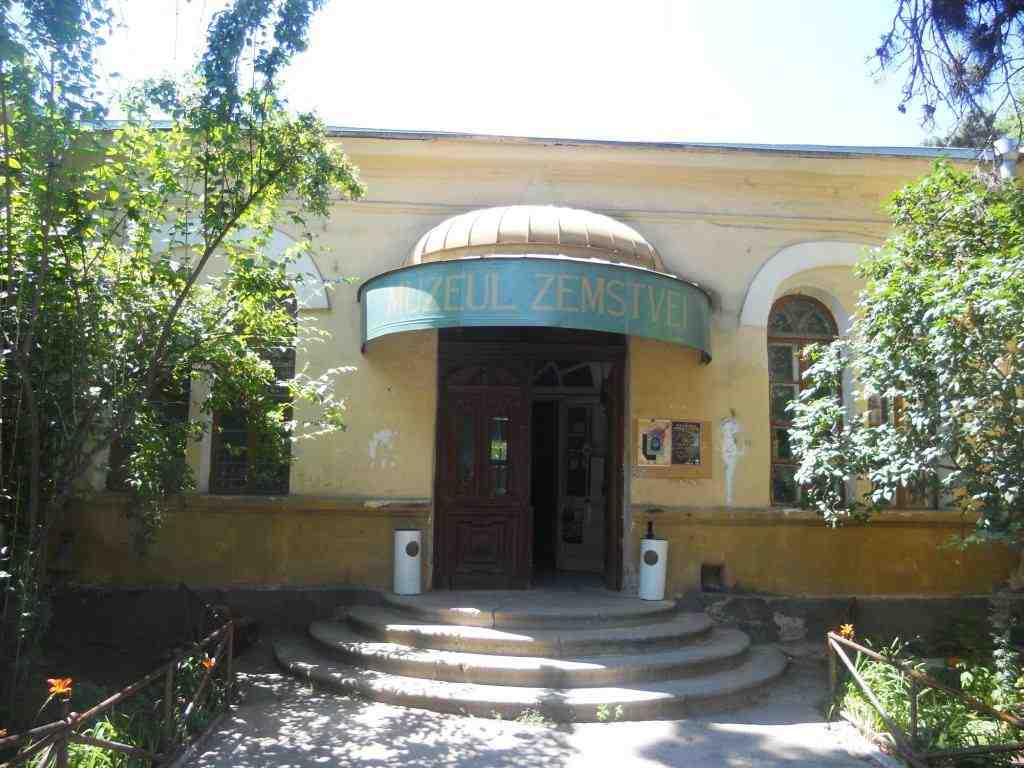
On your left, look for the long stone one-story façade with a recessed central entrance, repeated round-arched windows, and a triangular pediment rising over the middle.
This building carries more than one life inside it. It began as an orphanage. In eighteen forty-two, the city council set aside a large plot here for Chișinău’s orphanage, and by the middle of the nineteenth century the main block had taken shape. Builders raised the central building between eighteen fifty-four and eighteen fifty-seven, and they opened it in eighteen fifty-six. The plan was careful and practical: a long corridor ran through the whole structure, and on either side stood classrooms, work rooms for training through labor, and dormitories for fifteen boys and fifteen girls, their windows facing the inner yard.
There is something moving in that design. This was not only a shelter. It was an attempt to build order, education, and usefulness into a child’s daily life. Behind the buildings, the orphanage garden held another quiet first: the city’s first botanical garden. So this site cared for children and, in a way, for knowledge at the same time.
Architecturally, the place still speaks that language of discipline and symmetry. The main façade uses an eclectic style rooted in classicism, which means it borrows from older formal architecture but mixes details more freely. You can see it in the broad projecting sections around the entrance, and in those groups of three windows joined under one shared arch frame, called an archivolt. The long wings stretch outward with single arched windows, shallow pilasters, and rectangular attic-like tops that give the building a steady rhythm.
In eighteen seventy-five, builders added two matching one-story corner houses to the block, placed symmetrically at opposite corners. Then, in eighteen eighty-three, the orphanage buildings passed to the gubernial zemstva, the provincial council of the Russian Empire, a body that handled local administration. From that moment, the complex took on another identity. One room stored archives, another held insurance offices, and by eighteen eighty-nine these buildings also hosted agricultural and industrial exhibitions. Some of those objects stayed and became part of the permanent museum collection.
That layered identity matters. In nineteen eighteen, when Bessarabia entered Greater Romania, the zemstva stopped functioning, and the complex became fully museum space until nineteen thirty-two. After that, the agronomy faculty of the University of Iași moved in for several years. The last building added here came in the interwar period, in a Neo-Romanian style, with paired arched windows and a zigzag frieze under the eaves.
Even in the twenty-first century, this place refused to become silent. In two thousand ten, it entered the administration of the National Museum of Ethnography, and the sign “Zemstva Museum” appeared at the entrance. A year later, new exhibitions opened. Independent artists, cultural groups, workshops, theater, concerts, and film screenings filled the site and its back garden. Then came new restoration plans, a proposed handover to the Romanian Cultural Institute, and later, in two thousand twenty, the removal of the cultural groups using the space. So the story here is still unsettled: care, administration, study, art, and argument, all sharing the same address.
This is one of the rare places in central Chișinău where an entire historic block still survives as a whole.
Take one more look at its measured symmetry... and when you’re ready, we can continue to the next stop.




