
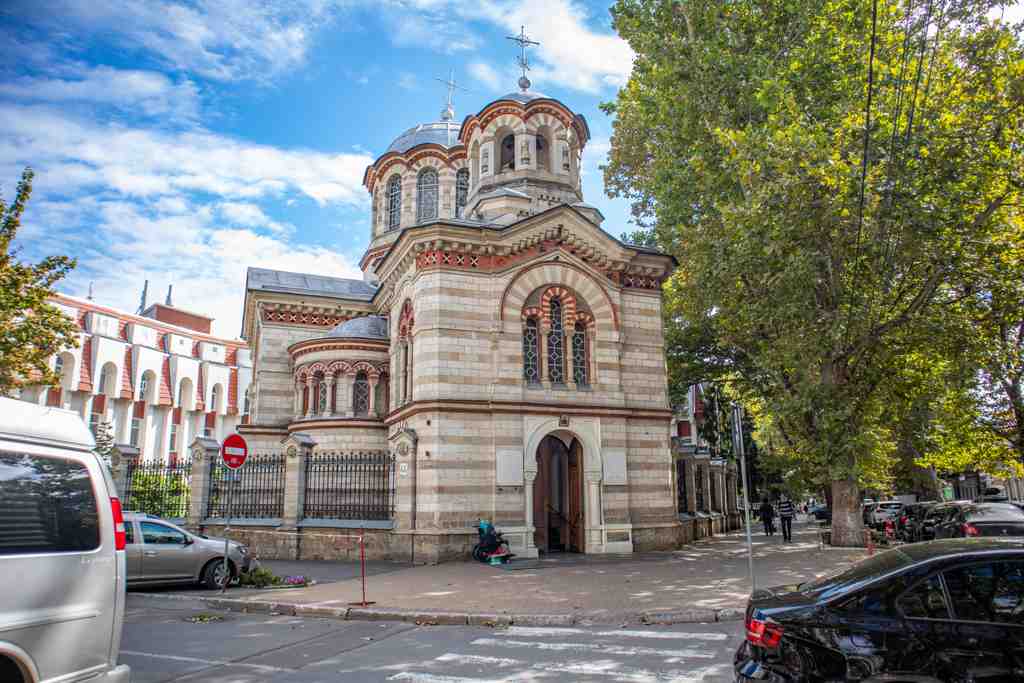
On your right, look for a compact church of striped light and dark stone, crowned with rounded domes, with red brick stitched into the facade as a vivid decorative pattern.
Saint Panteleimon Church holds more than faith inside its walls... it holds a family memory and a whole community’s sense of home. In eighteen ninety-one, the architect Alexandru Bernardazzi designed it for the Greek community of Chișinău, and the brothers Iannis, also called Ivan, and Victor Sinadino gave the project its force and funding. They chose Saint Panteleimon as the church’s protector to honor their father, Pantelimon I. Sinadino, whose name day saint was Pantelimon.
What makes this church so striking is how deliberately it looks elsewhere for inspiration. The plan forms a Greek cross, which means all four arms are equal in length, unlike the longer body of many churches. The eastern arm holds the altar apse, the rounded sacred end of the church, while the western arm carries the bell tower. Above the center, four intersecting arches lift an octagonal dome... a structural idea with Armenian roots. Outside, the walls alternate bands of pale and darker stone, and Bernardazzi sharpened the effect with red brick details, arched window openings, and those full, lively towers with cornices that ripple like fabric.
Even the fence matters here: forged iron on a stone base, broken by posts topped with lion heads. This church was never ordinary; newspapers of the time praised it as one of the finest artistic works of its kind in the Russian Empire.
It still feels like a small, confident statement of identity in stone.
Take a moment here, and when you’re ready, we can continue to the next stop.




