
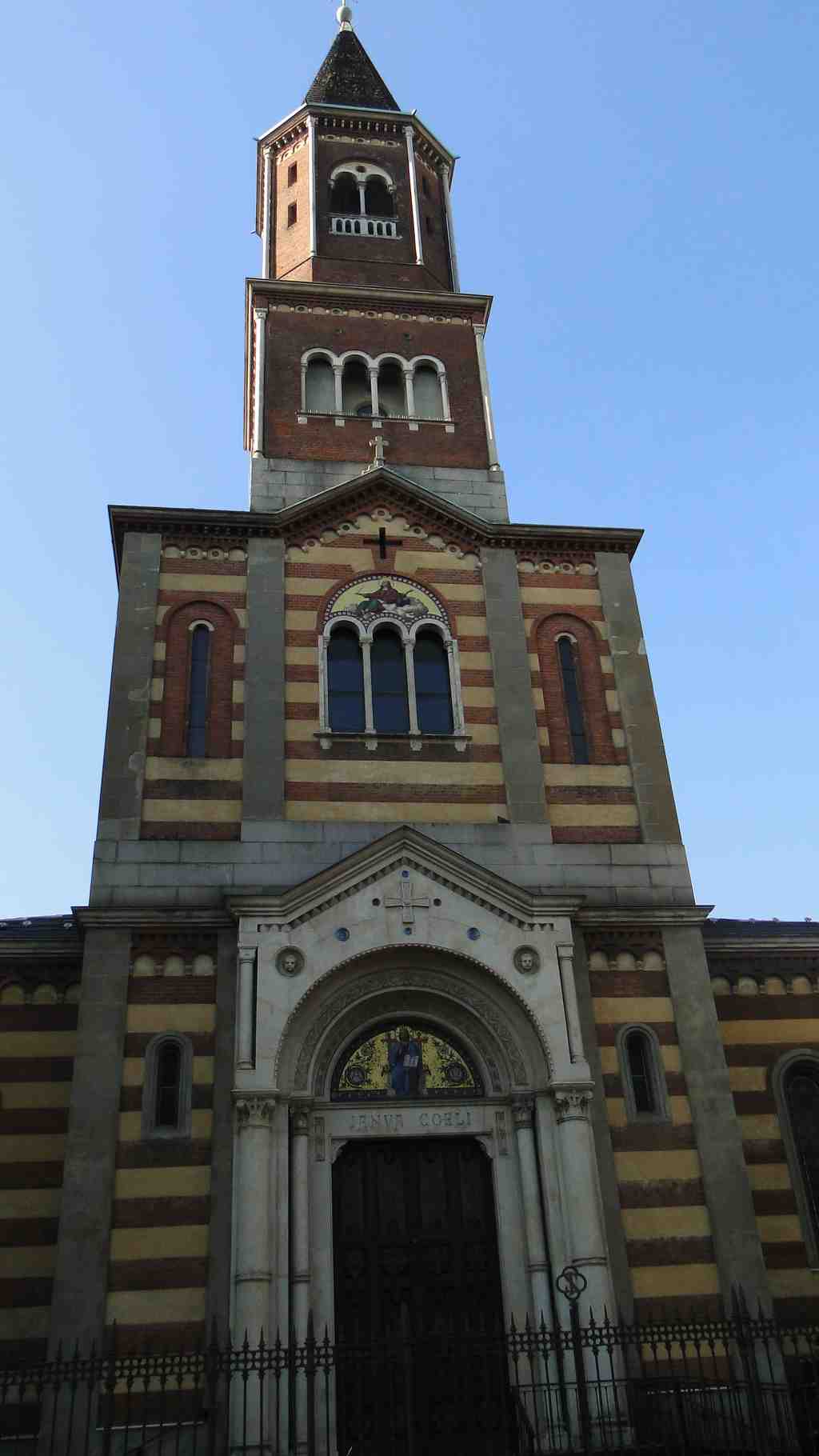
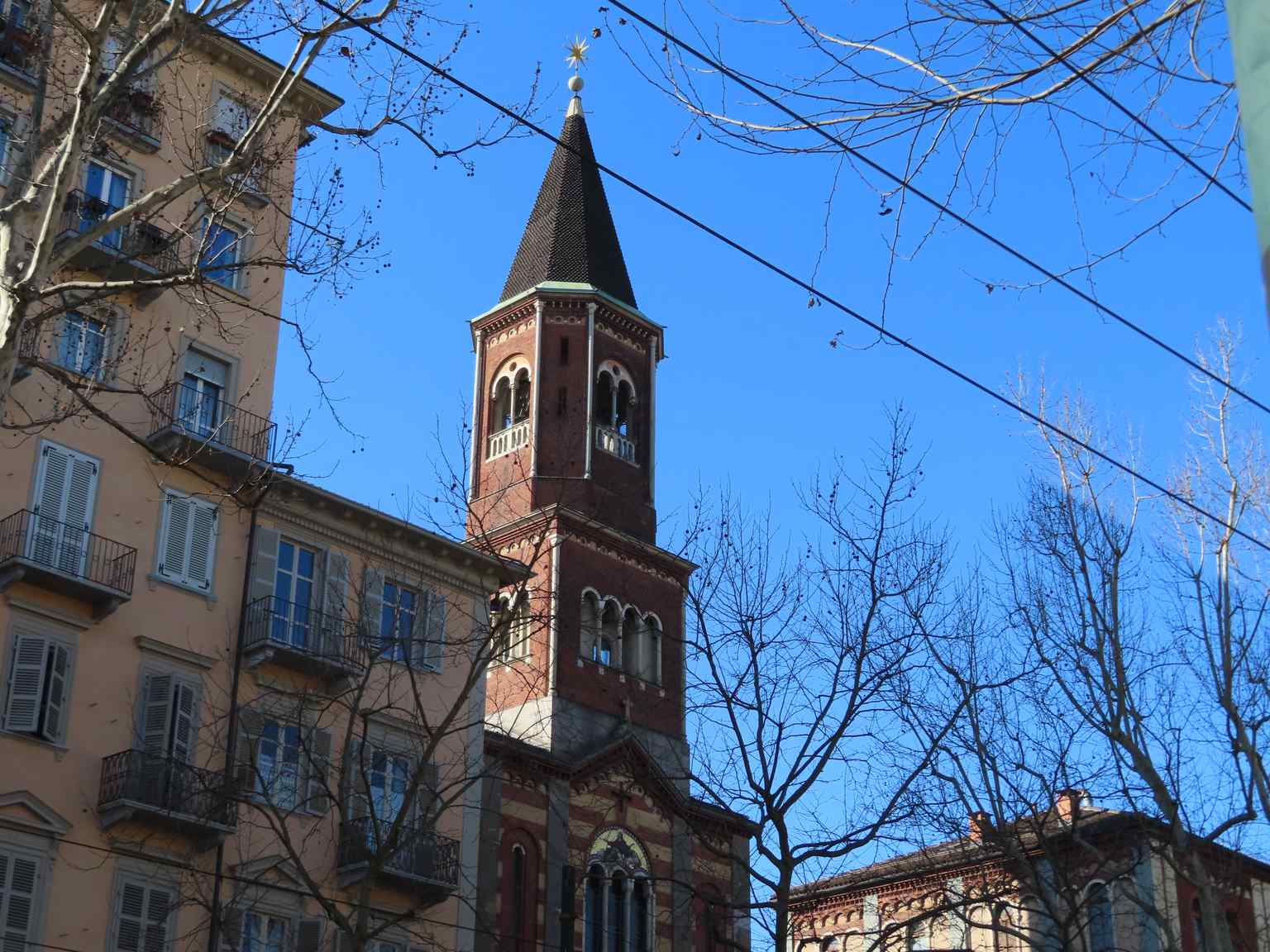
On your left, you will see the Church of San Giovanni Evangelista, standing tall with its striking facade of alternating horizontal red brick and yellow stone stripes, a central arched door topped with a bright golden mosaic, and a high square bell tower reaching into the sky. As you stand before it, let us reflect on the human stories hidden behind these grand walls. Stepping away from the wide boulevard of Corso Vittorio Emanuele II, we find ourselves in the heart of San Salvario, a district that grew rapidly and chaotically in the nineteenth century. The construction of the nearby Porta Nuova train station drew thousands of working class families, turning this area into a bustling, overcrowded hub. Seeing this flood of poor, abandoned young boys, the famous local priest Saint John Bosco, affectionately known as Don Bosco, decided to build a youth hospice and school here to help them. But progress often comes with a quiet social cost. To build his vision, Don Bosco had to buy up many small plots of land, an area that was already home to a community of local washerwomen. When these women first heard a priest was buying the land, they mistakenly thought he was building them a beautiful new washhouse, but when they realized they were actually being evicted, they cried out that it must be the end of the world. Don Bosco had to engage in a tense diplomatic battle, finally offering them a significant financial payout to convince them to leave their homes. It is a melancholic reminder that as a society reaches toward the future, some of its most vulnerable residents are pushed aside. You might wonder why Don Bosco built such a massive, imposing church for a simple youth shelter. The answer lies in both rivalry and duty. Just down the street, the Waldensians, a long persecuted Christian minority that had just been granted civil rights, had built their own temple and opened schools to Catholic children. Don Bosco felt a competitive urge to create an alternative to keep the neighborhood youth in his faith. Furthermore, his superior, Archbishop Lorenzo Gastaldi, practically ordered him to build a monumental church worthy of this elegant avenue. Though Don Bosco worried about the enormous cost, he bowed his head and accepted the challenge. He relied completely on the charity of the public. Local newspapers printed the names of donors, including one father who gave one hundred lire, which would be roughly five hundred dollars today, simply asking for prayers for his loved ones in return. With these funds, the architect Edoardo Arborio Mella designed the building in the Lombard Romanesque style, an architectural nod to the thirteenth century defined by the heavy, solid brickwork and rounded arches you see on the facade today. Consecrated in eighteen eighty two, the church survived the decades, though it bore the heavy scars of the twentieth century. In August nineteen forty three, devastating Allied air raids severely bombed the church and the boys center, demanding years of painful reconstruction. The church is open every day from seven in the morning to noon, and again from five to seven in the evening, if you would like to see the restored interior. For now, let us take a short three minute walk to our next stop, the Waldensian Temple, to see how another marginalized group finally found its voice in this changing city.





.jpg)