
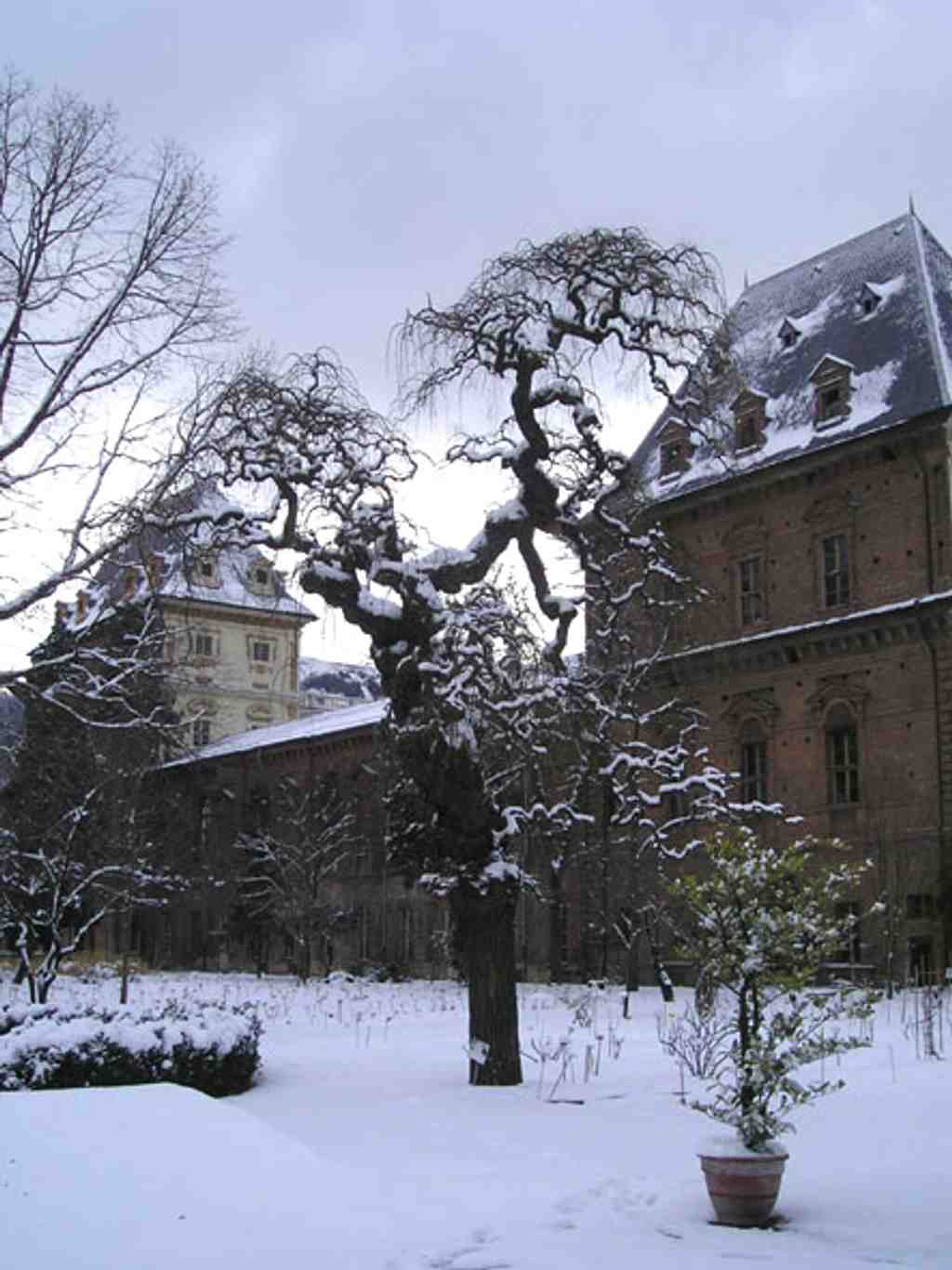
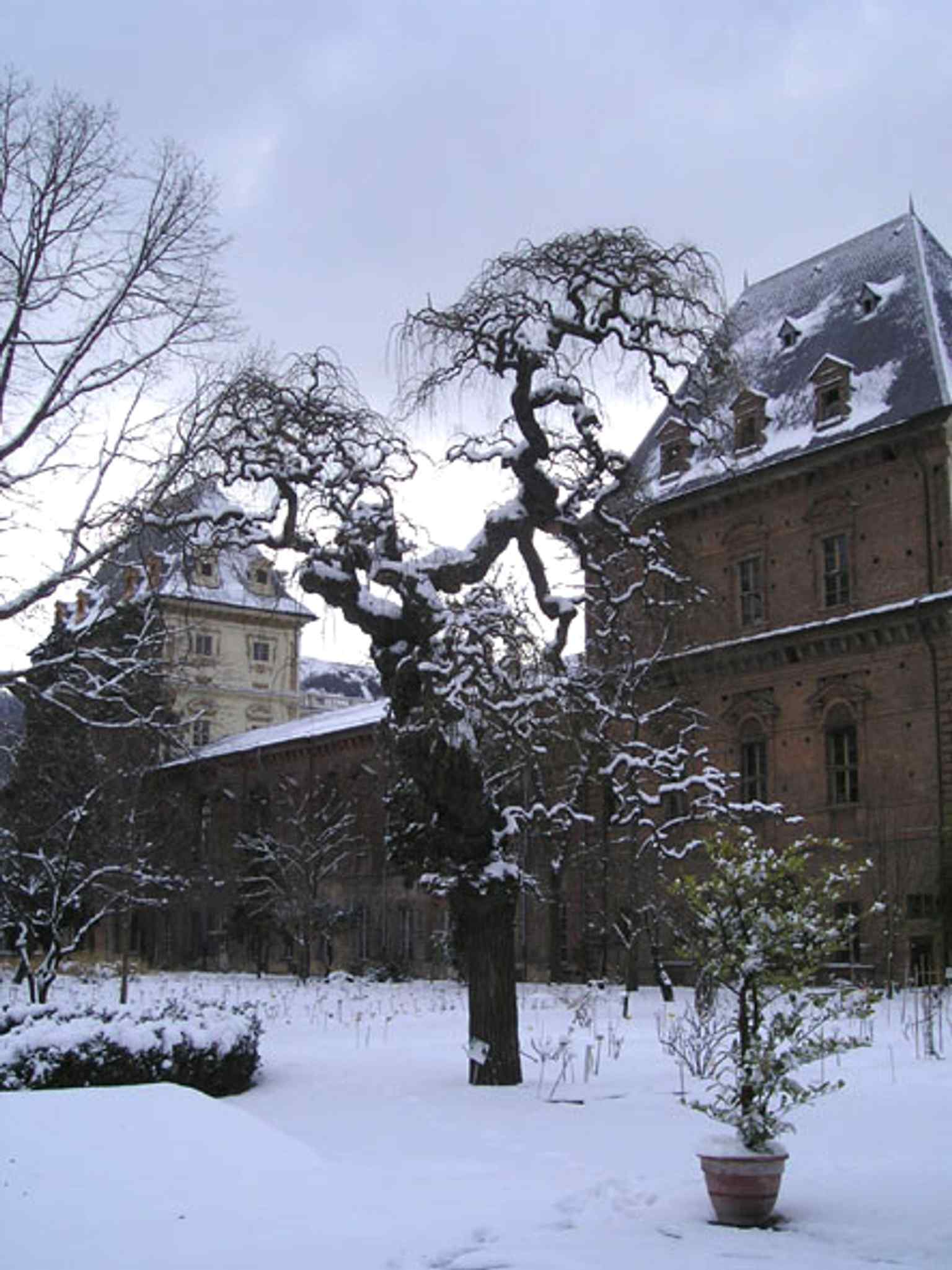
Here is the Botanical Garden of Turin, easily spotted by the grand, steeply pitched dark roof with small dormer windows rising behind the gnarled, twisting branches of the mature trees in the foreground. \n\nAlong the banks of the Po River, the wild, untamed environment of the water margin was slowly gathered, categorized, and brought under strict human order. This very ground was once a simple, practical vegetable plot belonging to King Vittorio Amedeo the Second of the House of Savoy. But in 1729, it was purposefully transformed. The unruly riverbank gave way to a controlled environment for scientific study, turning a royal food source into a living laboratory where the chaos of nature was neatly labeled and confined to perfectly measured beds. \n\n The garden began by focusing on medicinal plants, but under the guidance of its early directors, its ambitions grew far beyond the city. Take Vitaliano Donati, who took over in 1750. Donati was not a man content to sit quietly in a greenhouse. He traveled the world seeking rare botanical species. The King even sent him to Egypt to collect natural and archaeological wonders. Donati actually shipped back three stone statues from a temple in Karnak, which formed the very first seeds of Turin's famous Egyptian Museum. But his adventuring carried a heavy cost. In 1762, while sailing toward India on another collecting mission, Donati died at sea. \n\nDecades later, in 1801, the garden fell under the care of Giovanni Battista Balbis, a man whose life was pure drama. In his youth, Balbis was a Jacobin revolutionary, a member of a radical political movement that fought to overthrow the monarchy. After a failed conspiracy, he fled into exile, only to return as a military doctor marching over the treacherous, high-altitude passes of the Alps alongside Napoleon's army. After surviving the battlefields, Balbis abandoned politics entirely to devote himself to the quiet peace of these plants. Under his devoted care, the garden blossomed, adding nearly two thousand new species. But history has a long memory. When the monarchy was eventually restored, Balbis was punished for his revolutionary past. He was stripped of his public offices and forced into his third and final exile, leaving his beloved plants behind. \n\n The garden has endured its own quiet tragedies over the centuries. During the First World War, severe fuel shortages left the delicate glass greenhouses completely without heating. Tragically, countless priceless, centuries-old exotic plants froze to death, lost forever. \n\nToday, the garden is a space of education and care, even featuring a special path with braille markers so that visually impaired visitors can touch and experience the living plants. If you wish to wander the grounds, they are open Monday through Friday from eight AM to eight PM, Saturdays until two PM, and closed on Sundays. \n\nNow, let us trace the footsteps of the royals who once walked these riverbanks. We will continue our journey to Valentino Castle, which is just a seven-minute walk away.





