
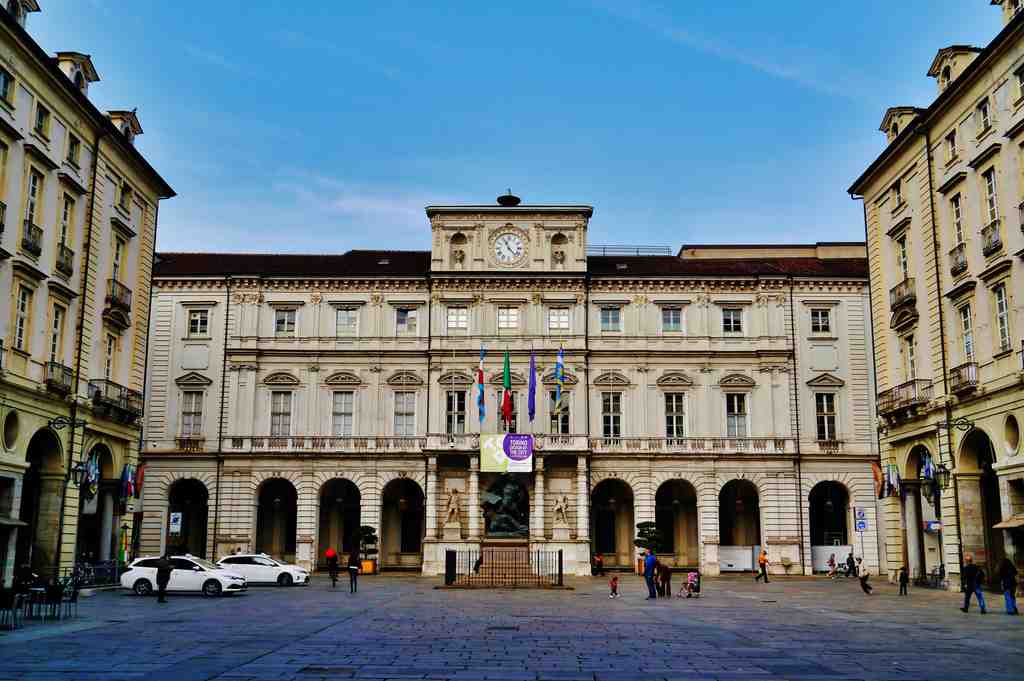
To spot the Palazzo Civico, just look ahead for an elegant, cream-colored building with a series of grand arches on the ground level, topped with rows of windows and a prominent clock sitting above the entrance, right in the center of the facade.
Welcome to Palazzo Civico-Turin’s own city hall and a building that’s seen more drama, celebration, and architectural hairdos than most people at a royal wedding! Imagine you’re standing in a bustling piazza, the morning sun glinting off pale Baroque stone, the air lively with footsteps and, if you listen closely, the toll of that grand clock up above. This is the heart of Turin, and Palazzo Civico is the city’s stately front door.
Now, way back in the days of flouncy wigs and ducal coats-think 1663-a clever architect named Francesco Lanfranchi, armed with designs inspired by Emanuele Tesauro, was asked to build a new city hall right here, on what was then Piazza delle Erbe. The site once bustled with medieval market life, but Lanfranchi’s bold Baroque lines-and a fair bit of aristocratic muscle-quickly set a new tone for Turin’s government. In fact, the very first stone was laid with quite the audience: an archbishop, a duke, and the formidable Madama Reale Cristina di Francia. If you ever want a building to stand the test of time, invite some royals to the groundbreaking-no pressure, right?
Once complete, the new Palazzo was actually much more slender than what you see now. No clock tower yet, and smack in the center: a dramatic Savoy-Orléans coat of arms, flanked by proud bronze lions. But before you get too attached, let’s set off a little drama: along came the Jacobeans during the revolutionary chaos of 1799, and-snap!-down with the lions and the arms. Political movements, it turns out, make for very bad interior decorators.
But let’s rewind to happier scenes! The grand opening of this palace just so happened to coincide with a right royal wedding: Carlo Emanuele II and Princess Francesca Maddalena d’Orléans. Picture lavish festivities spilling onto the piazza, the young couple waving from the balcony, while fireworks light up the sky above. And then, as is often the case with royal stories, tragedy followed celebration-Carlo Emanuele remarried here after Francesca’s untimely passing.
Just when you thought our city hall might rest easy, the 1700s brought another wave of change. Benedetto Alfieri, an architect known for dramatic flourishes, added those grand wings stretching toward Via Garibaldi and Via Corte d’Appello. The once cozy “piazzetta del Butirro” behind the palace became a stately courtyard, enveloped by the ever-growing building. Other architects took over in turn, tweaking facades and interiors with the careful hands of painters touching up a masterpiece.
Speaking of masterpieces, take a moment to imagine what happens inside! As you’d expect for a palace of power, the grand staircase sweeps visitors up beneath painted ceilings-thank Pietro Fea for those swirling frescos. The journey ends at the glittering Salone dei Marmi, or Hall of Marbles, resplendent with its 19th-century décor: glinting marbles, a heroic relief of King Vittorio Emanuele I astride his horse (a nod to the restoration of the royal family after Napoleon’s little detour in Italian history), and a balcony where wedding parties stand today to wave at the city below. In fact, if you’re ever in Turin and fancy a grand civic wedding, this is the spot to say "I do!”
Let’s not forget the mysterious and regal Sala Rossa-where the city council has convened since the palace first opened its doors. Plush with red velvets and damasks, the room positively glows with a blend of history and power. Look up for ceiling paintings by seventeenth-century artist Casella, catch the eyes of a mayor or two in stately portraits, and soak in the sense that people have been debating the fate of Turin right here for centuries. Above the main council chair? An enormous oil painting of Carlo Alberto di Savoia keeps a watchful, royal eyebrow on proceedings-surely ready to frown if someone suggests renaming the city after themselves.
So as you stand out here, listen to the echoes of celebration, debate, and royal intrigue swirling around Palazzo Civico. It’s not just a building, it’s Turin’s beating civic heart-and a reminder that sometimes, history is just as dramatic (and stylish) as the city itself.




