
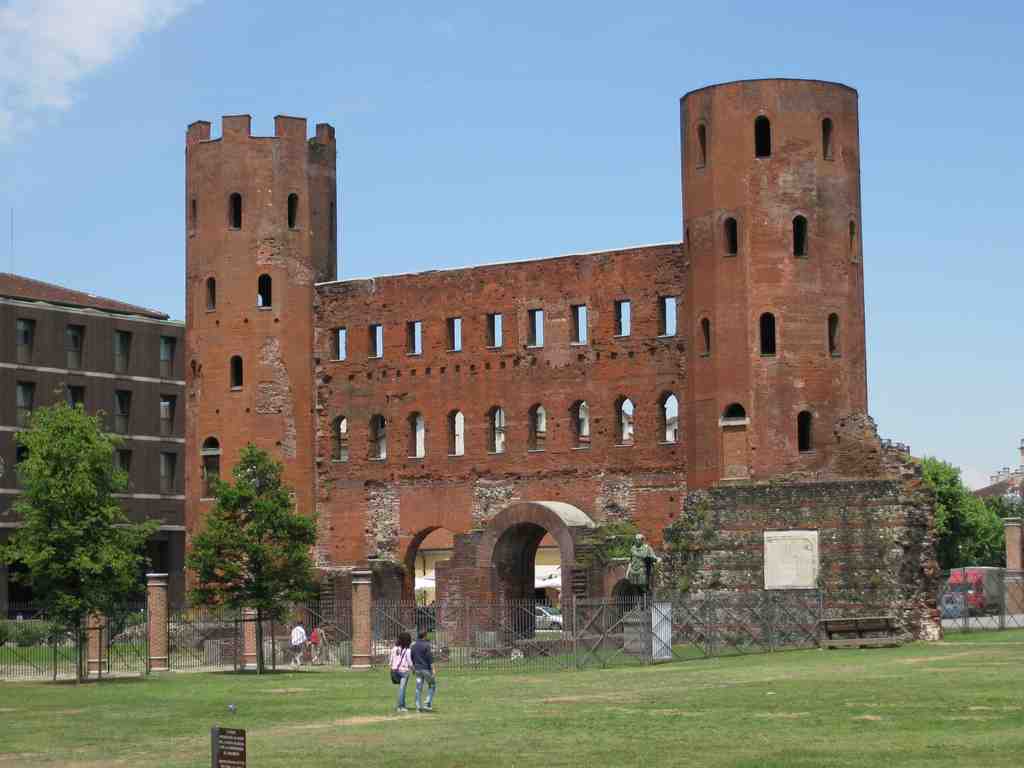
To spot the Palatine Gate, just look ahead for two towering, round red-brick structures with plenty of rectangular windows, joined by a central wall-this ancient doorway stands proudly in the open park, looking like a slice of Rome dropped into the heart of Turin.
Standing here, you’re about to travel back almost two thousand years-no time machine needed, just a sprinkle of imagination and maybe a bit of sunscreen. Close your eyes for a second, and picture the hustle and bustle of Roman Turin: carts squeaking over stone, soldiers marching through those tall arches, and traders arguing over prices for fresh olives right where you’re standing. These weathered towers you see in front of you-over thirty meters high, built with the classic Roman touch and a dash of imperial flair-once guarded the northern entrance to what the Romans called Julia Augusta Taurinorum. Today, it’s called “Turin,” but back then, this gate was known as the Porta Principalis Dextra. Sounds fancy, but it basically meant this was the main northern door into the city.
Look at those twin, sixteen-sided towers. Can you believe they’ve stood watch since the first century AD, surviving time, war, and the occasional overzealous pigeon? In those days, the central wall between them would have been busy with Roman traffic, and those four entryways below-two wide, two narrow-welcome both chariots and humble pedestrians. The deeper grooves worn into the stone? They’re ancient Roman “track marks” from countless wagon wheels grinding against the guardhouse, a little historical traffic jam evidence. You could call it ancient Turin's first set of speed bumps.
Above you, two tall lines of windows, the lower ones arched like open eyes and the upper with a jack arch style-these were not just for decoration. The Romans had a clever system of cateractae here, heavy grates that could drop down to seal the city when danger approached. Imagine the tension in the air when bandits or enemies gathered at the horizon and Roman soldiers stood ready to slam those gates shut!
The Palatine Gate owes its name to a mysterious “palazzo” that was supposed to be nearby. But here’s a fun quirk-no one really knows for sure which palace the name refers to. Was it the grand old House of the Senate, just inside the walls? Or maybe the City Palace, the Palazzo di Città? Some whisper it came from a long-lost amphitheatre, once alive with the roars of the crowd and gladiators, now buried somewhere in the fog of history. Others call it the Porta Comitale, hinting at nobles, or the Porta Doranea, after the nearby Dora River. As centuries rolled on, the city changed, but this stubborn old gate kept its post, even as names and fashions faded in and out.
In the 11th century, as the Roman Empire’s shadow gave way to medieval uncertainty, the gate got a gothic makeover-it even became a castrum, a little fortress! Several invasions and some medieval DIY repairs later, the western tower was rebuilt with battlements, turning this grand old archway into a true medieval lookout post.
Fast forward to the 1700s-the city planner wants to knock it down! Typical, right? But, like an ancient superhero, engineer Antonio Bertola swoops in, convincing the Duke to spare this treasure. Centuries later, in 2006, Turin finally gives the gate the respect it deserves, creating the Archaeological Park and even making the towers accessible-though I’d still recommend the stairs, not a toga and sandals.
And don’t miss those two bronze statues out front-Augustus Caesar and Julius Caesar, looking dramatic and ready to strike a pose. They’re not original, but they sure know how to make an entrance. The real fun? Historians still argue if they’re standing in the right spot!
So as you stand here, feet on ancient stones and eyes wide with wonder, remember: this isn’t just a ruin. It’s Turin’s memory, whispering stories through its battered bricks about emperors, soldiers, merchants, and maybe, if you listen close, the sound of a Roman gate grating down in the middle of a moonlit night. Well, that or just the faint echo of the city’s ancient wagons rolling home. Let’s keep moving-who knows what secrets the next stop will reveal?




