
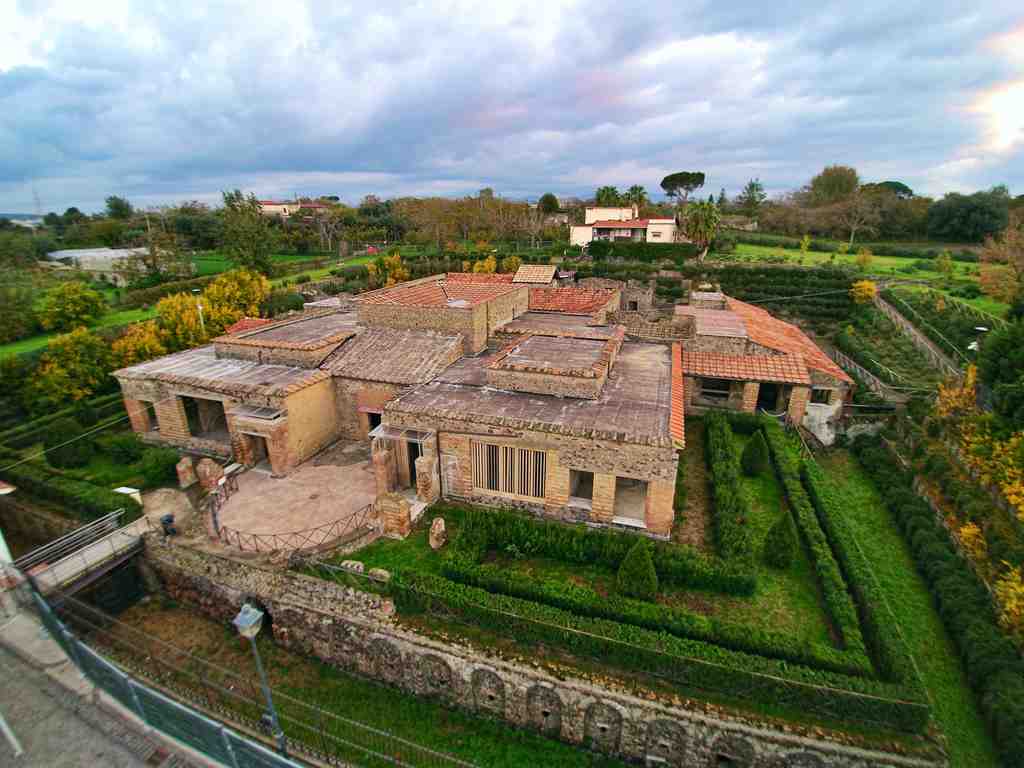
Like the rest of Pompeii, the Villa of the Mysteries was buried by the eruption of Mount Vesuvius in 79 AD and was only rediscovered and excavated from 1909 onwards. Now, it stands as an important part of the UNESCO World Heritage Site at Pompeii.
Situated around 400 meters northwest of the town walls, between the roads Via Delle Tombe and Via Superiore, this villa is in close proximity to other notable sites such as the Villa of Diomedes and the Villa of Cicero. It sits on a hill, offering a stunning view of the current Gulf of Naples. The villa is partly supported by a cryptoporticus, a covered walkway with arches.
The construction of the villa was believed to have begun in the 2nd century BC, but recent research suggests it was built in the early 1st century BC. During the Augustan age, the villa underwent significant expansions and embellishments, reaching its peak in grandeur. However, after the earthquake of 62 AD, like much of the city, it fell into disrepair and was transformed into a vineyard with the addition of wine-making equipment.
The ownership of the villa remains unknown, but a bronze seal found on-site suggests it may have belonged to L. Istacidius Zosimus, a freedman of the Istacidii family. Some historians speculate that it may have even been owned by Livia, the wife of Augustus.
The excavation of the Villa of the Mysteries began in 1909 and continued in 1929-1930, uncovering its remarkable treasures. Restoration work was conducted on the frescoes between 2013 and 2015, ensuring their continued preservation. In 2018, archaeologists discovered the remains of harnessed horses, providing a unique glimpse into the villa's history.
Despite being covered by layers of volcanic ash and pumice, the villa sustained minimal damage during the eruption. Its walls, ceilings, and frescoes miraculously survived intact. As you explore the villa, you'll see the ancient entrance, which leads to service rooms, a courtyard, and even a restored wine press.
Step into the peristyle, where you'll find the bathing and kitchen quarters, as well as the main atrium with an impluvium. From there, you can access the triclinium and portico, where you'll be treated to a breathtaking view of the Gulf of Naples.
The Villa of the Mysteries is truly a testament to the grandeur of ancient Roman life and the rich historical and artistic legacy of Pompeii. So, let's continue our journey and explore more of this incredible city!


