
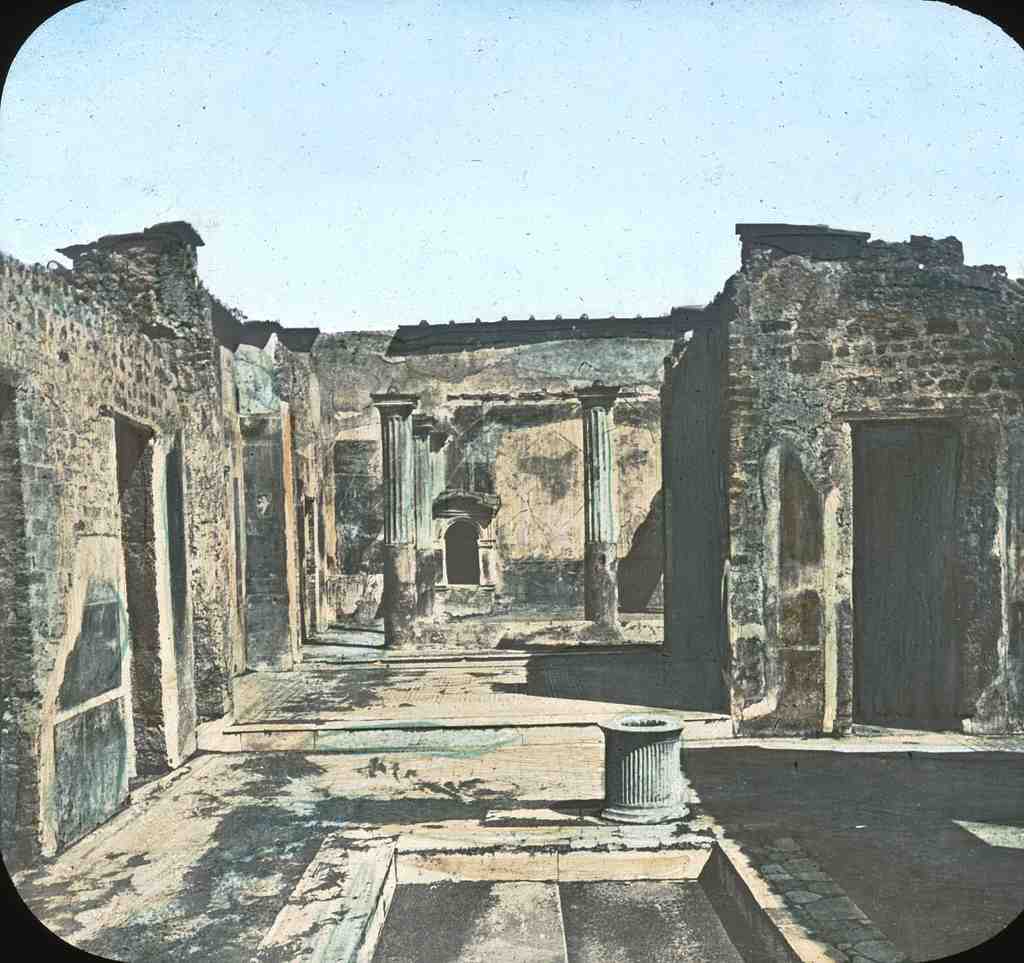
Discovered in 1824 by archaeologist Antonio Bonucci, this house has fascinated scholars and writers for generations. Although the size of the house itself may not be extraordinary, its interior decorations are of the highest quality, surpassing many other frescoes and mosaics found in ancient Pompeii. This has led to much speculation about the lives of the homeowners.
Unfortunately, little is known about the family who once resided here, as they were likely victims of the devastating eruption of Mount Vesuvius in 79 AD. The House of the Tragic Poet is located in Regio VI, Insula 8, which is the far-western part of Pompeii. It faced Via di Nola, one of Pompeii's largest streets, linking the forum and the Street of the Tombs. Just across from the house, you can still see the Forum Baths of Pompeii.
Similar to many Roman homes of that time, the House of the Tragic Poet is divided into two main sections. The front part facing south is a public space, possibly used as shops or servants' quarters. Two large rooms with outward-opening walls flank a narrow vestibule, leading to the atrium. The atrium is the most decorated room in the house and features a rectangular impluvium, a sunken water basin that collected water for household use. At the end of the hall stands the tablinum, another open space.
From these central areas, smaller private rooms branch out, marking the second section of the house. Along the western wall of the atrium, you'll find several bedrooms called cubicula. There is also an ala, a service area for a dining room, and an oecus, a small dining area. The northern end of the tablinum opens onto a spacious peristyle, a garden courtyard. To the right of the peristyle is the drawing room, believed to have served as the main dining salon, and nearby, a small kitchen area. On the left side of the peristyle, you'll find a back door that opens onto another street. At the northwestern corner of the peristyle, a small shrine known as the lararium was dedicated to the family gods and contained a marble statuette of a satyr carrying fruit.
Although an upper story was once part of the House of the Tragic Poet, it was most likely destroyed by the eruption of Mount Vesuvius. Fortunately, more than twenty painted and mosaic panels were originally present in this house. Six of them have been relocated to the National Archaeological Museum in Naples, Italy. These panels were chosen because they relate to the Iliad, which led to the house being called the Homeric House or Iliadic House.
As you explore, you'll notice that the vestibule floor features a mosaic depicting a domesticated dog leashed and chained to a point, accompanied by the words "CAVE CANEM," meaning "Beware of the dog." This served as a warning that visitors should proceed with caution and respected the privacy of the more intimate areas of the home. The rest of the vestibule floor showcases a checker-like pattern with black and white tiles.
The House of the Tragic Poet is truly a sight to behold, with its remarkable art and fascinating history. Let's continue our journey through Pompeii and discover more of its wonders!


