
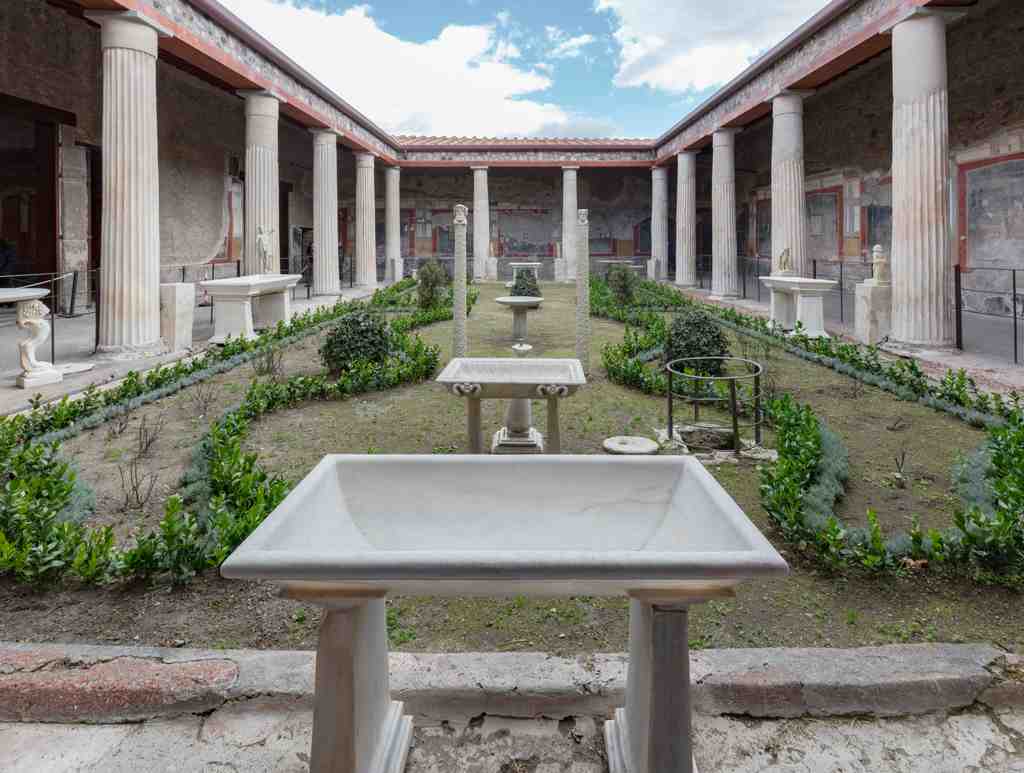
As we explore this magnificent site, you'll notice that the careful excavation of the House of the Vettii has allowed us to admire almost all of its original wall frescoes. These vibrant artworks were completed after the destructive earthquake of 62 AD and are considered prime examples of the Pompeiian Fourth Style, as described by art historians.
Situated in region VI of Pompeii, near the Vesuvian Gate, the House of the Vettii stretches across the entire southern section of block 15. Its layout adheres to the typical Roman domus design, with one fascinating exception-the absence of a tablinum, a central reception room found in most homes of this period.
The house can be divided into five major sections: the large atrium, the small atrium, the large peristyle, the small peristyle, and the shop. Along with its spacious garden, the House of the Vettii boasts main living quarters and servant quarters, each carefully organized around their designated areas.
To enter the grand atrium, we can access the house through the main entrance located on the east facade, from the Vicolo dei Vettii. Alternatively, the southern facade offers a second entrance from the Vicolo di Mercurio. Marvel at the five small windows on the east side, two narrow vertical windows on the south side, and a single small window on the west side, allowing a play of light and shadow throughout the house.
The large atrium, surrounded by four cubicula (or bedrooms), was likely occupied by the main residents of this opulent dwelling. Alae, or smaller rooms, and a winter triclinium, or dining area, also encircle the atrium. Passing through the fauces and vestibulum, we can immerse ourselves in the splendor of the atrium.
On the north section of the house, we find the small atrium, which was likely used by servants and for storage purposes. Nearby, a kitchen contains a cubiculum designated for the cook, while an impluvium efficiently collects rainwater through an opening in the roof. Although the second floor no longer remains, a staircase once stood in the southeast corner of the small atrium.
The second service area of the house connects to the main atrium and the second southern entrance. Here, a grand gate leads to the shop, also known as the taberna. This space was used to accommodate draft animals, which arrived through the gate, and was adjoined by an additional chamber and a latrine.
From the main entrance, the large atrium provides a splendid view of the rear garden, surrounded by the grand peristyle. Within this area, two triclinia, an oecus (a formal room), and two storage rooms overlook the peristyle. Many of the rooms in the House of the Vettii open directly to either the front hall or the serene rear garden.
Located to the north of the house, the small peristyle is accompanied by a triclinium and a cubiculum. One striking feature of the House of the Vettii is the absence of a tablinum, making it quite unique among its contemporaries.
As we wander through this extraordinary house, take in the breathtaking frescoes that adorn the walls. The House of the Vettii boasts twelve surviving panels depicting enchanting mythological scenes. These frescoes provide a glimpse into the remarkable blending of previous Pompeiian artistic styles. On the lower section of the walls, you'll notice a ring of faux colored marble reminiscent of the First Pompeian style. Moving upward, illusionistic scenes are depicted in the top ring, alongside the mythological imagery borrowed from the Second style. Finally, observe the slender columns supporting the upper ring, which derive from the Third style, known for its architectural trompe l'oeil.


