
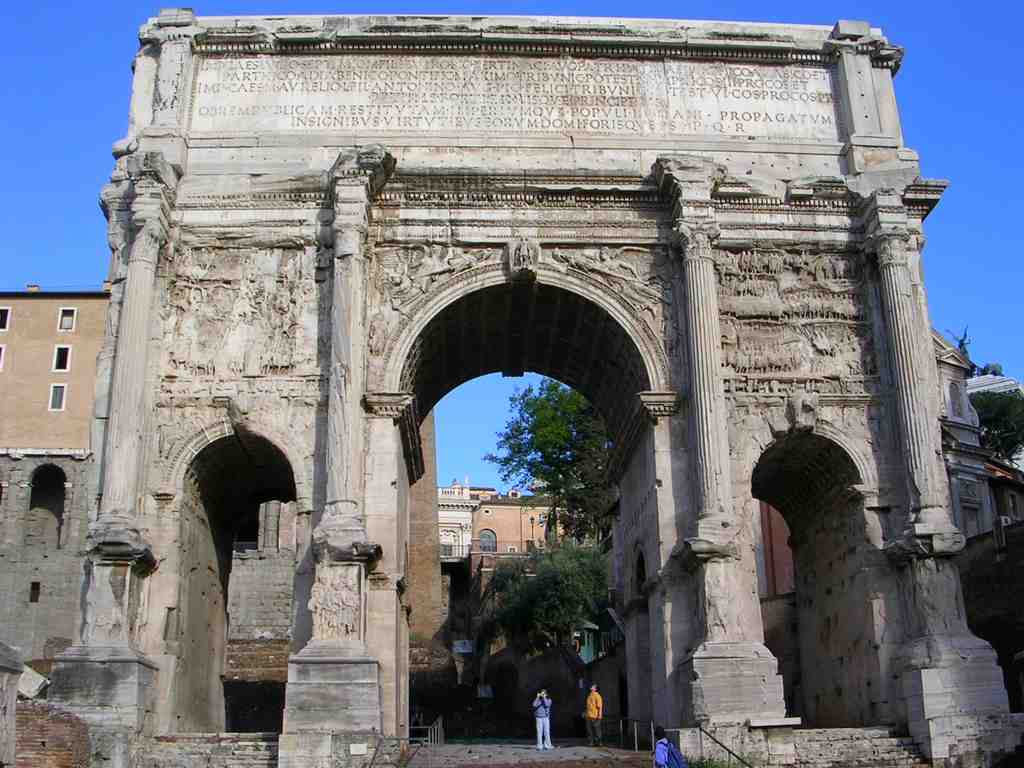
To spot the Arch of Septimius Severus, just look straight ahead for a massive, pale marble arch looming over the ancient Forum-with three passageways, richly carved reliefs, and columns, topped by a long band of large, ancient Latin letters that practically shout “I’m important!” at everyone walking by.
Now that you’re standing in front of this epic stone gateway, let’s travel back nearly two thousand years. Imagine the year is 203 AD. Rome is buzzing, and a brand new monument just popped up at the northwestern edge of the Forum-a glistening white marble arch, so tall it nearly brushes the clouds! This is the Arch of Septimius Severus, triumphal in every sense. It was built to celebrate one of Rome’s “mic drop” moments: the smashing victories of Emperor Septimius Severus and his two sons, Caracalla and Geta, over the Parthians in not one, but two epic campaigns.
Back then, the arch was raised a bit above the street level with grand stone steps leading up to a central archway-an entrance so elegant that even a Roman emperor might’ve tripped on purpose just so he could soak up the applause. The core of this arch is about as sturdy as Roman ambition, with three archways resting on enormous piers. Flanking each pier are columns-Corinthian and impressively carved-while flying winged Victories swoop down from the upper corners, almost as if they're carrying Rome’s reputation on their feathery backs.
Look for four large sculpted panels above-the “attic” part of the arch-where sculptors worked day and night to carve scenes of brutal battles and proud moments. Down each passageway, there are panels showing the glory of war: Romans fighting foes in distant Mesopotamia, cities under siege, emperors handing out rewards, and maybe even a king on his knees begging for mercy. Underneath the Victories, you’ll spot the four seasons personified, and scattered at ground level, the gloomy, shackled faces of defeated enemies-just in case any visitor forgot who ruled the world.
Here’s an ancient twist worthy of the best Roman soap operas: Septimius Severus’ sons, Caracalla and Geta, started as partners in power. But after dear old dad died, Caracalla decided to turn “brotherly love” into “brotherly shove”-straight to Geta’s doom. As if murder wasn’t enough, Caracalla then made sure to erase Geta’s very memory. All inscriptions mentioning Geta? Chiseled out. His face in marble? Gone. It’s the ancient Roman version of blocking someone on social media-except a lot more permanent!
Back to the arch itself: it wasn’t just for show. It was a proud announcement-an imperial propaganda billboard, if you will. The Severan dynasty just loved building arches, and this beauty, along with others like it in Libya, shouted their victories to every Roman who passed through. Not only that, the original top of the arch sparkled with bronze statues-imagine Severus and his sons, larger than life, riding a four-horse chariot, with bronze soldiers at their sides, glinting in the sun. You could see the whole scene reflected on local coins, spreading their fame to every corner of the Empire.
Close your eyes and listen-can you imagine the sound of boots on ancient stone, the rumble as a triumphal procession passes beneath this very arch, the cheers echoing off marble and travertine? With its blend of marble types, precise cuts, and artistic teamwork (it was a real sculptor relay race!), this arch was meant to last through the ages. Even the letters of the main inscription were once covered in gold, and on the brightest afternoons, they would glint so brilliantly you could barely read them. The words dedicate the arch to Severus and his sons-well, one son, at least, after Caracalla’s edits-with a line that essentially says: “Hey Romans, your empire just got bigger, thanks to us!”
Over the centuries, the arch suffered-the fires, pollution, even a medieval tower slapped right on top! At one point, almost the whole arch was buried, only the top visible above centuries of mud and debris. But that just kept it safe, and today, here it stands, battered but unbroken, with the story of Rome’s ambition, rivalry, and, let’s face it, a bit of ancient family drama, carved into every corner.
Interested in a deeper dive into the description, materials or the decoration? Join me in the chat section for an insightful conversation.




