
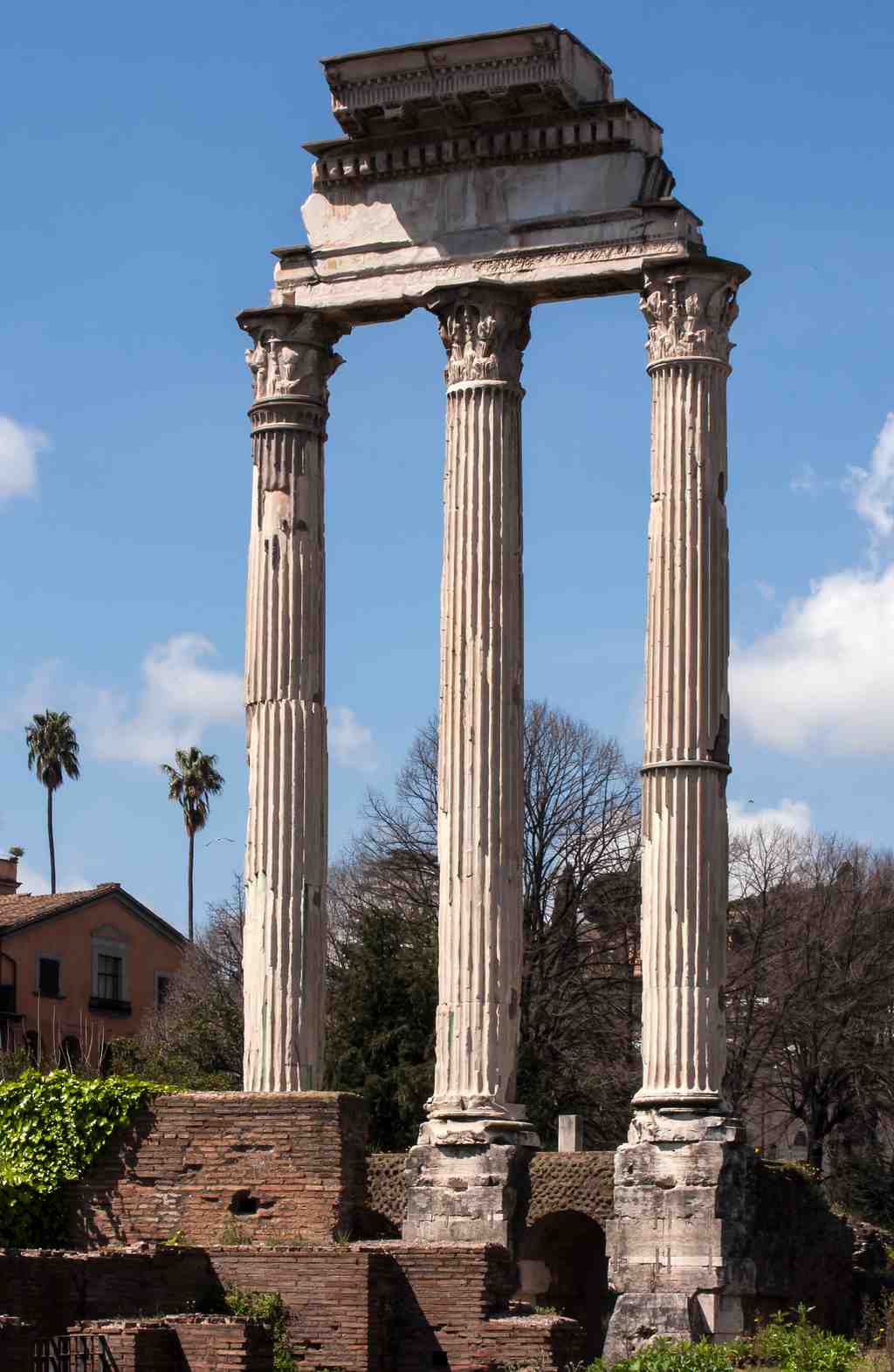
To spot the Temple of Castor and Pollux, look ahead for three towering, elegant columns standing side by side, topped with ornate stonework-they rise dramatically from a brick podium in the Roman Forum, like ancient fingers pointing straight up to the sky.
Alright, traveler, park yourself right here and let’s step back in time-back before Instagram, gladiators, or even Julius Caesar had made their mark. You’re now staring at what’s left of the Temple of Castor and Pollux, but believe me, the story still packs a punch, even if the building’s down to only three tall columns. Imagine these columns as survivors from a wild party-everyone else left ages ago, but these three just won’t quit!
Picture the year 495 BC: Rome is young, scrappy, and under threat by its wicked last king, Tarquinius Superbus, and a bunch of angry Latins. Right before a crucial battle at Lake Regillus, the Romans are feeling desperate. Their top leader, Aulus Postumius, makes a wild promise: “Hey, gods Castor and Pollux-if you help us beat these baddies, I’ll build you the finest temple smack in the Forum!” Never underestimate the motivating power of real estate.
Now, legend says Castor and Pollux, the original superstar twins of Greek mythology-sons of Zeus (or Jupiter if you’re keeping it Roman) and the famously beautiful Leda-magically appeared in the heat of battle, riding white horses, stirring up dust and courage in the Roman lines. The Romans win, and before you could say, “Did you just see that?” the twins pop up again, this time in the Forum, right on the spot where you’re standing. They water their horses at the spring of Juturna like two regular folks, cool as cucumbers, and announce the victory. The crowd goes wild, and Rome’s love affair with these horse-riding heroes kicks into high gear.
Fast forward to the temple’s dedication on July 15, 484 BC, a public holiday full of celebration and promise. But this place isn’t just a grand monument to two handsome gods-it’s got civic swagger, too! This temple becomes a hot spot for senate meetings, official speeches, and storage for the state’s all-important weights, measures, and even treasury. Under the temple, tucked away between foundation stones, someone set up a dentist’s office-I guess even senators had toothaches.
But Rome is nothing if not a city of do-overs. Time after time, the temple burned or was battered, then built back up, larger and fancier each time. The most grand version came courtesy of Emperor Tiberius, who rebuilt the temple in 6 AD after a raging fire. The remains you see-the three stoic columns-mostly date from his era, except for the podium, which hails from the days of Metellus, a victorious general before Rome had emperors.
This was no ordinary spot. Every July 15, the Forum shook to the thunder of thousands of hooves-a massive parade of 5,000 young men, glinting with shields and spears, led by two on white horses (guess who they represent?). Romans never missed a chance for a good show, and that cavalry parade was the blockbuster event of the summer.
As Rome evolved into empire, the cult of Castor and Pollux got a royal upgrade. At one point, Augustus flirted with comparing his own chosen heirs to these twin demi-gods-talk about pressure to live up to your PR! When those heirs sadly died, the torch passed to Tiberius and his brother Drusus, who stepped into the divine twins’ golden sandals (well, metaphorically).
Through it all, the temple stood as a witness to senate intrigues, moments of rebellion, and probably a fair share of late-night debates about tax collection-history isn’t always heroic. Even Edward Gibbon, the famous historian, whispered about secret schemes unfolding right here as the Roman elite plotted who would rule next.
But, of course, nothing lasts forever. With the passing centuries, the temple fell to ruin. By the 1400s, only these three columns remained, famous enough to lend their name to the street: via Trium Columnarum. In the 1700s, even these veterans wobbled, so scaffolding went up, and curious architects climbed for a better look-one even called them the finest model of Corinthian style in the world.
So, as you gaze up at them now, imagine all the drama-victories, legends, royal ambitions, and the steady march of time-passing beneath their silent, watchful gaze. Not bad for three columns, right? And to think, once upon a time, all you needed to get a temple built was to promise it to a couple of heroic twins-and actually deliver! Alright, onward, let’s trot to our next stop-but perhaps we’ll walk, not ride horses.
Ready to delve deeper into the founding, architecture or the archaeology? Join me in the chat section for an enriching discussion.




