
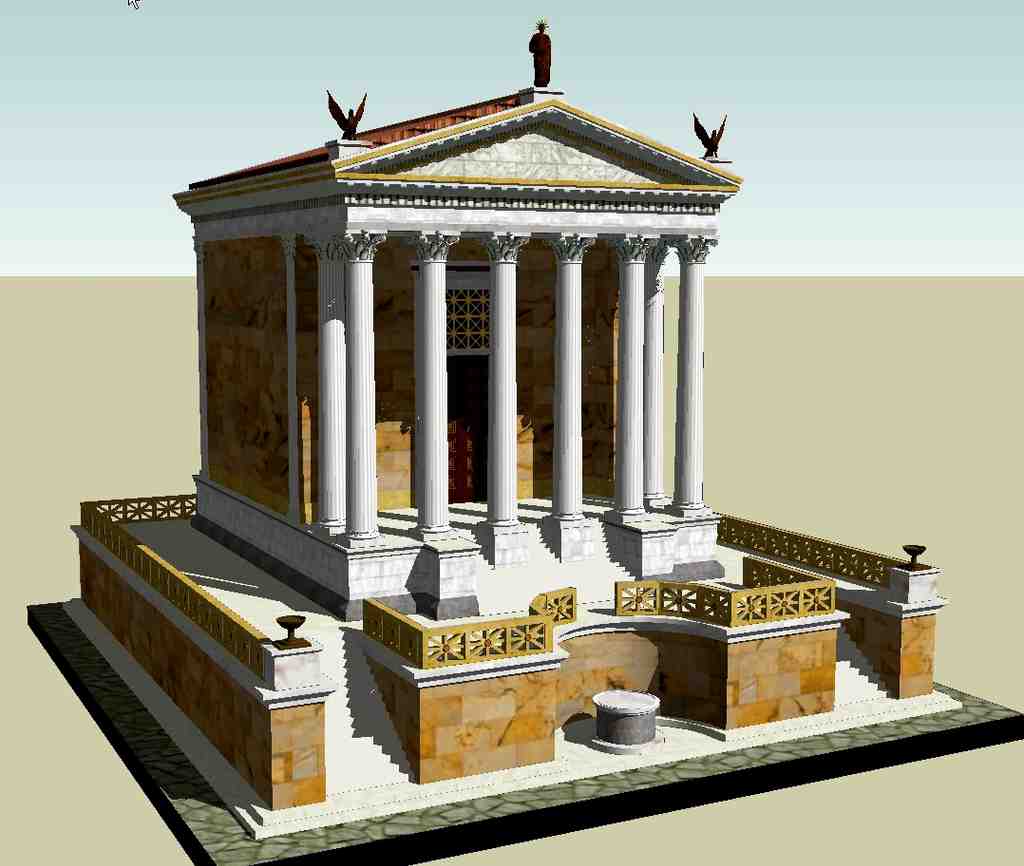
Straight ahead, you’ll spot the Temple of Caesar by looking for a raised marble platform with grand white columns, intricate golden accents, and statues perched above the roofline-standing out right in the center of the Forum.
Alright, let’s take you back to one of the most dramatic days in Roman history-right here, at the Temple of Caesar, also known as the Temple of the Comet Star. The air would have been buzzing with tension in 44 BC, soon after Julius Caesar’s assassination. Picture yourself in a sea of anxious Romans as Caesar’s supporters swept his body through these ancient streets, not to the planned, quiet burial in the Campus Martius, but right into the very heart of the city-the Forum. The old Regia, once the royal headquarters of the Pontifex Maximus, loomed nearby, hinting at Caesar’s almost kingly status.
As crowds gathered, a rousing speech by Mark Antony lit the crowd like a spark to dry leaves. Suddenly, all plans fell apart and, in a sudden, feverish moment, the body was laid out here on an ivory couch, flames flickering as two mysterious figures appeared, swords drawn, setting it alight with torches. The mob joined in, tossing branches, benches, even actors’ robes and soldiers’ weapons into the surging fire. Women threw in children’s amulets and their own precious jewels-Rome had never seen anything quite like this!
But the drama didn’t stop there. A comet unusually bright, streaked across the Roman sky for seven days-daylight visible, even! It was soon known as Caesar’s Comet, or the Sidus Iulium. Romans saw this as a sign that their beloved Julius had joined the gods, and coins soon carried a star to cement his divine status. You could say Octavian, Caesar’s heir (and future Augustus), got some excellent publicity-like a cosmic thumbs up from Grandpa.
In the following months, crowds refused to let Caesar’s memory die. The first makeshift monument appeared here. Soldiers, politicians, and even ordinary Romans swore oaths of loyalty facing the spot where these flames had burned, gathering to remember, to mourn, and sometimes, to rally in political unity. Within a couple years, Octavian, Antony, and Lepidus-an odd trio if there ever was one-decreed a proper temple for the now "Divine Julius." But as it turned out, politics on a Roman scale is slower than building a modern Italian motorway. The work dragged on until Octavian alone finished the job in 29 BC-he celebrated with a monstrous parade after his victories over Antony and Cleopatra. Give him points for timing, right?
The temple’s design was just as bold. Resting on this high podium, it became the perfect platform for fiery speeches and public gatherings. Imagine the sounds of politics echoing under the Roman sun as orators boomed from the rostra, which was decorated with the beaks of ships taken from the famous naval victory at Actium. Later, emperors and their families would use it for festivals, funeral orations, and to show off spoils from their campaigns. Talk about multitasking-divinity, memory, and a bit of showmanship all packed into one spot.
Inside, the temple held treasures to rival any museum: marble columns-maybe Corinthian, maybe Ionic, as the scholars still bicker about it-a famous painting of Venus rising from the sea, lush floral decorations, and a colossal veiled statue of Caesar himself, lituus in hand and a shining star crowning his head. With an open door, the statue gazed directly onto the Forum, keeping an eternal and perhaps judgmental eye on the Roman people.
Decades and centuries rolled by. Fire nearly destroyed the temple under Septimius Severus, but it rose again, Phoenix-like, restored and shining. When late medieval Rome came calling for building material, much of the temple was carted off for fresh construction, leaving only the cement core that you see today. Still, this bit of ancient stone remains a magnetic place-every March 15th, visitors lay flowers here to mark the anniversary of Caesar’s death, honoring a story that somehow manages to combine mystery, tragedy, political theater, and just a touch of celestial magic all in one historic square. If you find yourself inspired, just remember-no need to leave your jewelry in the fire!




