
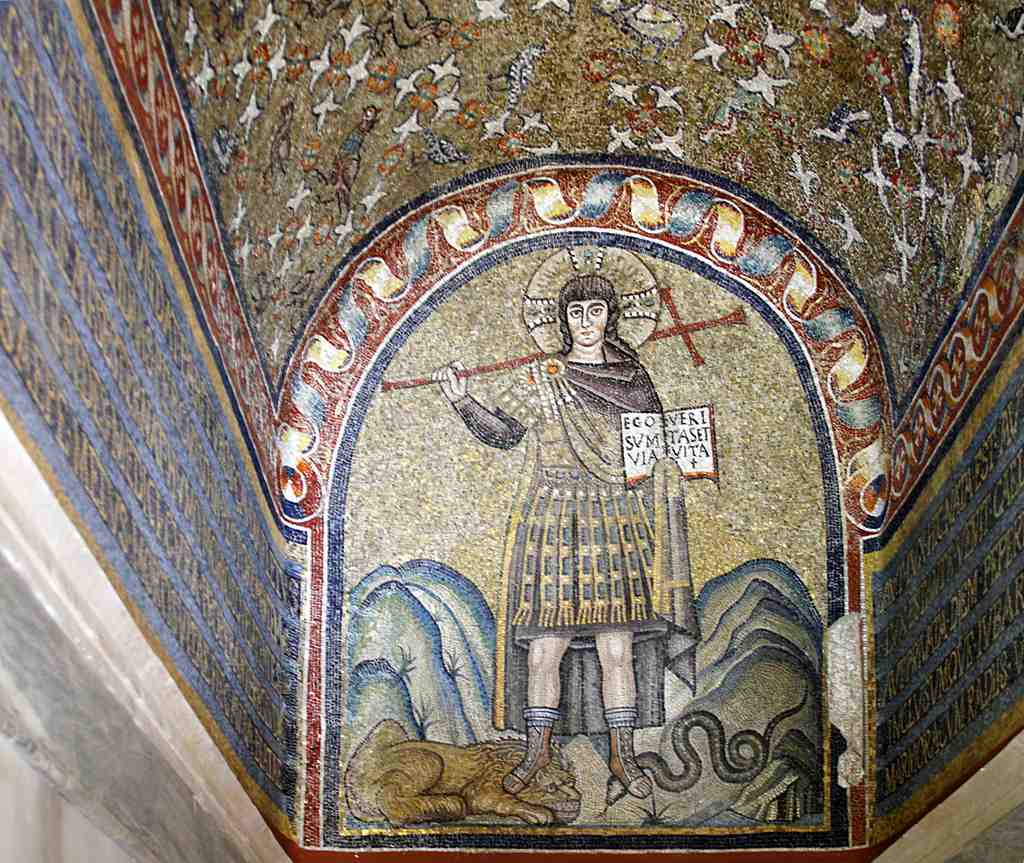
Look for a rectangular mosaic image with a gold ground, a haloed young Christ in military dress, and the unmistakable sight of a lion and a serpent beneath his feet.
This small image unlocks an enormous part of Ravenna.
What you are meeting here is militant Christ imagery: a triumph image rooted in Psalm ninety-one, where the faithful sing that the holy one will tread on the lion, the serpent, the asp and the dragon. In plain terms, the beasts stand for evil, and Christ does not merely survive it. He masters it.
In Ravenna, that idea gained real bite. The most famous early version appeared here in the city in the sixth century, in the Archiepiscopal Chapel. There, Christ stands frontally, calm rather than frantic, beardless, with a cross halo behind his head. He dresses not as a suffering victim but almost as a general or emperor. One hand opens a book with the words from Saint John: “I am the way, the truth and the life.” The other supports a cross over his shoulder. Under his feet: a lion and a serpent, already defeated.
Now the secret within the image. Bishop Peter the Second almost certainly chose that mosaic during the reign of Theodoric the Great, whose Ostrogothic court followed Arian Christianity. Arians accepted Christ as exalted, but denied that he shared fully in the divine being of the Father. Peter stood for the rival position, the one the wider church would defend as orthodox. So this was never just decoration. It was a theological argument in glass and gold. Christ trampling the beasts declared that false teaching itself had been put under his feet.
That is why Ravenna matters so much. You have already seen how one ruler, one bishop, one community after another tried to leave its mark. Here the argument becomes explicit. An image becomes a weapon, though a beautifully controlled one.
The verse itself lived in prayer as well as art. Monks sang it at Compline, the last office before sleep, and the Roman liturgy used it on Good Friday. So when viewers saw Christ over the beasts, they recognised words they had heard with their own ears. Scripture, worship, politics and image all locked together.
From Ravenna, the subject travelled. Carolingian artists carved it on ivory book covers. Anglo-Saxon sculptors cut it into stone crosses such as Ruthwell and Bewcastle. Later artists sometimes sharpened Christ’s cross into a spear and drove it toward the serpent’s mouth. Yet a quieter reading survived too: some scholars think a few rare versions show the beasts recognising Christ rather than being crushed by him. Even in triumph, the meaning could shift.
And that, perhaps, is Ravenna’s genius. Nothing here says only one thing. Every sacred image carries prayer, power, memory and dispute at once.
In a moment, as you head to the Cathedral of Ravenna, keep this in mind: the next building is not simply another church. It is the seat from which bishops turned images like this into public truth for the city.




