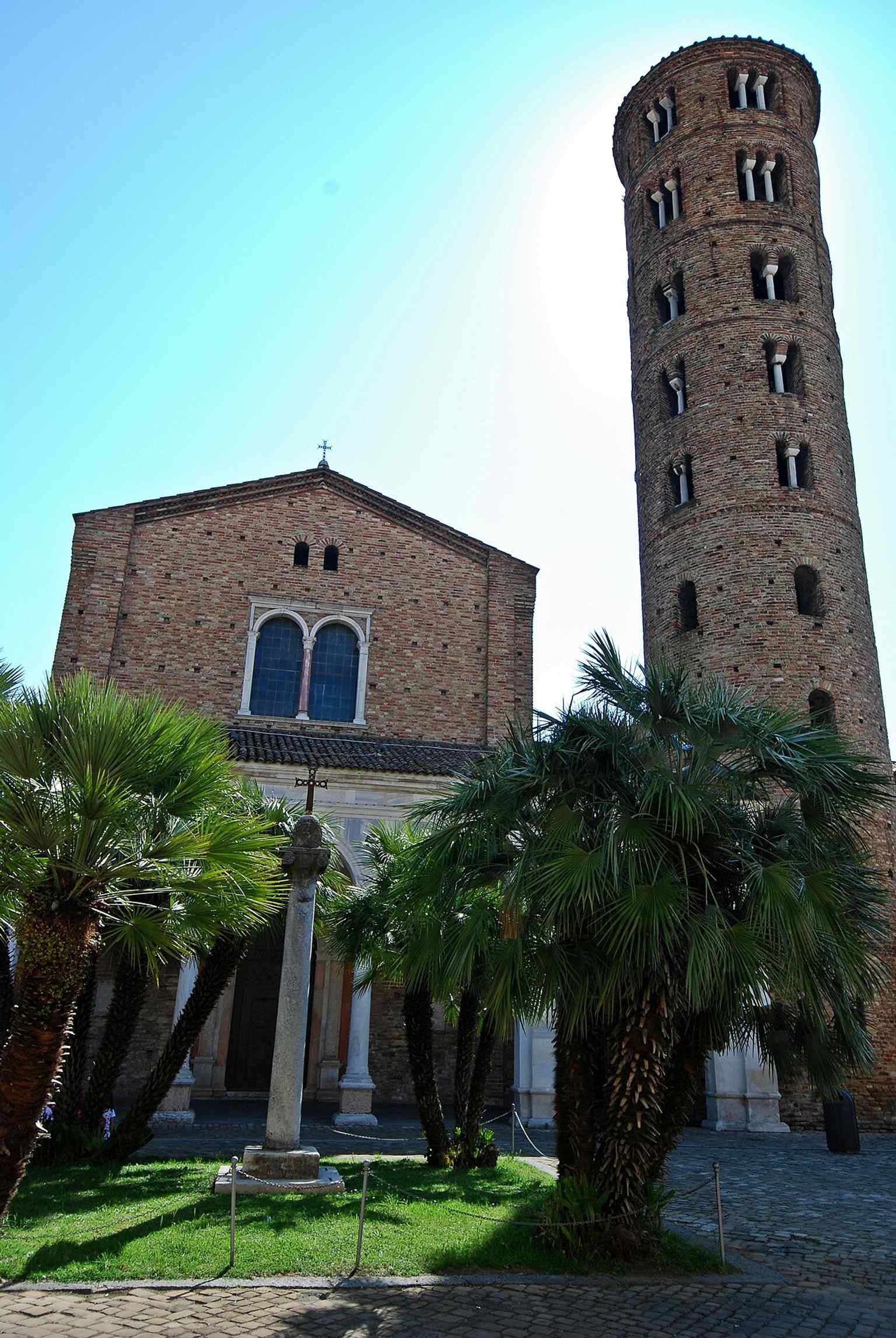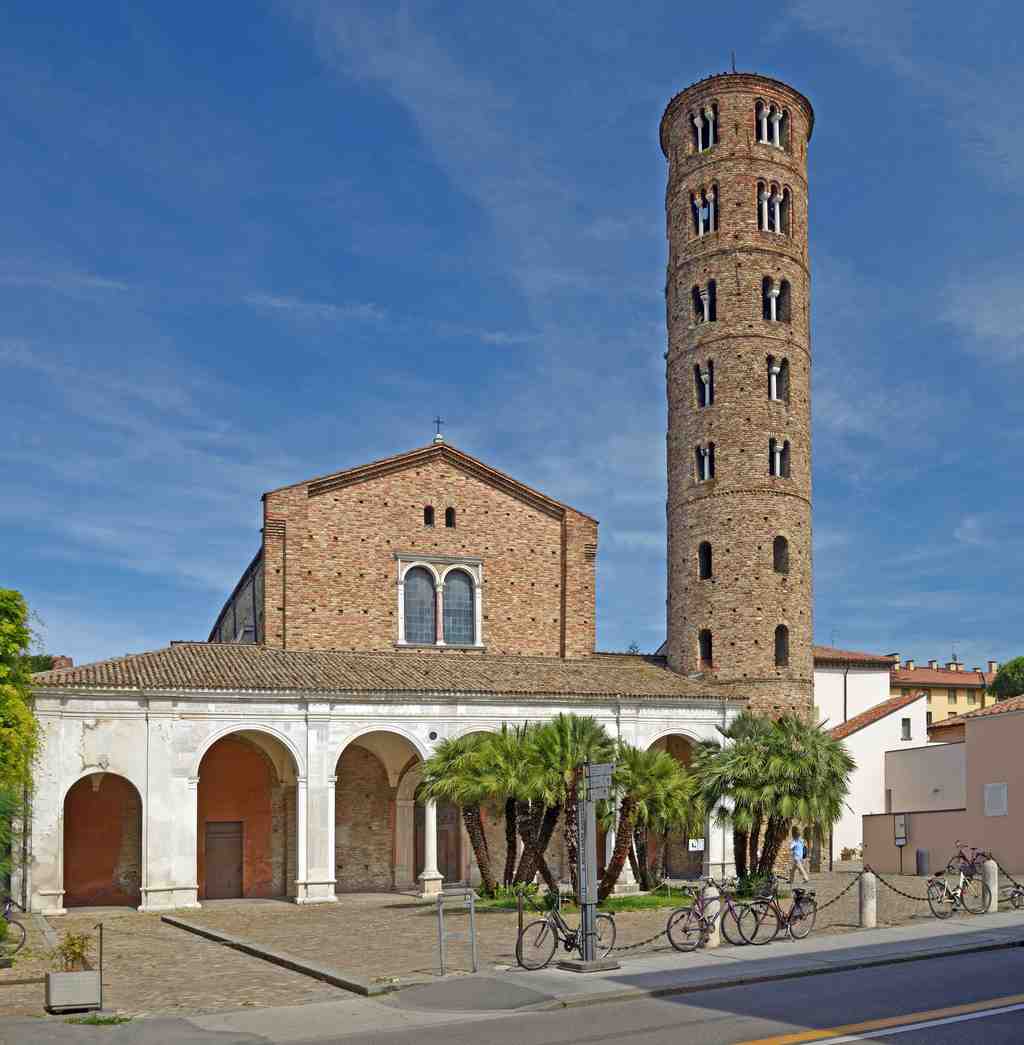
On your left is a long brick basilica with a simple gabled front, a white marble portico, and a cylindrical bell tower rising beside its right edge.
Sant'Apollinare Nuovo looks almost restrained from outside, and that is part of its seduction. This plain brick body once served as the palatine chapel of King Theodoric the Great - a palatine chapel meaning the private ceremonial church of a ruler’s court, placed deliberately beside his palace so worship and power stood shoulder to shoulder. He raised it in the year five hundred and five for Arian worship, the form of Christianity followed by his Ostrogothic court, and first dedicated it to Christ himself.
The porch in front of you is a later addition, a narthex - the entrance hall of an early church. In Ravenna they call it the ardica. Beyond it lies a basilica plan: a long central hall, called the nave, with side aisles running beside it. If you glance at the image on your screen, you can see that interior stretch very clearly, with marble columns leading the eye forward toward the reconstructed apse, the curved sanctuary end of the church. Now, before we go further, take a moment with the exterior. Notice how long and courtly it feels rather than intimate. Imagine not a parish church, but a royal chapel where ceremony helped a king present his faith as lawful, ordered, and magnificent.
Then the city changed hands, and this church changed sides with it. When Byzantine forces captured Ravenna in the year five hundred and forty, Emperor Justinian did not merely inherit Arian buildings; he confiscated them and handed them to the Catholic Church. Sacred space became a declaration of conquest. Places tied to the Goths were not simply reused, but translated into a new religious and political language.
Here, that transformation had a fierce human agent: Bishop Agnello. He reconsecrated the church to Saint Martin of Tours, a champion of Catholic orthodoxy, and oversaw one of the most revealing visual rewrites in late antique Italy. The upper mosaics survived - scenes from the life of Christ and ranks of prophets - but the great lower band, closest to human eyes, was reworked. New processions of martyrs and virgins advanced across glowing gold backgrounds, while traces of Theodoric’s court were removed.
One fragment escaped complete erasure: the mosaic of the palace scene. If you look at the app image, you can see the architecture remains, but the figures do not. Their bodies vanished in a deliberate damnatio memoriae - a condemnation of memory - and yet tiny clues betray the violence of the edit. Hands still appear on the columns, like ghosts that the victors could not quite scrub away.
Later, the church changed again. After pirate raids threatened the coast in the ninth century, Ravenna brought the relics of Saint Apollinaris here from Classe for safety, and the basilica took the name you know now: Sant'Apollinare Nuovo, the “new” Sant'Apollinare.
So this church offers a deliciously unsettling lesson: even mosaics, which seem eternal, can be revised by those who win. In a moment, we shall walk to the nearby remains of Theodoric’s Palace, barely a minute away, to find the missing half of this royal stage. If you wish to come back and go inside, the basilica generally opens daily from nine in the morning until half past six.