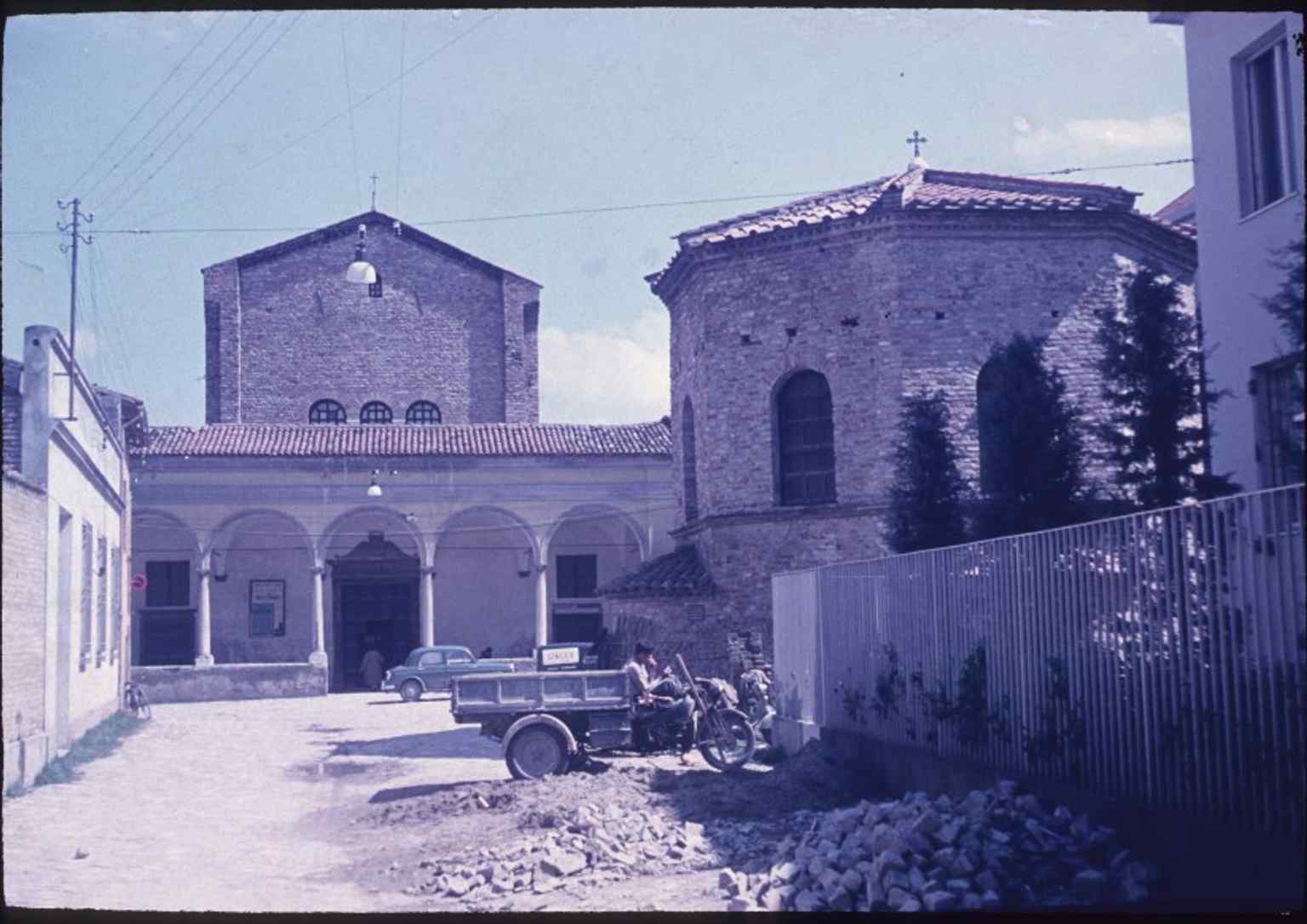
Look for a small octagonal building of warm brick, cut with simple arched openings near the top and marked by its compact, almost fortress-like shape.
At first glance, it seems modest. And that is the delicious surprise. You are standing before the last major surviving baptistery from late antiquity built for Arian worship, a rare witness from a version of Christianity that once had power here, then lost it almost completely.
This little octagon entered Ravenna under Theodoric the Great, an Ostrogothic king who spent his youth in Constantinople as a hostage and came away schooled in imperial manners, politics, and display. When Emperor Zeno gave him Ravenna to rule in the emperor’s name, Theodoric did not simply take a throne; he arranged a capital. He commissioned buildings that made his rule visible, lawful, and sacred all at once.
That matters here because this was never just a lonely shrine. The baptistery stood beside the old Arian cathedral, in a whole Arian episcopal quarter that included the bishop’s residence as well. If you glance at the before-and-after image in the app, you can see how much that setting changed when later streets and surrounding buildings disappeared, leaving the baptistery far more isolated than it once was. Now, a word that shaped lives in this city: Arian. Arian Christians believed Christ, as the Son, was not equal to God the Father in the same eternal way. The Council of Nicaea condemned that teaching as heresy, but Theodoric remained notably tolerant. He did not drive out the Chalcedonian Christians, who followed the teaching accepted at Nicaea. Instead, he gave each community its own sacred spaces. Separate baptism mattered because baptism was not a private preference; it marked belonging, loyalty, and the social body of the city itself.
So brick and belief lined up on the map. One community baptized here, another elsewhere. Power in Ravenna often announced itself by redrawing where people prayed, entered the faith, and gathered under a bishop’s care.
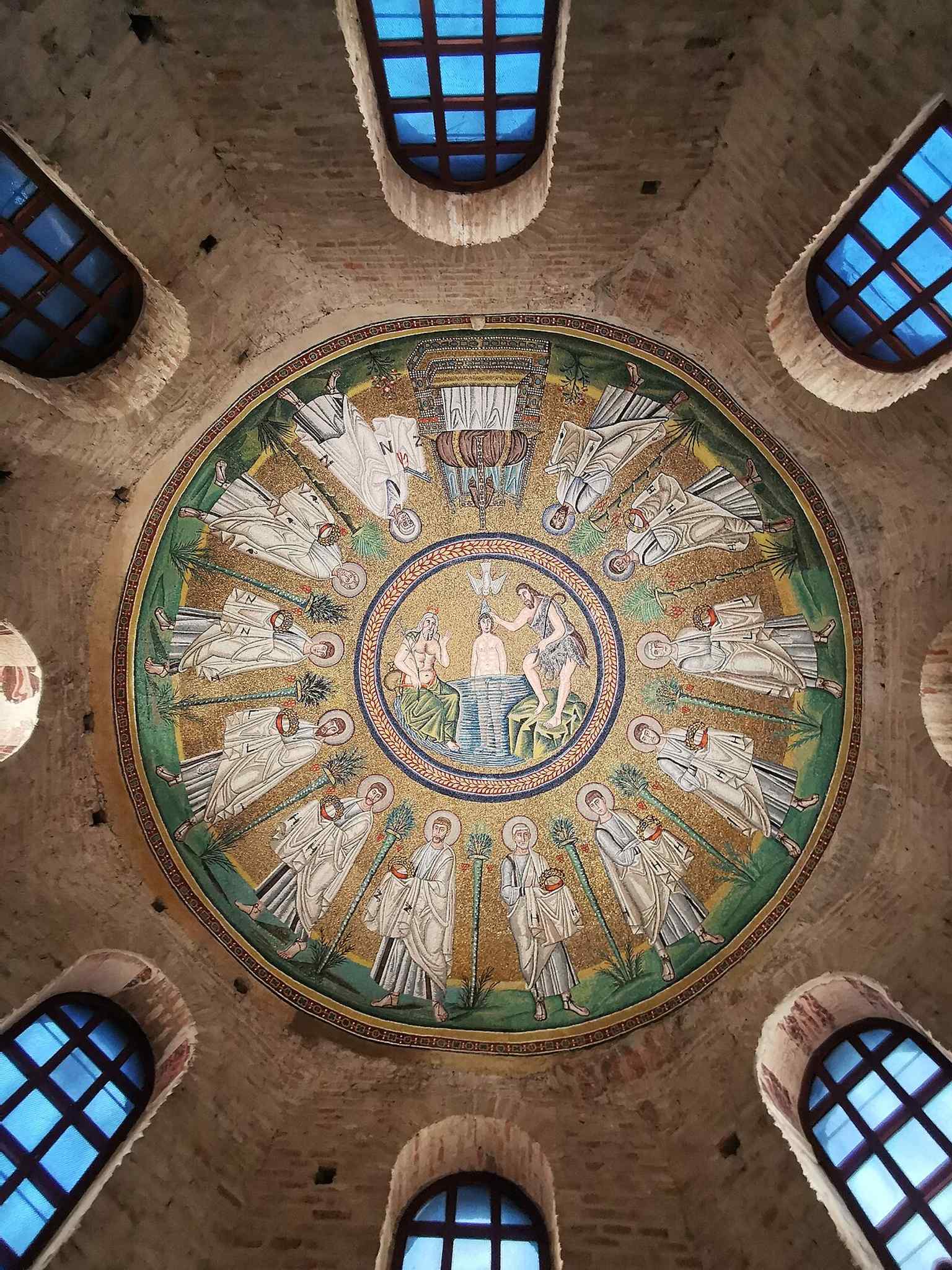
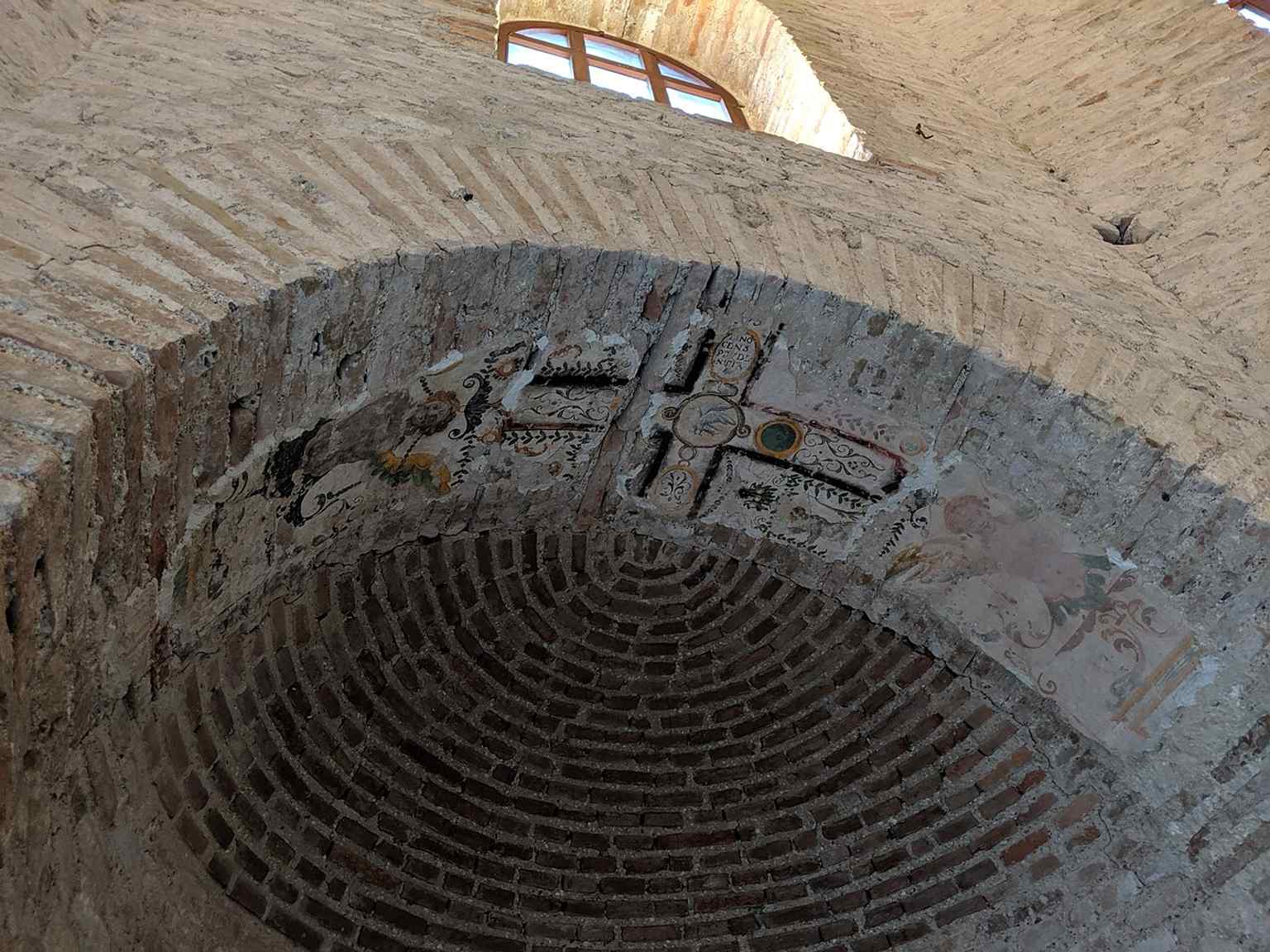
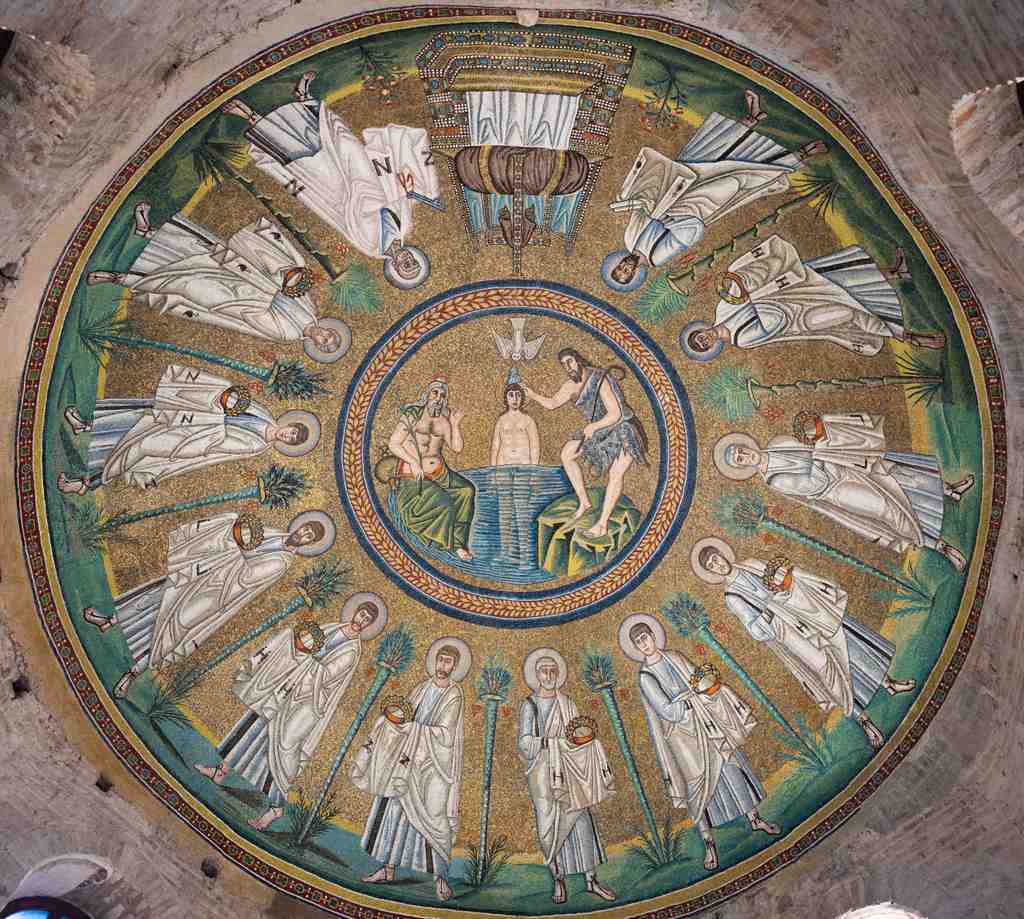
Inside, much has vanished. Archaeologists found roughly one hundred and seventy kilograms of fallen mosaic tesserae on the floor, proof that rich decoration once covered far more than the surviving dome. If you look at the image on your screen, you can see the part that escaped: Christ’s baptism in gold-lit mosaic, with a youthful, beardless Jesus in the Jordan, Saint John in a leopard skin, and even the River Jordan personified as an old pagan-style river god with crayfish claws in his hair. That classical figure is the sort of detail Ravenna loves: a Christian scene carrying an older visual language inside it, as though one age never quite stopped speaking to the next.
After the Byzantine conquest in the sixth century, Archbishop Agnellus and others folded former Arian buildings into Catholic use. This baptistery became an oratory to the Virgin, and its earlier identity softened, then blurred. Later, in the twentieth century, wartime destruction cleared away the buildings that had hemmed it in, and the exterior emerged again as a freestanding monument. Even now, the original floor lies more than two metres below the present street, as though centuries have been quietly piling up around it.
It now belongs to the United Nations Educational, Scientific and Cultural Organization, or UNESCO, but its real power is subtler: it shows how a city can keep changing masters while older convictions still glimmer overhead in glass and stone.
And here is the question to carry with you: when two communities share one city but enter faith through different doors, does architecture preserve peace, or teach separation to endure?
Keep that thought as we head toward the Basilica of Sant’Apollinare Nuovo, about five minutes away, where Theodoric’s Arian world becomes much larger and far more splendid. If you plan to return to go inside, it generally opens every day in the morning, with Friday through Sunday also reopening in the afternoon.