
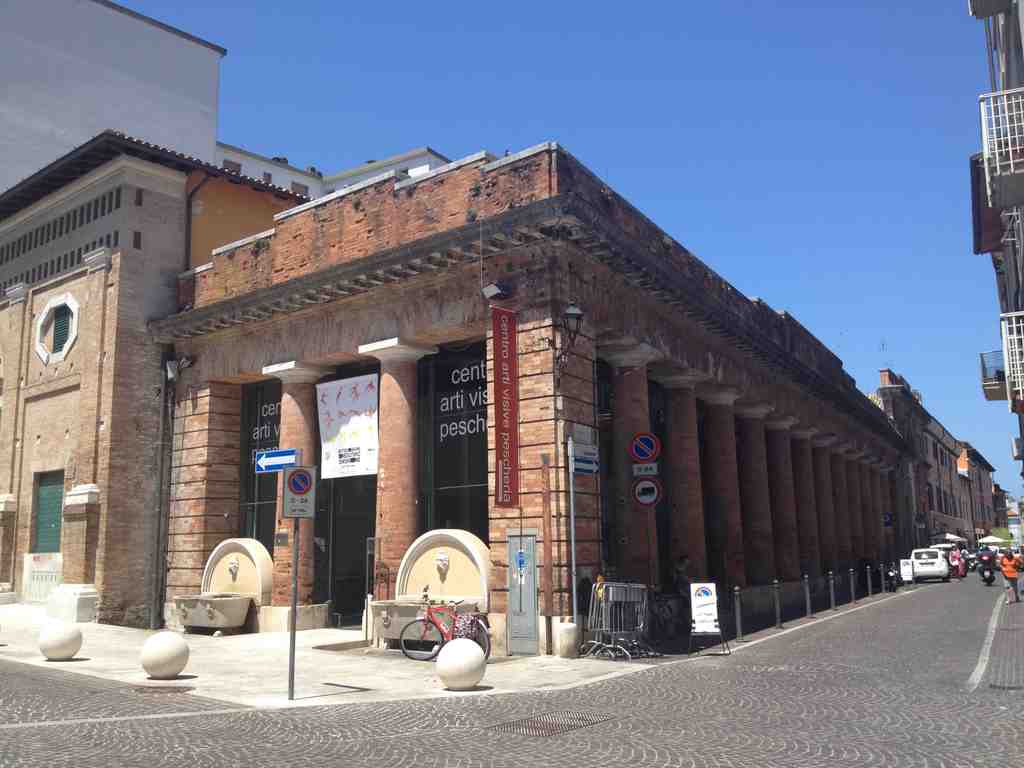
On your left, look for a pale stone neoclassical hall shaped like a small temple, marked by a deep loggia of heavy columns and a crisp triangular pediment.
At first glance, this feels dignified, almost ancient... but this is one of Pesaro’s best acts of reinvention. The Centro Arti Visive Pescheria began life as the city fish market, a practical place of trade, voices, scales, and wet stone. Engineer Pompeo Mancini designed it between eighteen twenty-one and eighteen twenty-three to look like a pagan temple, as if everyday commerce deserved ceremony too.
And the story under the story is even stranger. To make room for this market, the city bought a church, its sacristy, and the confraternity house from the Carnevali brothers in eighteen twenty-one for nine hundred Roman scudi, a substantial sum for the time. Even more ironic, an old catalog from seventeen eighty-three had dismissed that church of the Suffragio with a shrug, saying there was nothing interesting here. Pesaro kept the site anyway... and later turned it into one of the city’s most interesting places.
That is the quiet genius of repurposed places. In Pesaro, buildings do not survive by staying frozen. They survive by accepting a new life. A market becomes an art center, an overlooked church becomes exhibition space, and the city keeps moving forward without throwing its memory away.
In nineteen ninety-six, the city chose this old market for a bold experiment: a low-budget contemporary art center that would prove a provincial city could do serious, ambitious work without grand resources. That was the challenge, almost a dare. He opened the center on the twenty-seventh of July, nineteen ninety-six, with a solo show by Eliseo Mattiacci. If you glance at the image in the app, you can see how the old market still holds that temple-like confidence, even while serving a completely different purpose now.
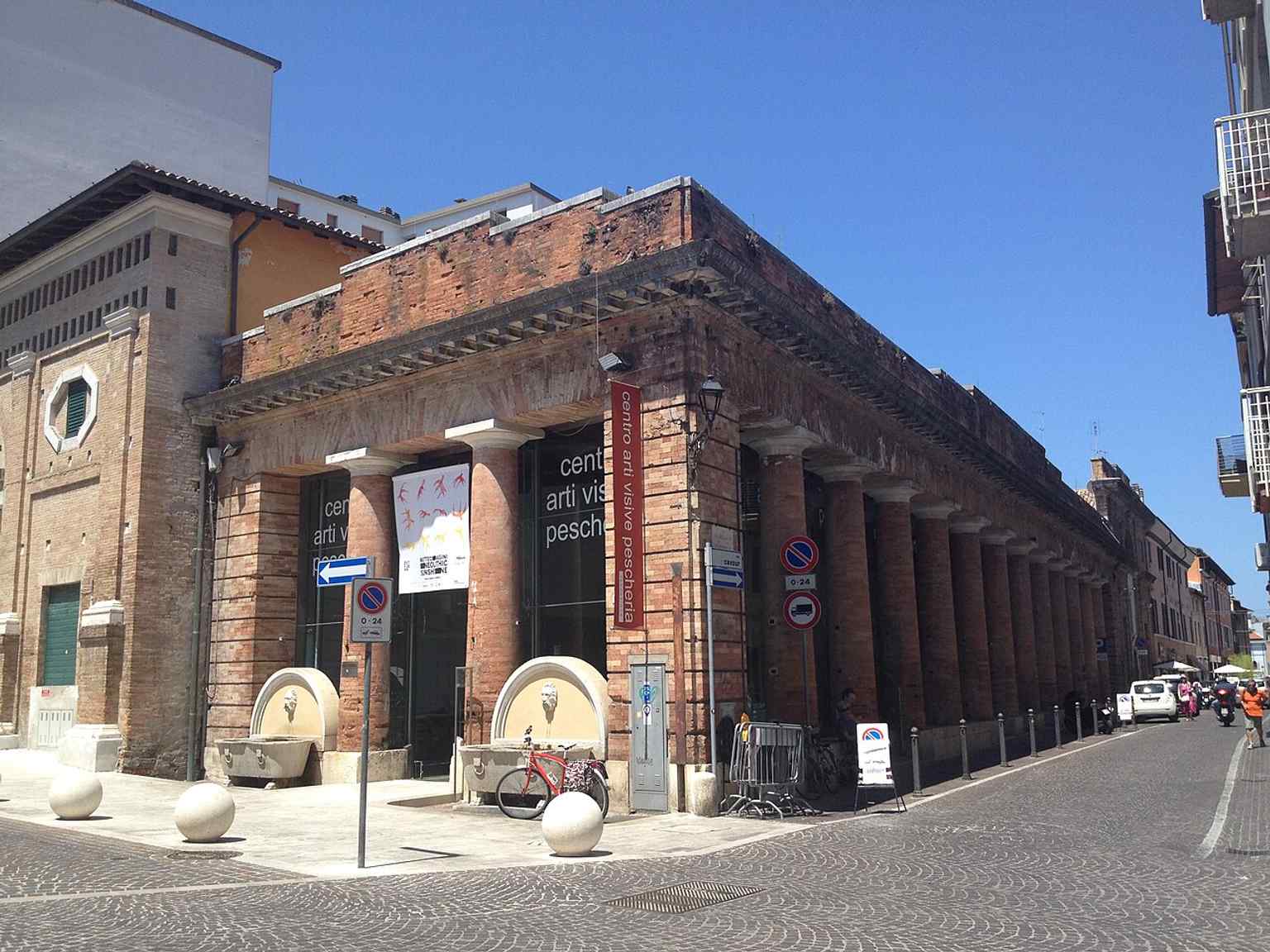
For the first years, the program mostly lived in the summer months. Then the place kept changing. In two thousand and one, the center absorbed the adjacent Church of the Suffragio, a rare polygonal church, and opened that new chapter with Enzo Cucchi’s exhibition Quadri al buio sul mare Adriatico, paintings in darkness on the Adriatic Sea. In two thousand and four, workers enclosed the loggia with glass, solving a simple but important problem: suddenly the Pescheria could stay active year-round.
Here is the question this building asks so beautifully: when a city gives an old market over to contemporary art, is it preserving the place... or teaching it to dream in a new language?
The answer may be both. By two thousand and six, the center had joined A-M-A-C-I, the Association of Italian Contemporary Art Museums, placing Pesaro in conversation with major national institutions. Later came design exhibitions, site-specific works by Jannis Kounellis, and in twenty twenty-four the Pescheria became one of the hubs of Pesaro’s year as Italian Capital of Culture, even hosting Marina Abramović’s mixed-reality work The Life.
So this is the pivot in Pesaro’s story: not nostalgia, but reuse with nerve. And very soon, that same inventive spirit will turn from art to engines, from gallery space to mechanical brilliance, as we head toward the Officine Benelli Museum.
If you want to return inside, the center is usually open Friday through Sunday from four to seven in the afternoon.





