
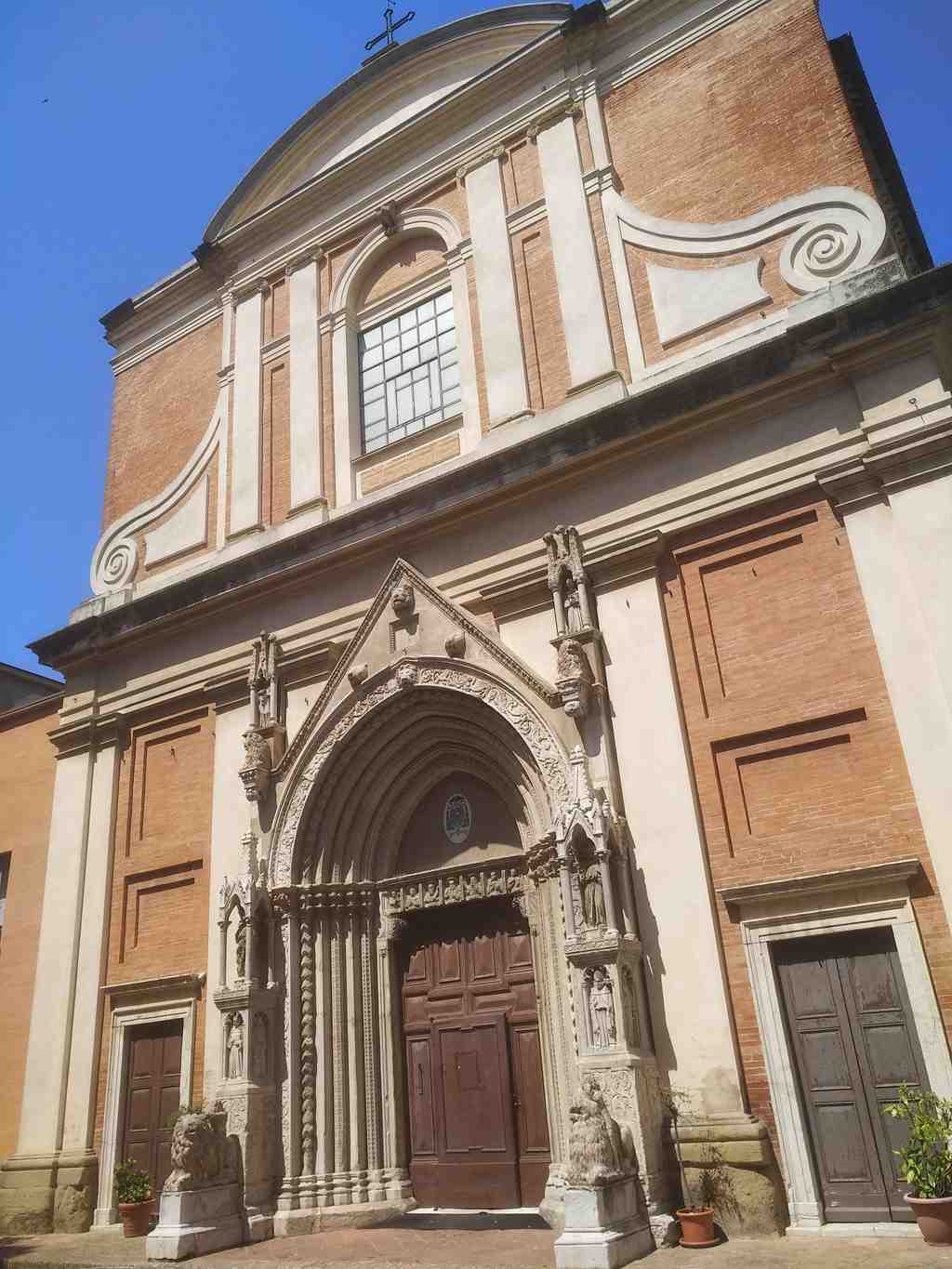
Look for a pale church front cut by a pointed portal of white Istrian stone and red Verona marble, with two stone lions guarding the entrance and a brick bell tower rising beside it.
The first surprise is simple... this church did not begin life as Sant'Agostino. In twelve fifty-eight, the Augustinian hermits raised a Romanesque church here and dedicated it to Saint Lawrence. Then, between the late fourteen hundreds and early fifteen hundreds, the Malatesta family enlarged it in the Gothic style, and the doorway in front of you became the proud announcement of that change.
That portal carries the fingerprint of one remarkable man: Malatesta IV, known as Malatesta dei Sonetti, “of the sonnets.” He was the only son of Pandolfo the Second, a military lord, but he also wrote poetry shaped by Petrarch. You can feel both sides of him here. He and his wife, Elisabetta da Varano, did not commission this entrance only for prayer. They wanted an entrance that spoke of faith, rank, and cultivated taste all at once. So the church received this masterpiece in white stone and red marble, populated with statues in little niches and watched over by heraldic lions... almost like a prince-poet setting the stage before you cross the threshold.
Then the story turns again. In the late eighteenth century, architects Pistocchi and Polinari refashioned much of the church in late Baroque style, and it was reconsecrated in seventeen seventy-six. The name changed slowly too. The Augustinian identity stayed alive through devotion to the Madonna della Cintura, the Virgin of the Belt, tied to the legend that Mary gave her belt to Saint Monica, mother of Saint Augustine. That belt became a sign of the Augustinian order's black robe.
But devotion did not protect the whole complex. In eighteen sixty-one, the state suppressed the convent. Soldiers replaced friars, and for decades the monastery served as a Carabinieri barracks. In nineteen nineteen, workers demolished the convent entirely to build the Chamber of Commerce. Where monks once walked under cloisters, administration took over. After the earthquake of nineteen sixteen, the church lost its right side aisle, and after wartime bombing nearby, restorers repaired the vault in nineteen forty-nine. The parish still carries another wound from the neighborhood: in nineteen forty-three, a mortar shell killed twelve children playing nearby.
So this façade stands as more than a church front. It is a survivor of changing names, changing styles, changing institutions... and still it carries older lives forward. In about three minutes, we’ll see that same pattern again at the Pescheria Visual Arts Center, where another old structure found a completely new voice. If you want to come back inside, the church usually opens from nine to noon and four to seven, with Sunday morning hours from eight to noon.




