
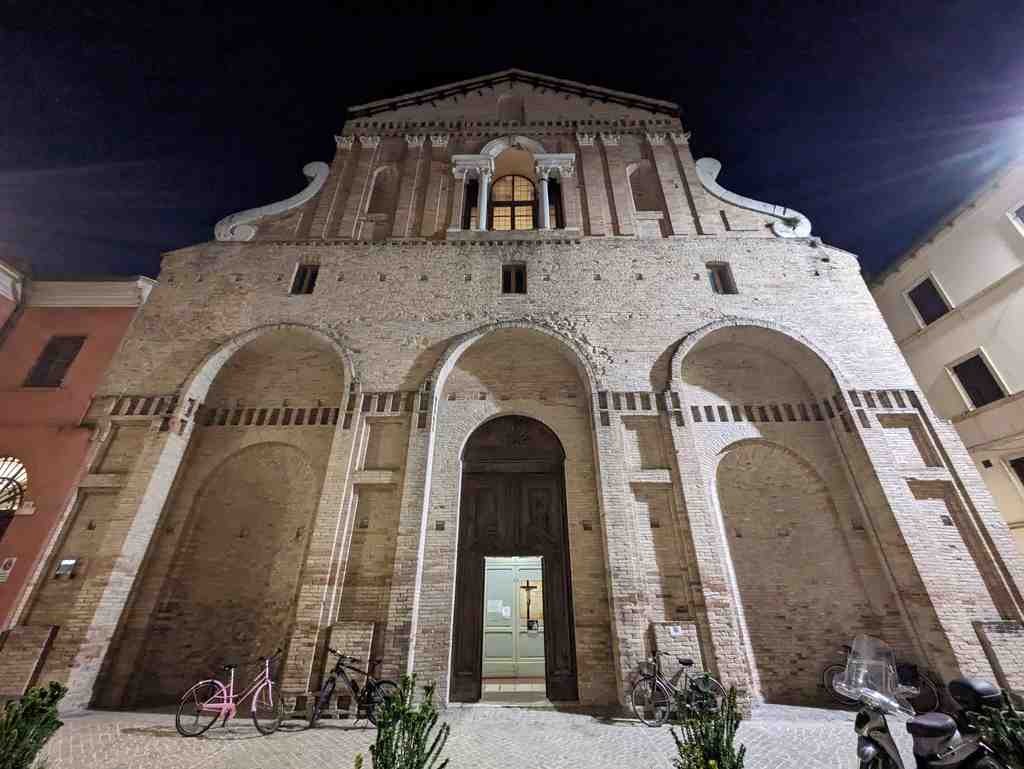
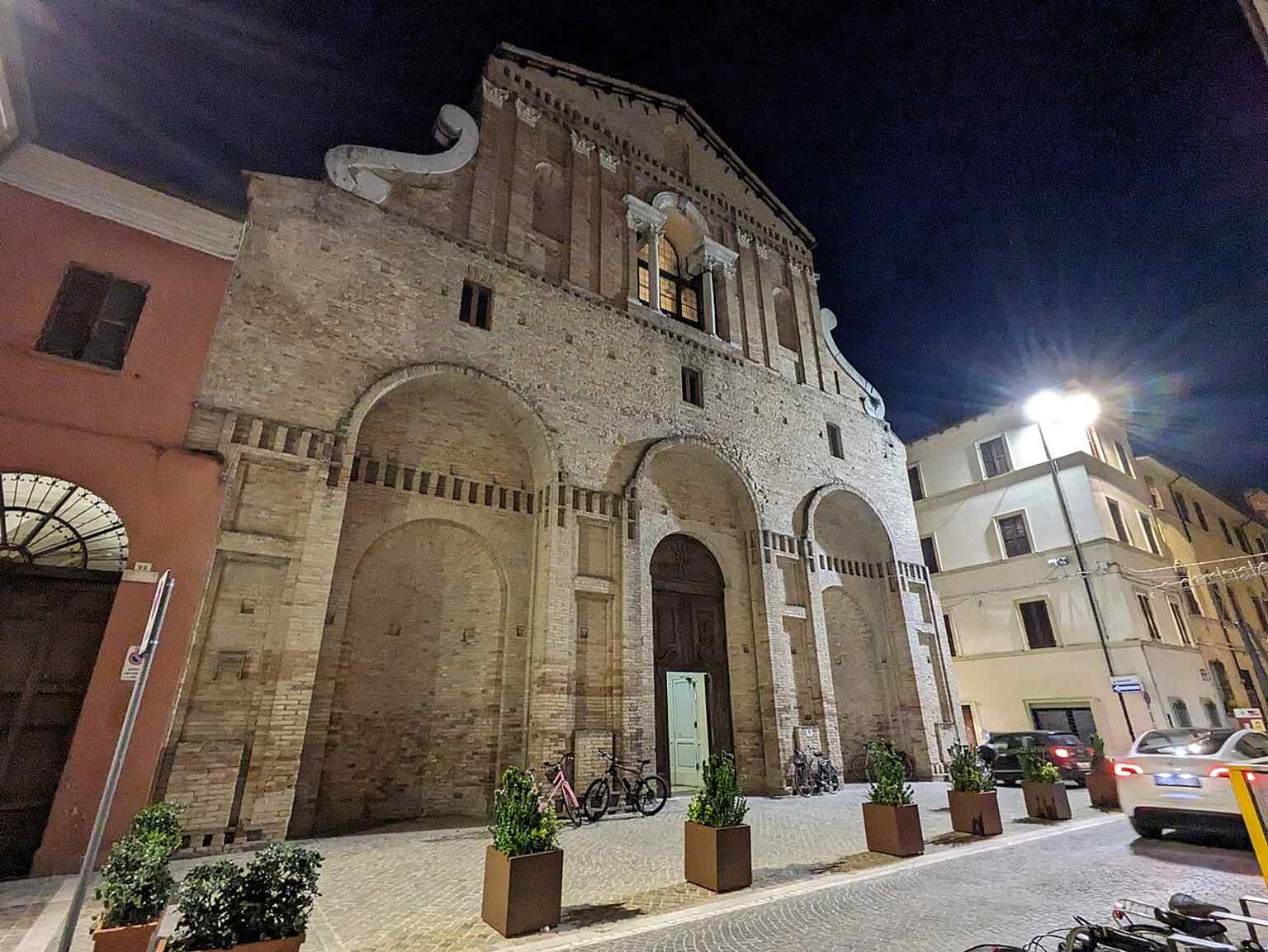
On your left, look for a broad brick church with a severe unfinished façade, a simple pitched roofline, and the attached convent stretching alongside it.
San Giovanni teaches one of Pesaro’s deepest lessons: even grandeur here had to negotiate.
Before the sixteen hundreds gave this place its long life, Alessandro Sforza had claimed this ground with a mausoleum and an earlier church. Then, in fifteen thirty-six, Duke Francesco Maria the First Della Rovere cleared them away. A year later, the architect Gerolamo Genga began imagining the church you see now, and after his death, his son Bartolomeo carried the work forward. In fifteen forty-three, Duke Guidobaldo the Second Della Rovere and Vittoria Farnese laid the first stone with full dynastic ceremony... but the friars tied to this complex, the Franciscan Observants, kept insisting on something less showy, closer to their calling.
So the building rose slowly, over more than a century, and it never quite dressed itself for court. Money ran short in the duchy. The friars preferred restraint. The façade and sides remained unfinished, and still remain so. That plainness is the point. Giorgio Vasari, who knew magnificence when he saw it, still called this the “bel San Giovanni,” the beautiful San Giovanni.
Its making changed the city around it too. To open space for the new church, the duke and the community bought the Pianosi houses for one thousand four hundred thirty scudi, a significant sum at the time, and the street itself took the name Via San Giovanni. If you glance at the image in the app, you can see how church and convent belong to one long story, side by side.
Inside, the nave, the long central hall of the church, forms a Latin cross and leads to an octagonal presbytery, the space around the main altar. There were once nine side altars. In seventeen twenty-nine, workers removed four of them to restore balance. It is such a revealing gesture: not adding more, but taking away. Even prestige bowed to measure.
And yet this place held civic pride as well as prayer. The tombs of the Almerici, Antaldi, Baldassini, Gavardini, and Perticari families stood here for generations. Later, suppression in eighteen sixty turned the convent into military quarters, and by the world wars the church itself stored arms and munitions. Worship returned only in nineteen twenty-six. The cloister came back to the friars in nineteen seventy-five, and the convent found new public life as the Biblioteca San Giovanni.
So here, once again, Pesaro refuses a single identity: ducal project, Franciscan house, civic memory, barracks, library, restored church. In a few minutes, at the Rossini Theatre, that discipline of form will open into performance. If you want to come back inside, the church generally keeps daily hours from early morning into early evening, with later opening on weekends.





%208.jpg)