
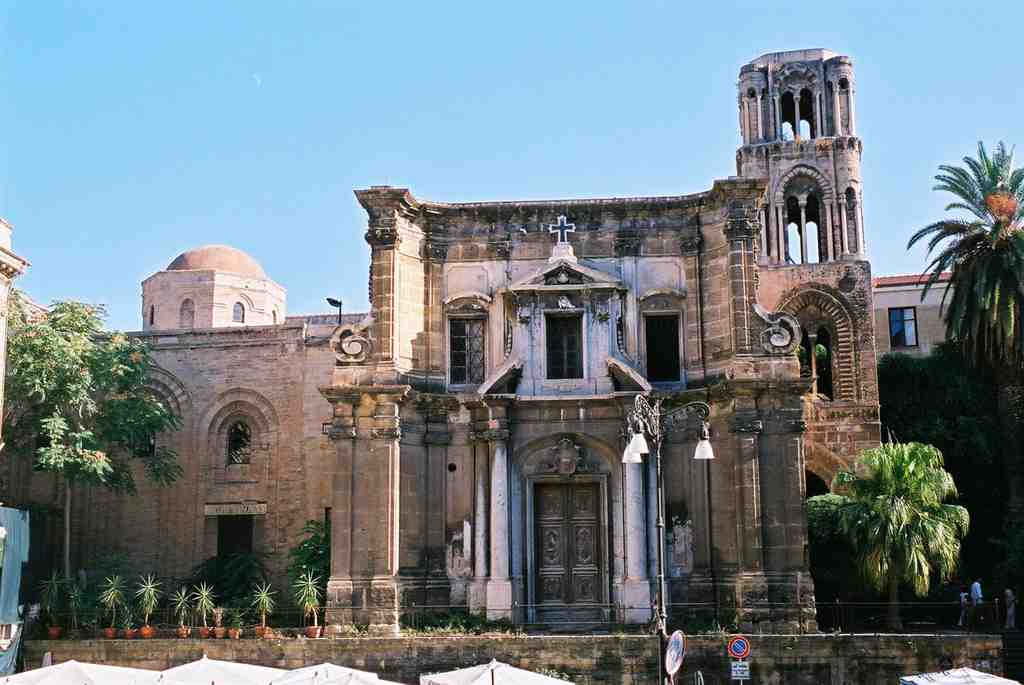
Take a look right in front of you-what you’re seeing is the Church of Santa Maria dell’Ammiraglio, or Martorana, with its striking Baroque façade and tall, arched bell tower, nestled beside the Norman church of San Cataldo and facing the lively Piazza Bellini.
Now, imagine standing at this spot about 900 years ago. Instead of traffic and the occasional selfie-taker, you’d find yourself among bustling markets, foreign tongues, and merchants in long, flowing robes. This church, the Martorana, was the sparkling new jewel of medieval Palermo, gleaming with golden mosaics and the promise of something different-something truly special. It all started in the twelfth century, when a clever Syrian Christian admiral named George of Antioch decided he wanted a place for his soul (and his eternal rest) that reflected the wonderfully tangled culture of Sicily. This was an island where, after a century of Arab rule, Normans had swept in, grabbed the crown, and said, “Actually, we love your art and mathematics-let’s mix it up a bit!” So, with both Greek and Arabic inscribed proudly on its ancient charter, the Martorana rose up.
At that time, Latin, Greek, and Arabic were spoken all around the city-sort of like today’s Palermo, only with fewer tourists asking for WiFi passwords. If you were to slip through those chunky old doors, you’d find yourself surrounded by a blinding array of mosaics, created by artists who must have spent more time up on scaffolding than most cats do on bookshelves. Glittering colors, saints in golden halos, and even an image of King Roger II himself, standing beside Christ and being crowned-not by a pope, mind you, but by Jesus directly, in true Byzantine fashion. Talk about skipping the middleman! Roger wore his upwardly mobile ambitions as openly as a king-sized crown, which might explain why his image, dressed in imperial garb, makes an appearance on the wall right here.
But don’t let the mosaics steal all your attention. There are layers of history hiding behind these stones like shy ghosts at a masquerade. Take the architecture-at the base, you’ll spot signs of the “Greek cross” plan, a classic in Byzantine churches. Walk around the outside, and you’ll see arches and decorative touches borrowed from Islamic traditions. A frieze at the top bears an inscription in Greek letters but wrapped in Arabesque style-a visual reminder of Palermo’s past, where Christian, Muslim, and Jewish communities coexisted in remarkably cosmopolitan fashion. Why just borrow sugar from your neighbor when you can borrow architectural genius?
Then came centuries of change. Over time, a Benedictine convent was founded right next door by a tough and devout woman named Eloisa Martorana-hence the nickname “Martorana.” The nuns moved in, and, as you might expect of nuns living next door to the greatest church bakery in Palermo, they started making Frutta di Martorana: marzipan fruits so realistic you’d swear that apple was about to crunch. Even today, pastry shops all over Palermo sell these tasty souvenirs of the convent’s creative spirit.
Later, the church was radically transformed as new rulers swept through-Aragonese crowns, Spanish viceroys, even more renovations in the never-ending quest for heavenly beauty. Grand Baroque flourishes were added, tweaking the once-Byzantine basilica and giving it that dramatic flair you see today. The bells in the campanile might as well have rung out new building instructions every decade. Oh, and in the 19th century, someone tried to “restore” the church, as in, “Let’s take it back to the Middle Ages,” but many of the Baroque elements remain proudly visible up front, just daring you to try and peel back the centuries.
But the real heart of Martorana beats with the Arbëreshë-the Italo-Albanian community. Driven from their homes centuries ago by Ottoman invasions, they found refuge in Sicily, bringing lively Albanian customs, costumes, and language with them. Even now, if you slip inside at the right moment, you might hear hymns sung in Koine Greek or Albanian, echoing with ancient faith. Easter is the biggest celebration, but even weddings here make a spectacle, with brides dressed in traditional Albanian garb and whole families singing with gusto.
Today, Martorana stands as a living mosaic, an ever-evolving masterpiece that is part of a UNESCO World Heritage Site. It’s a place where East meets West, past meets present, and marzipan meets your sweet tooth. So, next time you’re tempted to dash off for a pastry, stop and let your senses drink in this remarkable survivor-a church that has seen it all, heard it all, and still every morning, opens its doors wide to welcome a little more history.
For a more comprehensive understanding of the liturgy and rite, architecture or the interior, engage with me in the chat section below.


