
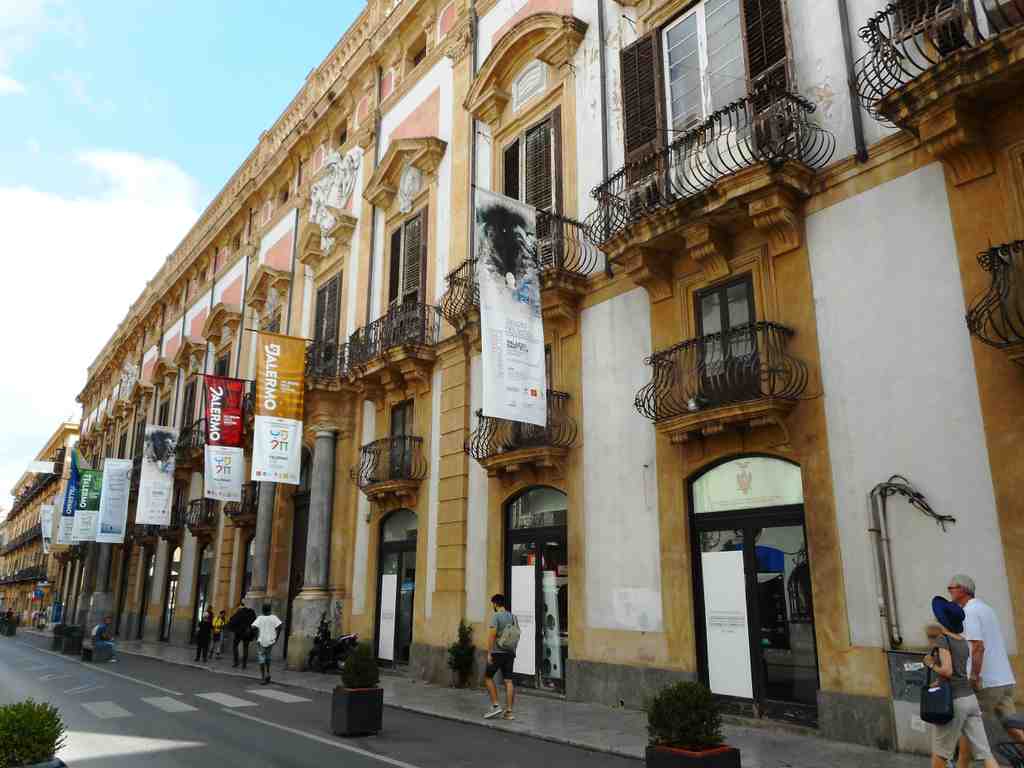
To spot the Sant’Elia Palace, just look to your right along Via Maqueda-you’ll see an elegant facade stretching along the street, painted in soft yellow and pink, with rows of wrought-iron balconies and tall windows lined up perfectly above arched doors, and bright banners swaying in the breeze.
Alright, here we are, in front of the Sant’Elia Palace! If you listen closely, you might almost hear the echoes of horse-drawn carriages clattering on the old stones, carrying Palermo’s aristocrats to a ball two centuries ago. Let’s step back in time and uncover the story of this aristocratic mansion.
Picture Palermo in the mid-1700s: Via Maqueda-the “Strada Nuova,” or “new street”-was all the rage because the city had just ripped open the old medieval neighborhoods to make way for grand new avenues and palaces. The Sant’Elia Palace you see now began with a noble called Giovanbattista Celestri di Santa Croce. He wanted something big, something spectacular-a palace to rival all others-and started expanding his existing home, gobbling up neighboring buildings, and hiring the finest craftsmen. There was some mystery over the actual architect-it’s like the palace’s own whodunit! For years, people thought a fellow named Nicolò Anito did it all, but recent discoveries suggest he was more of a “helper” than the mastermind. Instead, the true architectural genius behind these walls is still lost to history. Imagine a masked architect sneaking in at night, whispering, “They’ll never know it was me!” What a plot twist for Palermo!
By 1756, construction was in full swing-not just one courtyard, but two! Dramatic entrance portals, fancy stucco crests, and soon, sculptors and painters would arrive, dusting their powder from busy hands and arguing over which corner of the ballroom deserved more gold leaf. Walking past these elegant balconies and archways, you’re passing what was once one of the city’s most extravagant homes. The walls inside are bursting with frescoes-imagine mythological scenes painted by Ottavio Volante, full of gods and heroes, while nearby artisans crafted delicate stucco garlands and blazons celebrating the noble family. Every room was a stage, and every party a performance. Flickering lantern light, noblemen murmuring, and silk skirts rustling as they crossed the terrazzo floors-all designed to show off the family’s power and importance.
But fate is tricky, and family fortunes don’t always last. The Santa Croce family line faded out, and just about a century later, the palace passed to a cousin-Romualdo Trigona, Prince of Sant’Elia, whose name the palace still carries. Even the Trigonas, though, couldn’t hold onto it forever. Over the next hundred years, this grand old house wore many hats: it was rented out to the city senate, became a university for the encouragement of agriculture and the arts, and even served as a school. Imagine bored schoolkids scribbling graffiti in the shadow of lavish neoclassical ceilings!
And in the 20th century, things got a little wild: the palace saw years of neglect, empty and abandoned, its ornate courtyards echoing with only the sound of wind and pigeons. Parts were even looted, and it looked like the grand days of Sant’Elia were over. But Palermo doesn’t give up on its treasures so easily. In 1984, the local government swooped in and bought the palace, determined to save it. Years of careful restoration followed-inside and out, from the peeling facades to the hidden frescoes.
Now, as you stand outside, look up at those rows of balconies and imagine the grand reopening in 2007, bursting with light and artwork again, as the palace became a museum space. Today, every corner is alive with temporary exhibitions and events, welcoming everyone-locals and travelers, families and dreamers. Even the pathways are accessible to all, so no one has to miss the magic.
From secret architects to noble intrigue, from aristocratic excess to resilience and revival, Sant’Elia’s story is one of transformation. If these golden walls could talk, they’d whisper tales of glory days and wild parties, echoing right into the present. Ready to continue the adventure? On to the next treasure!


