
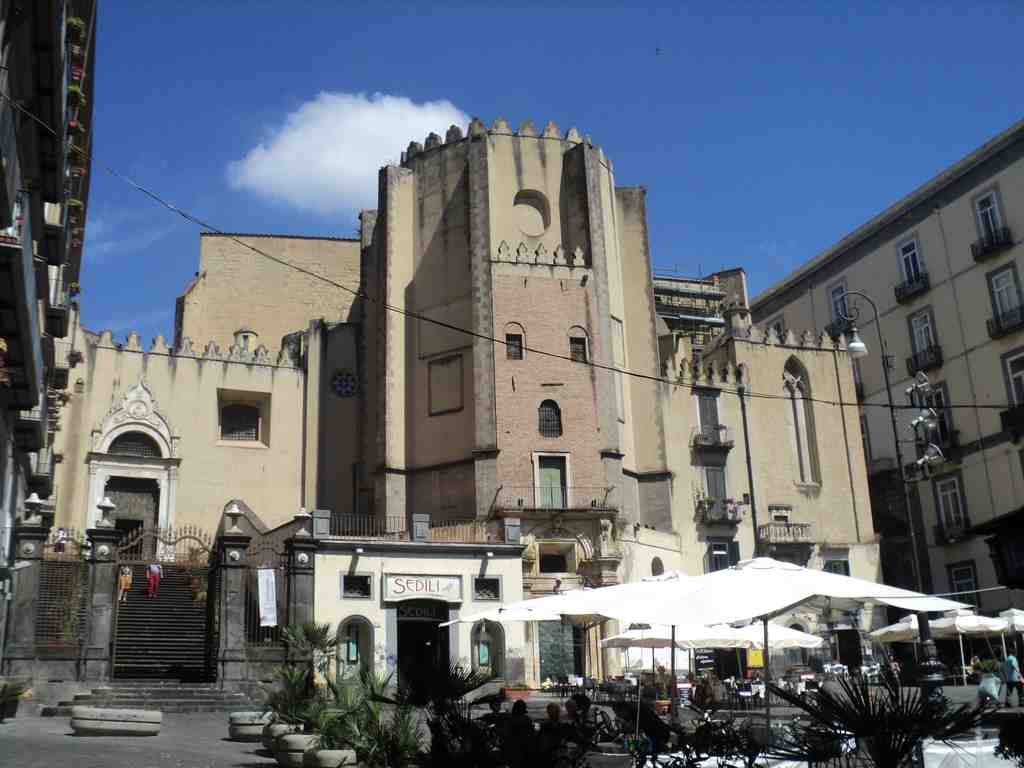
Straight ahead is San Domenico Maggiore, an imposing complex anchored by a towering, polygonal stone apse with crenellated rooflines and a grand staircase leading up to its arched portal. Take a look at your screen to see the full Gothic majesty of this exterior.
This fortress of faith was shaped by the Angevins, the powerful French royal dynasty that ruled Naples in the thirteenth century. King Charles the Second commissioned its grand Gothic redesign, effectively transforming the space into an intellectual crossroads. This very site became the original seat of the University of Naples. And in 1272, its halls echoed with the lectures of a philosophical giant... Thomas Aquinas.
Aquinas lived and taught within this monastery. One night in 1273, a sacristan claimed to witness Aquinas levitating in prayer before a crucifix, weeping heavily. According to the account, Christ spoke to the friar, asking what reward he desired for his brilliant writings. Aquinas replied that he wanted nothing but God. This profound mystical encounter completely shattered the great thinker's academic drive. He abruptly abandoned his masterpiece, the Summa Theologica. When his secretary begged him to finish, Aquinas stated that compared to the divine secrets just revealed to him, everything he had written now appeared to be of little value. He died mere months later, taking the mystery of his vision to the grave.
The intellect endlessly seeks the divine, but the body remains tethered to a much harsher reality. Deep inside the sacristy lie the remains of another ruling dynasty... the Aragonese royals who governed Naples centuries later. You can view their ornate sepulchres on your app.
In the 1980s, a team of paleopathologists... scientists who specialize in diagnosing ancient diseases... performed modern autopsies on these mummified kings and queens. What they discovered beneath the velvet and gold was a staggering chronicle of physical suffering and toxic vanity. Isabella of Aragon was celebrated as one of the great beauties of the Renaissance. But she had contracted syphilis. To cure the disease, she self-medicated with heavy doses of mercury, a poison that turned her teeth entirely black. Desperate to maintain her flawless image, she used a metal file to scrape away the dark stains, completely obliterating her enamel. She ultimately died of chronic mercury poisoning.
Her relative, King Ferdinand the Second, met a similarly grim fate. The young monarch suffered from a severe double infestation of head and pubic lice. To combat the maddening itch and the humiliation of the condition, he slathered his skin and hair in a mercury-rich ointment. The treatment absorbed rapidly through his skin, inadvertently poisoning and killing the king at the age of twenty-eight.
Naples is a city that constantly sheds its skin, enduring the physical ruin of empires, the desperate measures of poisoned monarchs, and the unfinished thoughts of geniuses. The pursuit of perfection leaves deep scars behind. The church is open most days until five thirty in the afternoon if you would like to explore its interior. We are now going to follow the ancient Greek street plan deeper into the city's origins, heading toward the Basilica of San Giovanni Maggiore, which is about a five-minute walk from here.




