
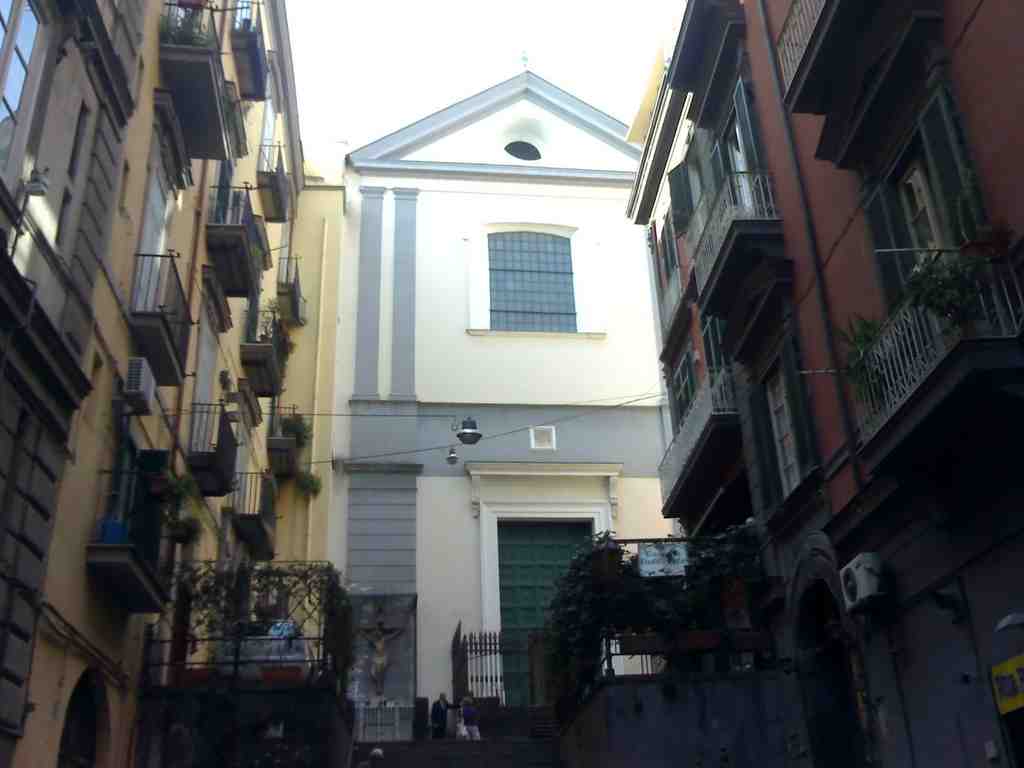
Notice the pale, smooth facade up and to your right crowned with a sharp triangular pediment, featuring a large, square paned window above a set of simple green doors.
Beneath those very doors lie subterranean pagan temples. The foundations of this church date back to the year 324, resting directly upon an ancient pagan sanctuary likely dedicated to Hercules, or perhaps Antinous, the tragic lover of Emperor Hadrian. When Emperor Constantine ordered this church built, it was a deliberate act to overwrite a site of profound imperial cult worship. Yet, the old world was not entirely erased. If you walk inside, you will find two massive columns of cipollino marble framing the apse, the semicircular recess behind the altar. Those columns were salvaged straight from the original pagan temple.
Over the centuries, this basilica became a center of immense worldly power. In 1298, within these very walls, Robert of Anjou was solemnly crowned the Duke of Calabria. It was a space where the divine endorsed the mortal rulers of Naples.
But the earth beneath Naples is restless. Earthquakes repeatedly shattered the basilica, century after century. The most devastating struck in 1870, tearing down the right nave, the long side aisle of the church, and collapsing the vaulted ceiling. The damage was so absolute that city officials declared the building an irrecoverable ruin. They formally proposed to demolish it and pave over the rubble to build a public square. The basilica would have vanished entirely if not for a single determined priest named Canonico Giuseppe Perrella. He defied the city, personally raised the funds, and saved this magnificent architectural tapestry from destruction.
Because the building survived, so did its oldest, most mysterious legends. Tucked away in the left transept is a marble plaque from the eleventh century. It bears an invocation to Parthenope, the mythical siren whose body was said to have washed ashore and been buried right beneath this very spot. This deeply rooted myth made the church a pilgrimage site for centuries.
By 1689, church authorities had grown tired of the rumor. They installed a second plaque directly beneath the first. The new inscription bluntly warned visitors that this stone was just a superstition and did not hold a siren. Yet, tellingly, they never removed the original pagan invocation. They simply let the orthodox doctrine and the ancient myth share the wall.
You can explore the interior Monday through Saturday from nine to six, and Sunday mornings until one.
Let us proceed to our final stop to see how all these layers of history collide, just a short three minute walk away at San Pietro Martire.




