
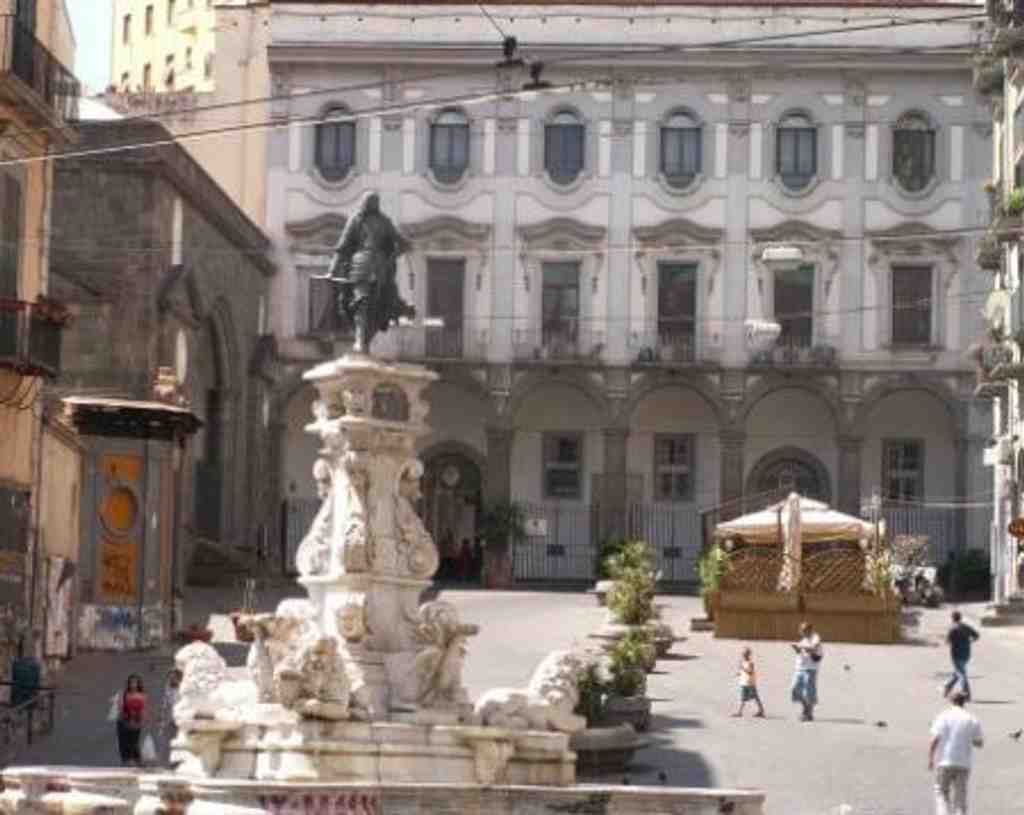
Look to your left, just past the multi tiered stone fountain crowned with a dark bronze statue, to spot the church's flat rectangular facade and heavy stone entrance portico.
Once, this was not merely a building, but a sprawling micro city. In the early fourteen hundreds, it was the domain of the Olivetans, a strict branch of monks, who cultivated orchards and crafted medicinal herbs in a vast complex of cloisters right where you are standing. It was a place of immense prestige, a spiritual hub where the powerful royals of the era attended daily mass.
But cities are living things, prone to sudden shifts and brutal reinventions. In seventeen ninety eight, the king abruptly evicted the monks. The empty halls were soon claimed by the Lombards. This was a powerful confraternity, a religious brotherhood of merchants and artisans from northern Italy. Their own nearby church, dedicated to Saint Anne, had just been demolished. So, they brought their archives, their devotion, and their name to this abandoned monastery, effectively rebranding the ancient site as Sant'Anna dei Lombardi.
Then came the violent turn of eighteen oh five. An earthquake tore through Naples, collapsing a massive section of this sanctuary.
What was lost in the rubble remains an aching wound in the history of art. Inside the collapsed wing were three monumental paintings by the revolutionary artist Caravaggio. One of them was a highly controversial depiction of the Resurrection. Instead of painting a triumphant, serene figure rising from the tomb, Caravaggio broke all tradition. He painted a man emerging into the light with visceral, raw terror. His contemporaries called it indecent, but it was an intensely human, modern vision. Those irreplaceable canvases were crushed to dust beneath the falling stone.
It is a heavy loss to absorb. Yet, the fact that this building still stands, having survived evictions, natural disasters, and modern urban development pressing right up against its walls, speaks volumes. It shows how the enduring spirit of this city survives terrible devastation, weaving deep losses and necessary reinventions into a continuously surviving legacy. If you wish to step inside to see the surviving art, the church is open most days from nine thirty to six, with a later start on Sundays.
Now, turn your attention across the street. We are heading toward the grand Renaissance architecture of Palazzo Orsini in Gravina, just a two minute walk away, where we must navigate the incredibly dangerous political games of the sixteenth century.




