
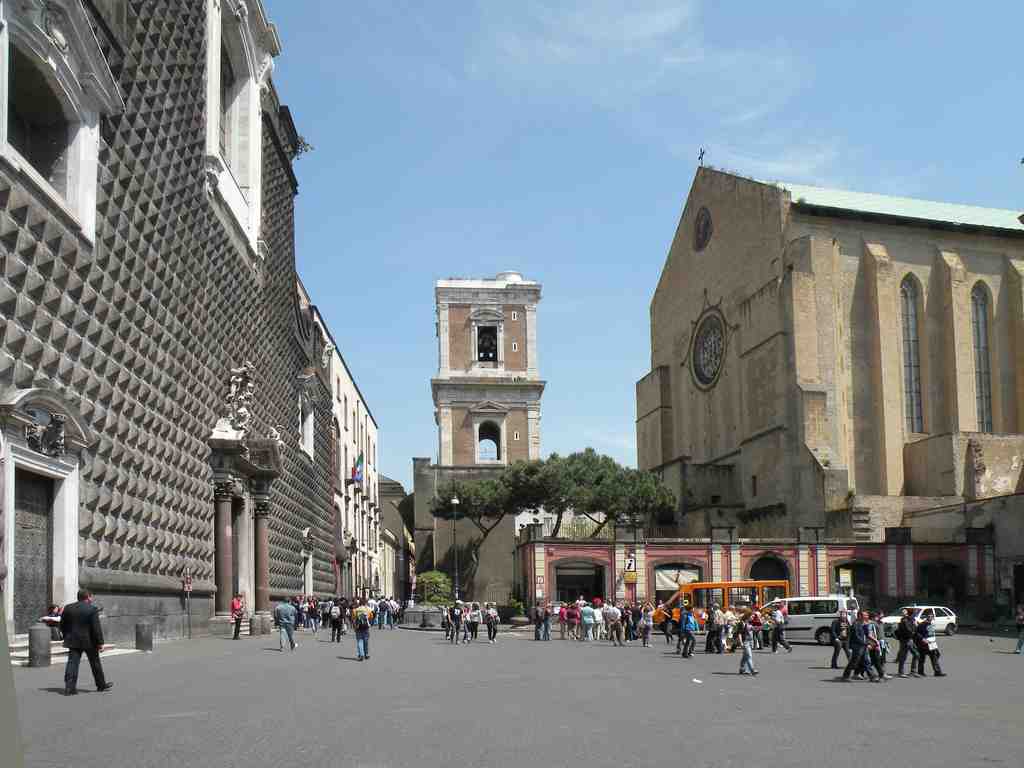
On your left is the massive, pale stone facade with its sharply peaked roof and a prominent, circular rose window set right in the center. This is Santa Chiara.
It was built in the early thirteen hundreds by Queen Sancha and King Robert of Naples. Sancha was a deeply devout woman who initially refused to marry, wishing instead to become a nun. She finally agreed to the union on the condition that they live like brother and sister. Reflecting her intense spiritual partnership with the King, she designed this as a double monastery, housing Franciscan friars and cloistered Poor Clare nuns in entirely separate wings.
But the severe, unadorned stone you see today carries the weight of a profound cultural trauma. On August 4, 1943, Allied incendiary bombs struck the roof. The dry wooden timbers ignited, and the fire raged uncontrollably for days. The soaring central hall, known as the nave, became a giant kiln that baked and pulverized centuries of exquisite marble and stucco. Feel free to check your screen to see a comparison of the church's interior before and just after that devastating blaze.
The fire destroyed stunning Baroque decorations and exposed a heartbreaking secret. Beneath the ash were the ruined fragments of massive apocalyptic frescoes painted by the medieval Florentine master, Giotto. They had not been destroyed by the bombs, but by shifting fashions. In the eighteenth century, royals who found the medieval art too gloomy had them whitewashed. The fire peeled away the plaster only to reveal that Giotto's masterpieces had been hacked with pickaxes centuries earlier to help the new stucco adhere.
The subsequent restoration was fiercely debated. Instead of recreating the lost Baroque interior, architects chose to leave the stark, original Gothic stone exposed. It stands today as a stark monument to resilience... a testament to a community that continually resurrects itself from the ashes.
Yet, survival here is not just about enduring tragedy. It is also about finding joy. Hidden behind the church is the famous Majolica Cloister. In the seventeen hundreds, the nuns' somber garden was transformed with vibrant ceramic majolica tiles. Painted with colorful scenes of peasants and masked balls, these brilliant ceramics brought a flash of worldly life into their strict, secluded vows.
Imagine watching centuries of your own history burning uncontrollably in a single night... how do you find the will to rebuild from the ashes? Keep that resilience in mind as we make the one minute walk toward Gesù Nuovo, another architectural marvel of reinvention just across the square. And if you wish to explore Santa Chiara's cloisters and museum before we move on, the complex is open daily until five in the evening, though it closes earlier on Sundays.




