
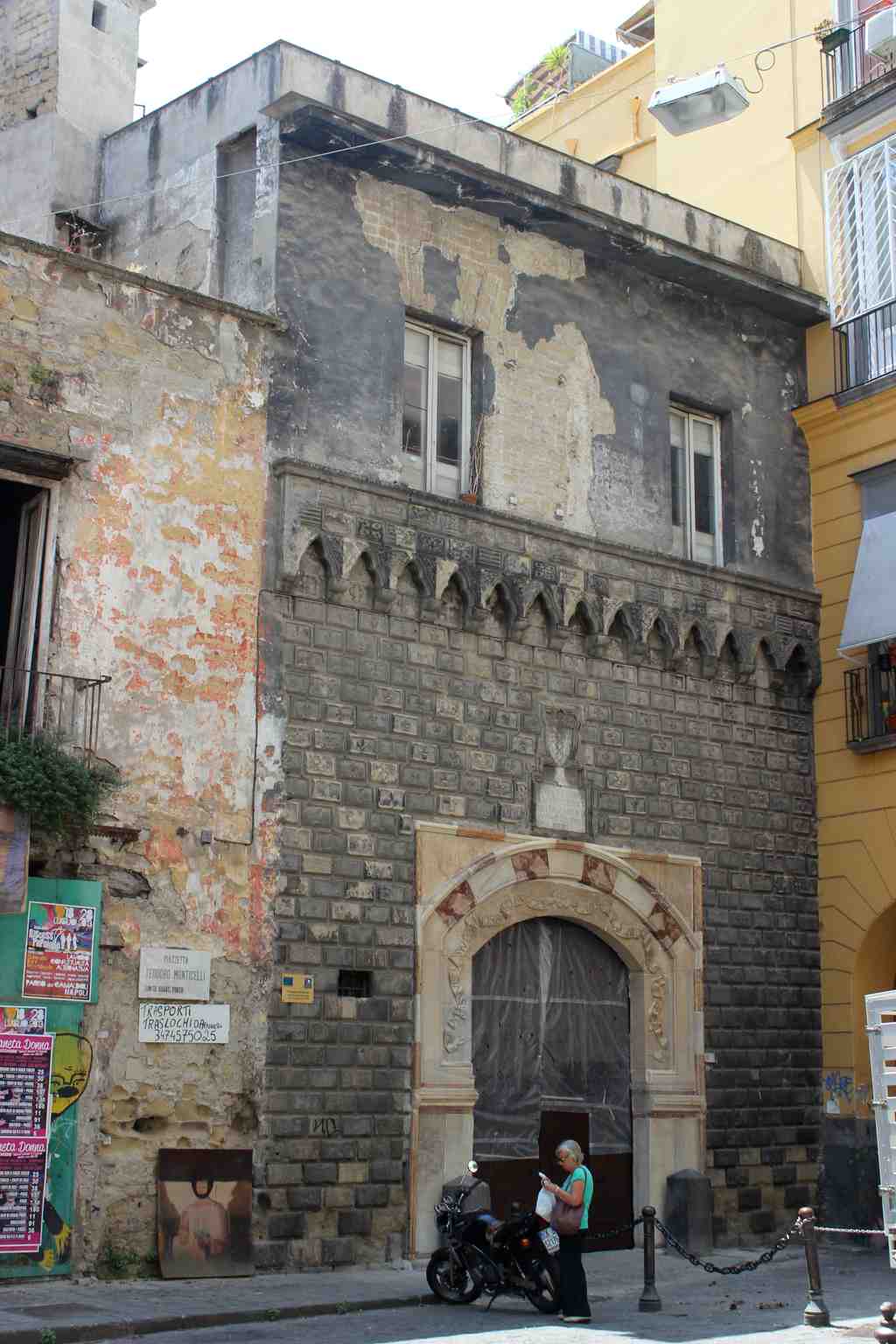
Before you stands a striking facade constructed of dark, tightly fitted rusticated stone blocks, anchored by a wide arched marble doorway and crowned by a protruding band of pointed stone arches.
This is Palazzo Penne. It was built in the year 1406 by Antonio di Penne, the powerful secretary to King Ladislaus of Naples. Antonio was an imperial notary, a man who wielded the king's authority through ink and parchment. He wanted an architectural monument that proved his ascent into the highest ranks of society, blending the heavy, rough-hewn Tuscan style of the main stone wall with the elegant, slightly flattened archway typical of Catalan design.
Examine the rusticated facade. Can you spot the carved relief of a feather pen in the center of the stones?
That quill is a permanent signature of his family name, Penne, but it is also a deliberate boast about the source of his immense influence. The stones themselves speak of his pride. Above the doorway, an inscription quotes the ancient Roman poet Martial. It translates to a taunt against jealous rivals, reading, you who turn your head, envious one, may you be envious of everyone, and no one of you.
Perhaps it was that very arrogance that birthed the dark folklore surrounding these walls. According to local legend, Antonio fell in love with a woman who demanded he build her a magnificent palace in a single night. To accomplish the impossible, Antonio signed a blood pact with the devil. Beelzebub would build the palace before dawn, and in exchange, he would take Antonio's soul.
But Antonio added one final clause. The devil would only get his soul if he could accurately count a handful of wheat grains scattered across the new courtyard. When the devil counted, he came up five grains short, losing the wager. Antonio had secretly mixed sticky pitch into the wheat, trapping the missing grains under the devil's claws. Furious at being tricked, the demon raged until Antonio made the sign of the cross. A chasm ripped open in the courtyard, swallowing the devil whole. Locals say a well was built over the demonic pit... and strangely enough, recent excavations in the courtyard actually uncovered an ancient, hidden well.
For centuries, locals blamed that buried demon for the long, painful decay of the building. By the early two thousands, the once proud home had crumbled into a neglected rooming house, its roof rotting and its historic marbles defaced. The regional government bought it for ten billion lire, which is about five million dollars today, but left it to rot further. It was only saved when two local women, descendants of a famous philosopher, fought a fierce legal battle to stop illegal construction that would have parcellized and gutted the interior. They forced the city to finally begin restoring the palace to its rightful dignity.
Antonio di Penne's earthly ambitions survived the devil, centuries of decay, and modern greed. But to see the ultimate proof of his prestige, we must follow his ghost. Our next destination is just a six minute walk away. We are heading to the solemn grounds of Santa Chiara, the sacred resting place of Neapolitan nobility, where Antonio managed to secure his own grand tomb.




