
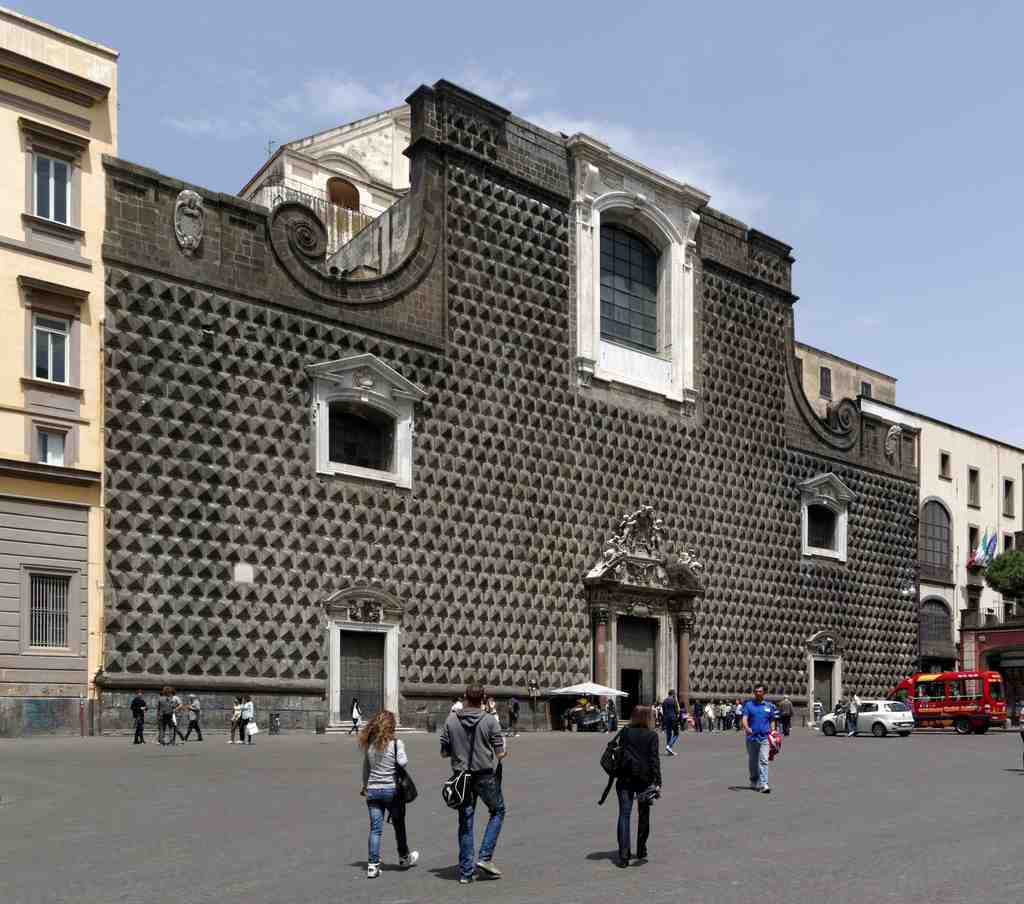
Straight ahead is a massive facade covered entirely in dark stone blocks carved into sharp, projecting diamond shapes, anchored by a grand white marble portal in the center.
You are standing before Gesù Nuovo, or New Jesus. But this striking building was not born a church. It began in the late fifteenth century as a grand secular palace for the powerful Sanseverino family, built as the city expanded westward. Its transformation from a noble residence into a formidable Jesuit stronghold reveals how the cultural soul of this city absorbs tragedy, reinvents its purpose, and weaves dark legends out of stone.
In fifteen forty-seven, Ferrante Sanseverino, the Prince of Salerno, made a dangerous choice. He stood with the people in a massive popular uprising against the Spanish Viceroy, who was attempting to force the Spanish Inquisition upon Naples. For his defiance, Ferrante was stripped of his titles and forced into exile. His magnificent Renaissance palace was confiscated by the crown and eventually sold to the Jesuits in the fifteen eighties for forty-five thousand ducats, a staggering sum equivalent to tens of millions of dollars today.
The Jesuits kept the unusual facade, made of a dark volcanic rock called piperno, cut into heavy diamond shapes known as rusticated ashlar. If you look closely at these stones, you will notice strange engravings. Master quarrymen carved these symbols, which local lore claimed were esoteric wards meant to attract positive energy. But the legend insists the builders placed the stones in the wrong order, reversing the magic. This mistake supposedly doomed the building to centuries of misfortune, including devastating fires and collapses.
One such collapse happened during a massive earthquake in sixteen eighty-eight. The disaster destroyed the church's original dome, and beneath it, obliterated the grand tomb of Carlo Gesualdo, an infamous prince and murderer whose dissonant choral music was centuries ahead of its time.
Yet, the building's supposed curse took a miraculous turn in two thousand and ten. An art historian and a team of Hungarian musicologists discovered that the mysterious symbols on the facade were not reversed magical wards at all. They were letters of the Aramaic alphabet representing musical notes. When read from right to left, bottom to top, the entire facade becomes a colossal musical score, translating into a forty-five minute Gregorian chant for stringed instruments.
That hidden music seems to have offered its own kind of protection. During the height of World War Two, as bombs rained down on Naples, terrified citizens huddled inside Gesù Nuovo. A bomb crashed directly through the ceiling of the nave, the soaring central hall of the church, landing near a side chapel. Miraculously, it failed to detonate. The casing of that unexploded bomb remains on display inside today, a silent witness to the lives spared.
If you want to step inside to see the vast, illusionistic ceilings and the bomb casing yourself, the church is open every day from eight in the morning until twelve forty-five, and again from four to seven in the evening.
When you are ready, let us continue to San Pietro a Majella, just a six minute walk away, where we will explore a rather different, much darker musical legacy.




