
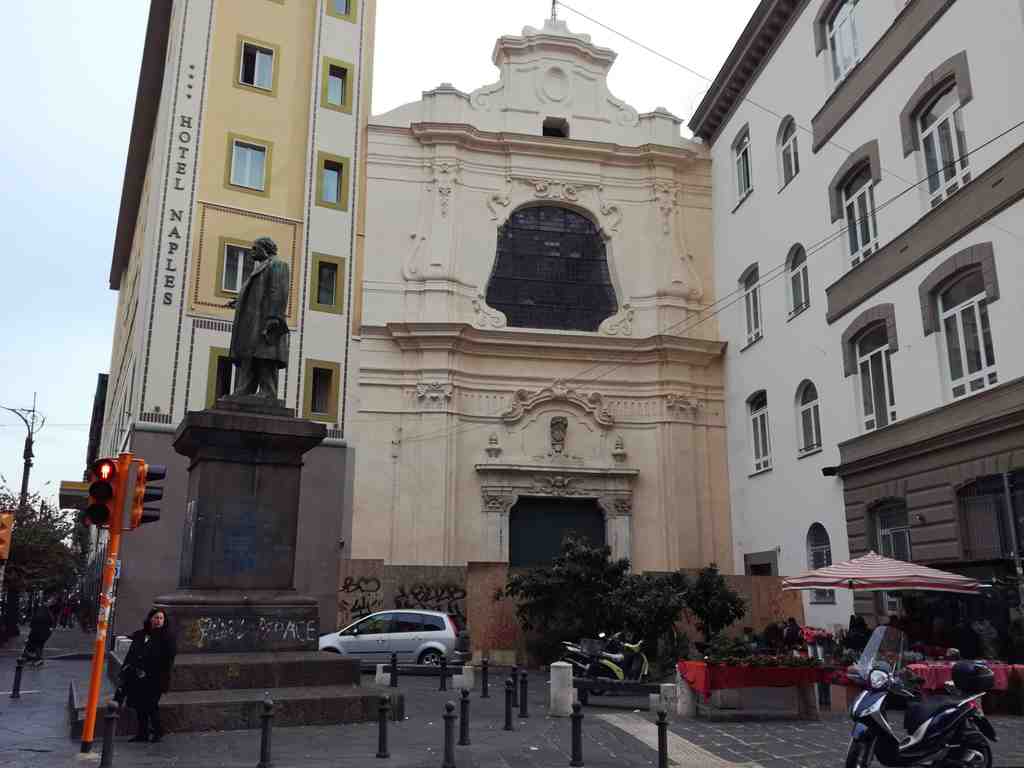
To your right is a pale stucco facade featuring a large, dark lobed window and an ornate crest at the roofline, standing quietly behind the tall bronze statue on a stone pedestal.
This is San Pietro Martire. If you glance at your app, you can see how it looks nestled into the modern university district. We end our journey together here, at a structure that perfectly captures the unending cycle of ruin and resurrection that defines this city.
The church's story begins with the Angevin Dynasty. It was commissioned in 1294 by Charles the Second of Anjou to house the Dominican Order, a Catholic religious group dedicated to preaching and intense study. It is fitting, then, that the statue in front of you honors Ruggero Bonghi, a nineteenth-century politician who helped reform public education in a newly unified Italy.
For centuries, this monastic complex held a very local kind of magic. In its small cloister was a well tapping into the underground Sebeto river. This Water of San Pietro was renowned for being pure and supposedly incorruptible. There were many stories of miraculous interventions and healing associated with it. When the Holy Roman Emperor Charles the Fifth visited in the sixteenth century, he was so captivated by its clarity that he refused to drink anything else. When it was time to leave, he ordered massive wooden casks of the water loaded onto his fleet to sustain him on his long voyage home.
But the survival of this building is a miracle in itself.
In the late nineteenth century, Naples underwent the Risanamento, a massive urban renewal project. Demolition crews ruthlessly bulldozed the medieval slums of this neighborhood to carve out the broad, modern avenue you see today. San Pietro Martire narrowly escaped the wrecking ball, standing as a lone survivor of a vanished, older Naples. Decades later, during World War Two, an Allied bombing raid aimed at the nearby port struck the complex. The blast shattered its walls and damaged centuries of art.
Yet, the city slowly rebuilt it. The ancient monastic spaces were eventually adapted for the University of Naples, and today, students hurry to lectures through halls where monks once walked in silent prayer.
If you look at the interior photo on your screen, imagine stepping through the entrance. You would immediately face a grim bas-relief, a shallow stone carving, depicting a skeleton. It holds a scroll with the words, Everything ends. This was a classic memento mori, a stern reminder to the monks of the brevity of earthly life.
The women buried inside knew that lesson well. Isabella of Clermont, a fierce fifteenth-century queen, lies here. She was no passive royal, she personally raised funds and military support to crush rebellions against her husband's throne. Her daughter, Beatrice of Aragon, rests beside her. Beatrice rose to become the Queen of Hungary, but after being widowed twice and losing her grip on power in foreign courts, she was forced to return to Naples, living out her final days with little of her former glory.
Everything ends. That is what the stone skeleton warns. But standing here, looking at a church that outlasted floods, bulldozers, and bombs to become a vibrant place of learning, you might realize that the soul of Naples never truly vanishes. It simply reinvents itself.
If you wish to look inside, please note the church is only open to visitors on Saturdays between ten thirty in the morning and six in the evening.




