
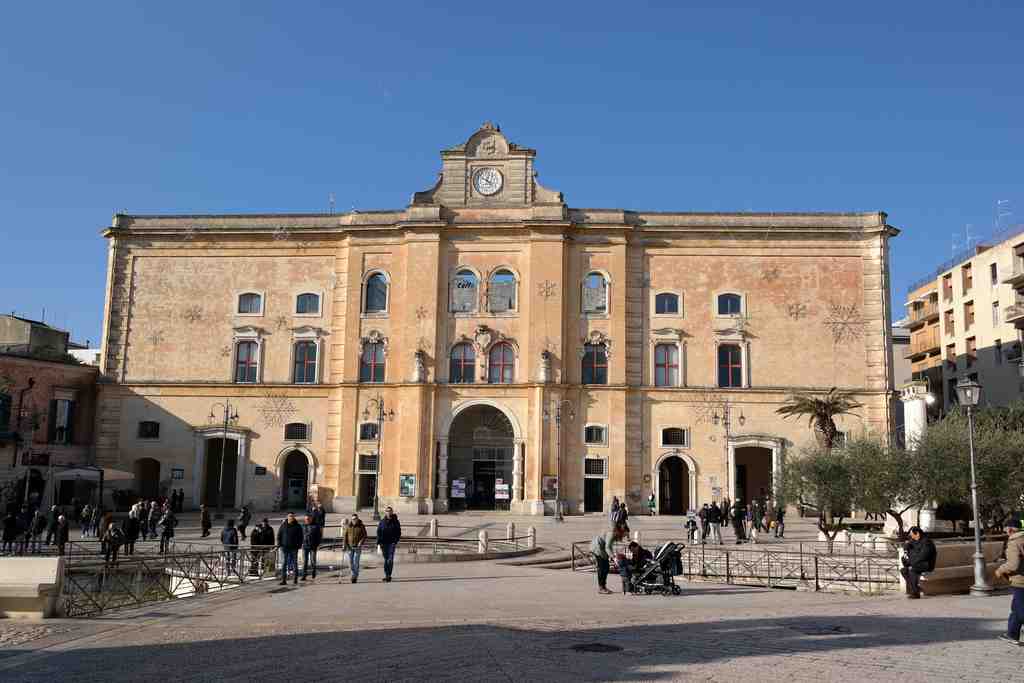
To spot the Palazzo dell’Annunziata, look for the huge, rectangular cream-colored building with tall arched windows and a grand clock perched right at the center of its roof, dominating the piazza in front of you.
Now, let me sweep you back to the bustling heart of Matera in the 18th century. Imagine dust swirling as masons and architects argued over blueprints while the glorious outline of the Palazzo dell’Annunziata began to rise from deep, stubborn foundations-so deep, in fact, that workers had to dig down nearly fifteen meters, a bit like Matera’s early answer to a basement swimming pool. The year was 1735, and an architect named Vito Valentino promised the Dominican nuns a stunning new monastery, complete with a church at its core. The Sisters were eager; time was ticking, and so was Valentino’s patience.
But nothing in Matera is ever simple-halfway through the construction, the architect and the nuns’ administrator clashed with the kind of drama you’d expect from a soap opera, forcing Valentino off the project before he could finish. The poor guy likely never expected to be replaced by Mauro Manieri from Lecce, who arrived with his brothers to fix, change, and, well, basically start over. Manieri even demolished the new church that was halfway built just to create a fresh courtyards and reimagined interiors. You have to admit, this was one building that experienced an architectural identity crisis!
Picture the confusion: by 1747, the nuns moved in, but the grand church was missing, leaving the building feeling a bit like a gigantic cake with the cherry forgotten on top. Yet, what did emerge was the towering, almost out-of-scale façade, so huge that locals started using it as the ultimate comparison for anything unusually big. The church itself would only appear nearly a hundred years later, courtesy of engineer Gaetano di Giorgio-finally giving the Palazzo its spiritual heart. By then, though, the nuns must have been expert movers, switching temporary lodgings more frequently than tourists searching for better Wi-Fi.
Times changed. By 1861, the monastery was dissolved and suddenly, this palace of spiritual devotion swapped habits for gavels, becoming a courthouse and, on the side, a school. Fast-forward to the early 1900s: a cornice and the now-iconic clock were added to complete the monumental look you see today. Tick tock!
By the late 20th century, after a harsh earthquake left the building empty and crumbling, a restoration transformed it once again-a phoenix rising from the ashes. In 1998, under the eyes of the Italian Prime Minister himself, its doors swung open as Matera’s provincial library, making it a palace not just of bricks, but of books. Even now, echoes of its history linger: the old chapel serves as a cinema, and rooms once hushed with prayer are alive with whispers of stories.
So, as you stand before this mighty façade, try to imagine centuries of sisters, architects, arguments, judges, teachers, and readers, all leaving their marks inside these formidable walls-a story as grand and layered as the building itself.




