
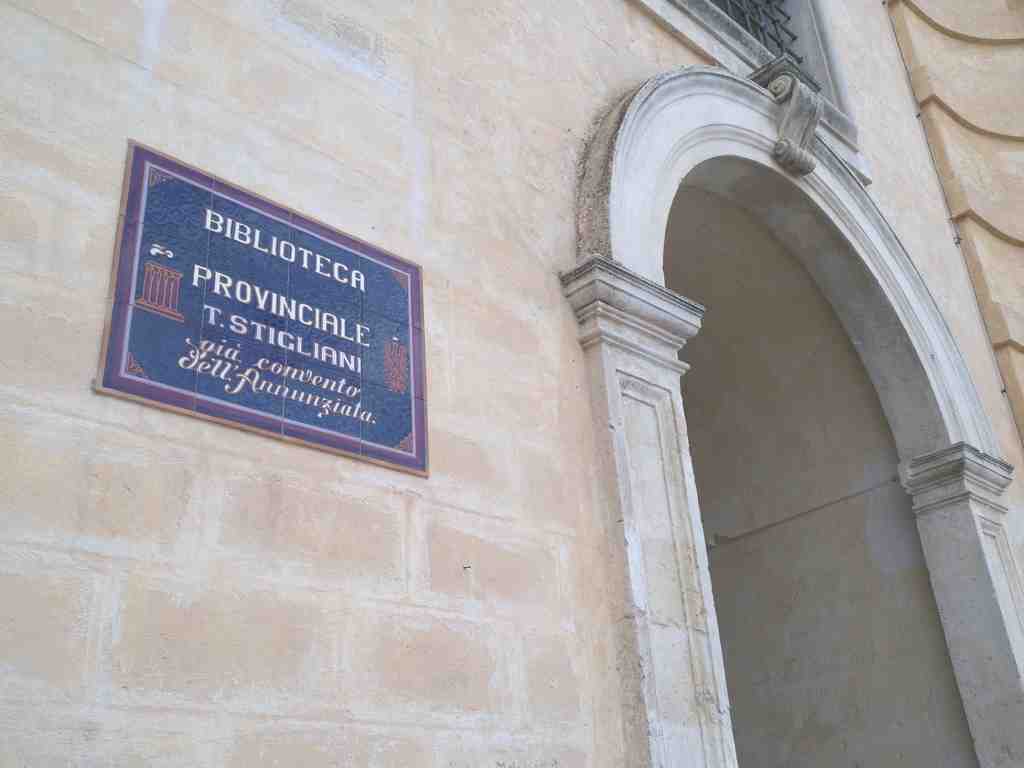
To spot the Tommaso Stigliani Provincial Library, look for a sun-warmed stone building with a grand, arched doorway just off the street, and a glossy sign announcing its name right beside the entrance.
Now, imagine standing here almost a hundred years ago-Matera was a place with very few books, hardly any libraries, and the local population struggling with high illiteracy. The legendary Italian poet Giovanni Pascoli himself, after arriving to teach Latin and Greek here in 1883, was so distraught by the lack of reading material that he sent long, exasperated letters to his old teacher Carducci, practically begging for more books. If only he could see this place now!
The Tommaso Stigliani Library came to life in 1933 thanks to a certain Pasquale Dragone-a lawyer with a heart as big as his mustache and a true passion for books. At first, it wasn’t quite the magical realm of knowledge you see today. Picture a cramped ground-floor room with only two spaces and around 2,000 donated books trying desperately to stretch themselves across nearly bare shelves. Yet Dragone, who soon became the library’s first director, rolled up his sleeves and decided it was high time Matera started turning pages.
In the early years, the library wasn’t exactly swarming with readers-probably because it felt more like somebody’s oversized closet than a welcoming library. Only after moving in 1937 to Via Don Minzoni did it start to bloom, becoming a proper institution where locals could finally lose themselves in stories, hunt down rare manuscripts, or just escape the daily grind for an hour or two. As word spread, the library began to hoard treasures: the unused collection from the nearby National Archaeological Museum’s library arrived, stacks from noble families like the Dragones were donated, and one of the biggest catches was the D’Errico collection-nearly 4,300 gorgeously bound volumes on everything from old legal codes to the wild stories of 19th-century Naples. Imagine how proud the staff must have been to guard such jewels!
Things got a little dramatic in the 1940s, though. Wartime Italy wasn’t exactly a peaceful place for libraries. In 1944, Dragone was suspended from his job for political reasons, and a parade of temporary directors marched through the front door. Organization? Let’s just say there were probably more overdue books than days in the year.
By the 1960s, the library's shelves were groaning under the weight of all those books, and the crowds of eager readers made it clear: “We need more room, please!” That chance came when the old Civil Hospital moved out, and suddenly there was a spacious new building waiting on Via San Rocco. With new reading rooms and an even better collection, the library became a beacon for students desperate to do their homework somewhere other than the kitchen table.
Not only did it expand its book collection-think ancient manuscripts, rare incunabula, and even an organ and a delightful assortment of old gramophones (must have made for some unusual library music)-but it also embraced its role as Matera’s center of learning, reprinting lost works on local history, launching bulletins, you name it.
Yet, in 1986, a structural mishap shut the library down, keeping bookishly inclined Materani twitchy with anticipation for years. Finally, after much debate and a proper dose of Italian drama, the current space in Palazzo dell’Annunziata opened with fanfare in 1998, attended by none other than Prime Minister Romano Prodi. Today, the library’s archive has ballooned to over a quarter of a million documents-ancient books, modern tomes, rare periodicals, and enough curious donations to satisfy even the pickiest bookworm.
So as you stand outside, think of all the worn hands that opened these doors in search of wisdom, the smell of old pages inside, and the passion that turned Matera from a town without books into the proud home of one of southern Italy’s true treasures. And probably the only library where you can find a 500-year-old book and a gramophone in the same building!




