
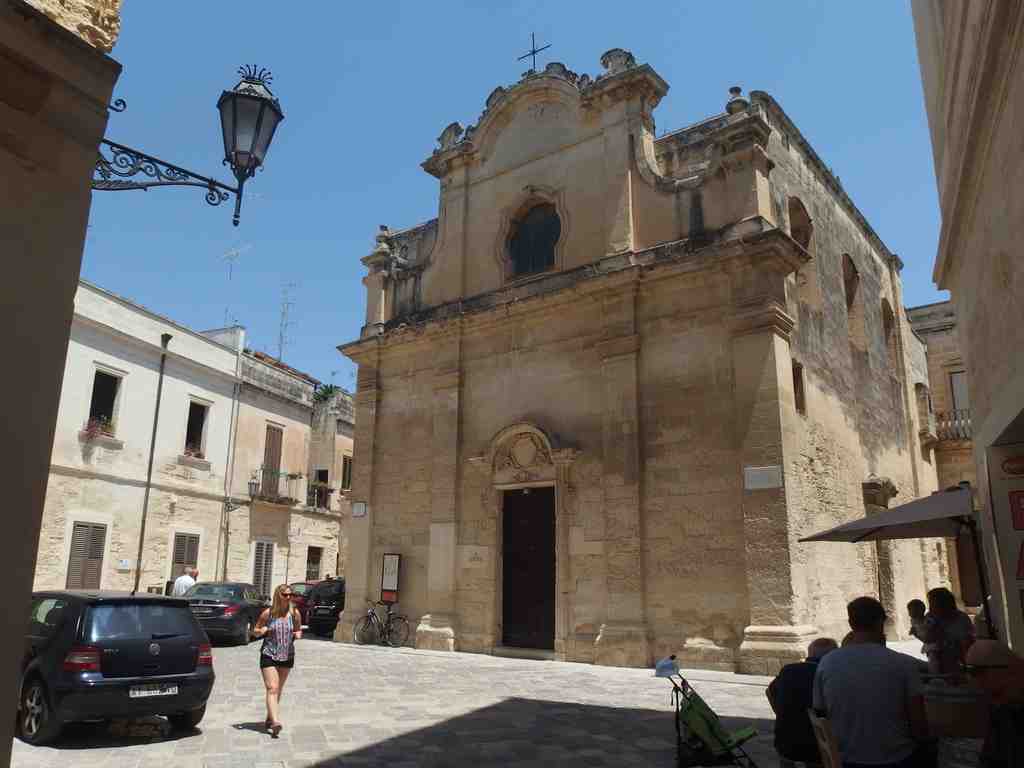
You’ll spot the Church of San Niccolò dei Greci just ahead: look for a soft golden stone facade divided into three sections with simple columns, a curvy baroque top, one main doorway with a rounded arch, and a single tall window right above it.
Alright explorer, take a moment to imagine yourself stepping back in time, right here in Lecce’s old heart, where sunlight glows on ancient stone and a gentle breeze teases the air. Before you stands the so-called “Greek Church,” but don’t let the name fool you-this building holds a story about searching for freedom in a world turned upside down.
Picture the late 1400s: the city was alive with the footsteps of newcomers. Fleeing the threat of the Ottoman Empire, Albanian families crossed the sea, clutching their traditions and dreams of worship without fear. They didn’t just bring their sandals; they brought their faith-a rich Byzantine rite expressed in songs, prayers, and, of course, delicious bread (but hey, unfortunately I can’t offer you a snack!).
These Albanian-and later Greek-communities settled first in a humble chapel where the Church of the Gesù sits today, but fate had another plot twist. When the Jesuits arrived and claimed that land, these resilient folks found themselves, quite literally, churchless-forced to wander from one holy spot to another, determined to keep their Eastern traditions alive in a land of bells, Latin hymns, and sometimes suspicious stares.
Finally, they created a new home here, on the site of what had long been a place for Byzantine believers. In 1765, the current church was built, showing off late Baroque style, but with its soul facing east toward the rising sun, like all good Byzantine churches. Imagine the sounds of builders, stone chisels ringing and scaffolding creaking as Lecce's architects, Palma, Marsione, Lombardo, and Carrozza, gave new life to ancient roots. The entrance faces the sunset, because in the East, that altar must always greet the dawn.
Let’s zoom in for a peek inside your mind’s eye. Visualize a single light-filled hall, divided by three big arches, with the faint hint of old frescoes-survivors of medieval days-peeking through above the altar. The scent of wax and incense would fill your nose. Separating the ordinary from the sacred: a stone icon screen called an iconostasis, decorated with painted icons. See the faces staring out in calm devotion: Saint John the Baptist (who, by the way, always looks like he’s about to ask for a snack), the Virgin Mary, Jesus the High Priest, and Saint Nicholas-the big star here, loved by Albanian and Greek folks alike.
And listen! Even today, this church sings with the ancient sounds of Greek and Albanian prayers-don’t be surprised if you catch a Divine Liturgy in full swing, with chanting rising through the arched roof. In the center: an altar hidden just out of view, two side tables, and icons so bright, they practically glow with centuries of devotion.
Want a bit of art gossip? Many of the icons were painted by Demetrio Bogdano, a priest-artist from Corfu, who sometimes gave older masterpieces a fresh coat of paint. Others came from Crete, bought in Venice by a community that never really gave up its roots, just learned to plant them in new soil.
Welcome to a crossroads of languages, faiths, and dreams-where the past still glimmers, and every stone has a tale to whisper. Just don’t ask the saints inside how old they are-they never give a straight answer!




