
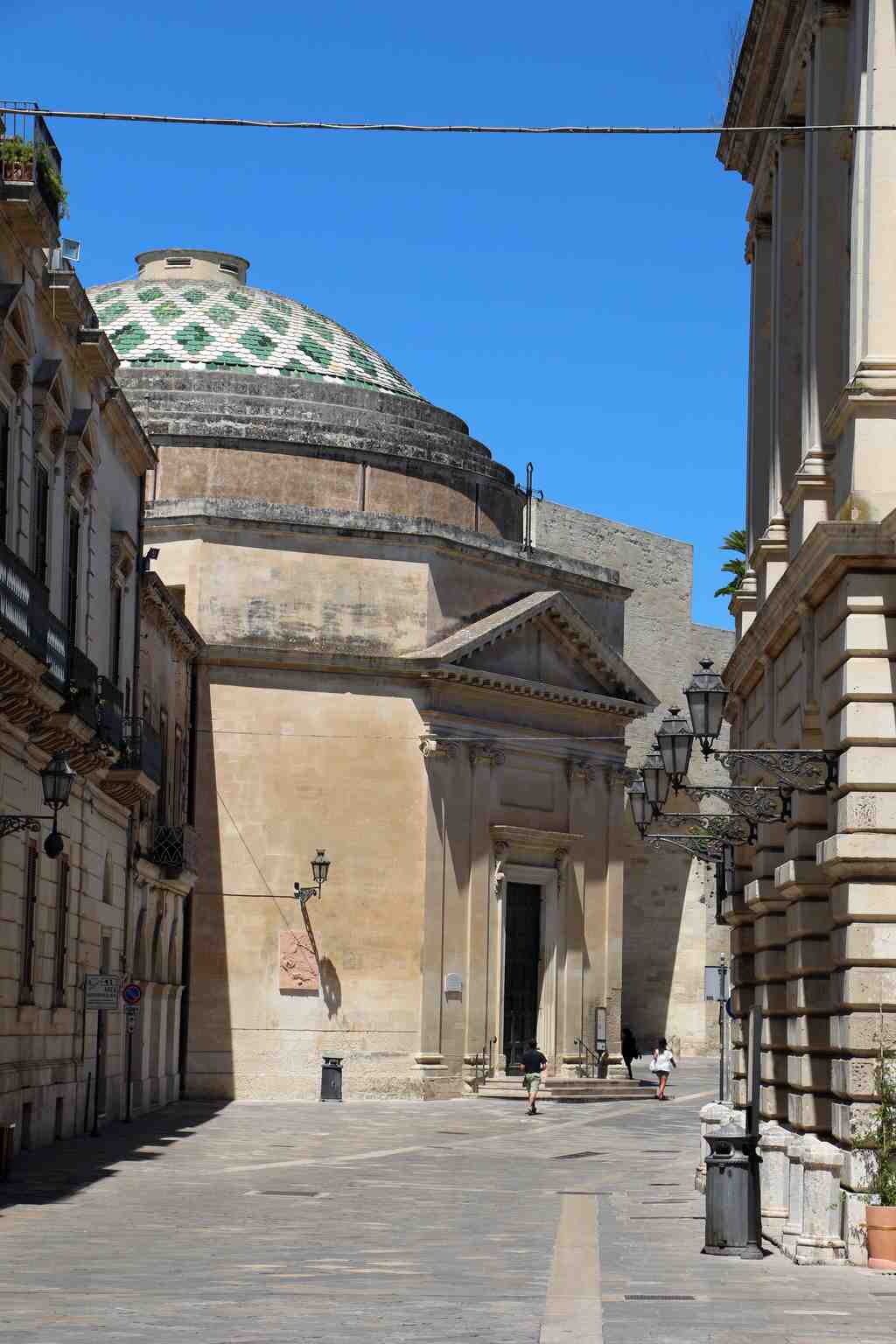
Straight ahead of you, you’ll notice an impressive stone building with a squat, geometric shape and a striking dome decorated with green and white tiles-just look for the octagonal form and elegant neoclassical façade with its sturdy columns and dramatic triangular pediment.
Now, let’s time travel! Imagine the hustle and bustle of 16th-century Lecce. The Church of Santa Maria della Porta, or San Luigi as it’s also called, wasn’t always nestled inside the historic heart of Lecce. No, our story starts outside the city walls, with a simple chapel dedicated to the moment when Mary found young Jesus debating the doctors in the temple. But then, around 1548-when Emperor Charles V was the big cheese of Europe and stone walls sprung up for defense-the church was rebuilt inside the city, as if it tiptoed through the city gates while no one was watching.
Fast forward to 1567, when something truly miraculous happened. A woman named Laura Macchia, who had been paralyzed for an unbelievable fifty years (that’s half a century of not being able to walk!), was cured in an instant right here. You can imagine the excitement on the streets-the awe, the disbelief, the tears of joy! The people were so amazed they expanded and beautified the church, and if you look closely by the smaller side door, there’s an inscription commemorating Laura’s miraculous healing.
The story doesn’t end there. In 1606, the church was officially promoted to parish status by Monsignor Giovan Battista Guanzato, a man whose robes were probably almost as impressive as this dome above you. The church stood as a beacon for centuries, later becoming the base for the congregation of San Luigi Gonzaga. But as Lecce grew and spread out, so did the parish, and today, though most of the community is now based in a modern complex beyond the old city walls, this old church retains its sense of peace and history-like a wise grandparent with many stories to tell.
Speaking of stories, let’s look at the architecture. This isn’t your average old stone chapel. Rebuilt in neoclassical style between 1852 and 1858, the church has a unique octagonal shape, giving it a geometric, almost fortress-like charm. The dome, with its colorful glazed tiles, catches the sunlight in a mosaic that seems to wink down at passersby. The entrance is grand, framed by tall Ionic pilasters and a proper triangular pediment, so you know you’re about to enter somewhere special-no secret knocks required!
Step inside (at least in your imagination for now) and you’d see an interior marked by archways, intricate cornices, and ornamental detail. Four large arches support the dome, surrounded by smaller ones leading to chapels dedicated to Lecce’s favorite saints. There’s even a sculpture of the Madonna della Porta herself, keeping an unblinking watch from her marble niche.
So as you stand here, take a moment to let your senses soak it all in-the play of sunlight across old stone, whispers of miraculous legends, the mingling of ancient faith and spirited architecture! And remember: in Lecce, even the walls have stories (and the occasional miracle) to share. Shall we continue to our final stop?




