
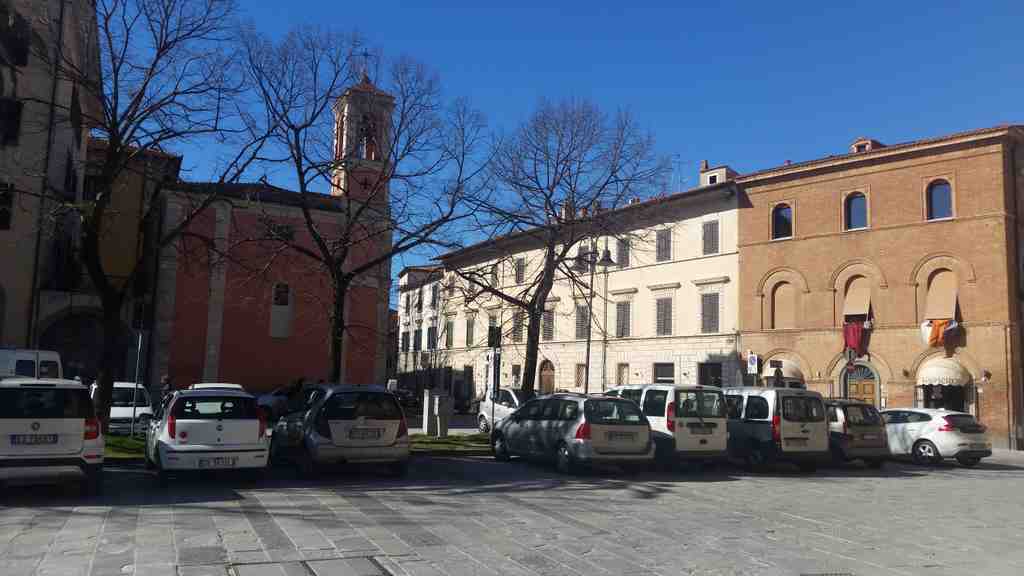
To spot the Plaza de la Palma, look straight ahead for a rectangular open square lined with stately buildings; to your left you’ll see the warm terracotta side and bell tower of the Misericordia church peeking out behind a row of trees, with the whole area basking in the sunlight like a piazza in a classic Italian film.
Ah, you’ve made it! Welcome, my friend, to Piazza della Palma-the beating heart of Grosseto’s old town and, if you ask any local, the spot where history, gossip, and daily life mix together like the ingredients of a fine Tuscan ribollita. You can’t mistake it: this big, open space, longer than a baker’s lunch break and lined with trees, stretches from north to south. At first glance, you’ll see it’s hemmed in by handsome buildings and, at one end, that proud red church tower of the Misericordia. Stand right here and let your imagination wander back in time, because oh, does this place have stories.
Believe it or not, you’re standing where Grosseto was truly born. Archaeological digs a few decades ago-yes, with men in dusty hats and brushes-uncovered traces of early huts and earth houses right beneath your feet. Picture villagers in the Dark Ages hustling around, building little wooden structures, sheltering from the moody Ombrone River just a stone’s throw away. Clever folks, they picked this spot because it’s about five meters higher than the rest of town-not enough to give you altitude sickness, but plenty to keep their socks dry during the frequent floods. It was a central hub, circled by its own wooden palisade or maybe a ditch, with smaller settlements huddled around like ducklings around their mamma.
Now, while most homes were humble, mud-and-wood affairs, by the 9th century the most important buildings-churches of course!-were already being built from stone. Solid as a rock, these structures stood out like the best-dressed guest at a village festa. Grosseto itself gets its very first mention in official documents in the year 803 AD. In those days, it was called “loco Grossito” (I know, it sounds like a character from a spaghetti western, right?) and by the 10th century, it was important enough to get proper defenses and earn the title “castrum”-a real fortress town, ready in case of bandits... or maybe just jealous Pisan neighbors dropping by unannounced.
Fast forward through centuries of market sellers, tradesmen, squabbles, and lovers’ rendezvous, and we land in the 19th and early 20th centuries, when things changed faster than a caffe gets cold. The original San Leonardo church was knocked down to make way for the pinkish-red Misericordia church you see there, whose bell tower pokes up just enough for everyone to know who’s boss. The mighty Grosseto prison was built nearby too-imposing enough to keep even the naughtiest Tuscan kid in line. Rich landlords moved in, schools were built (the earliest secular kindergarten in the region opened across the piazza in 1879), and grand homes like the Ponticelli Palace appeared with their fancy turrets.
But ah, let’s get to the main act-la palma! The square gets its nickname from the legendary palm tree that stood, right at the center, for over two centuries. The story goes, there was once a courtyard behind the old palace of Egidio Bruchi, Grosseto’s liberal-minded mayor. In the late 1700s, someone planted a palm there-a Mediterranean oddity that gave the spot not just shade but a touch of the exotic. It was described in travel diaries and became a kind of natural mascot for everyone in town.
But fate, like a mischievous wind, had other plans. In 1937, a furious storm tore the old palm apart, leaving locals so despondent you’d think their favorite team had lost the derby. Bruchi, ever the optimist, found another palm and planted it, right beside the stump of the beloved old one. Then, during the bombings of 1943, Bruchi’s palace was destroyed, clearing space for the wider, open piazza we see now. And so the square was born anew, with a series of palms planted in memory-each standing against the elements, disease, and yes, even the dreaded red palm weevil! The latest chapter: in 2020, a Californian palm took its place at the center, thanks to the generosity of a local merchant.
Today, the piazza is still the stage for everyday drama: kids running, cars weaving in and out, folks catching up over an espresso. There’s even a museum of natural history-once a neglected nursery, now full of dazzling fossils and curious local flora. But let’s be real-everyone still calls it Piazza della Palma, no matter what the politicians try. And every time the wind rustles those palm leaves, it's like hearing whispers from all who came before-farmers, priests, rebels, children, and dreamers, each wanting their story told in the shade of this timeless square. Now that’s the Italian way, no?


