
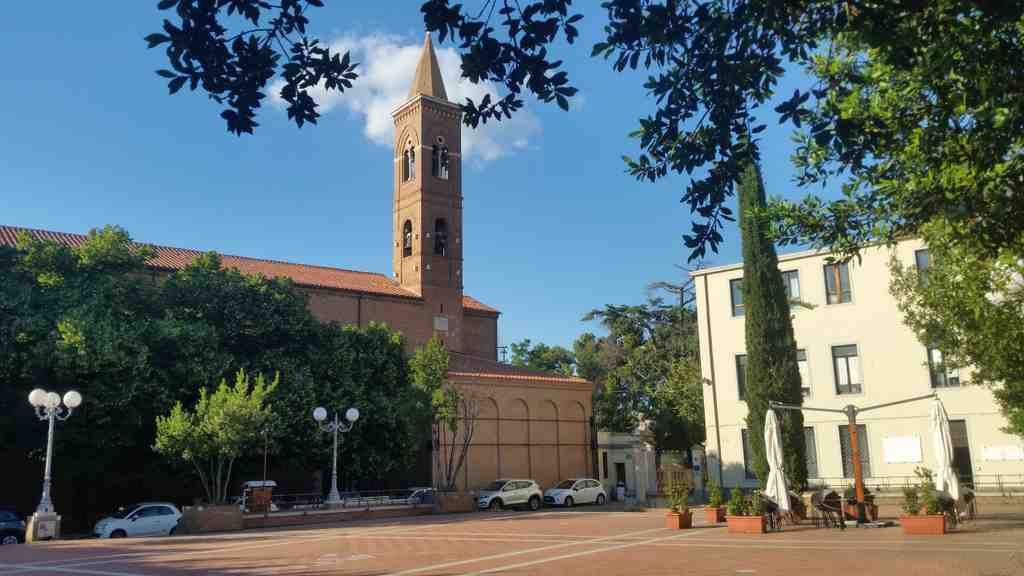
Easy to spot! Look ahead for a large open square with warm brick pavement, lush hedges on one side, and the tall, slender bell tower of the Church of San Francesco rising high above the trees-just follow that pointed spire!
Now, take a deep breath and imagine you’re not just standing in a modern Italian piazza, but traveling through nearly eight centuries of colorful, chaotic, and sometimes rather cheeky history! Piazza San Francesco isn’t just the heart of Grosseto’s old town-it’s a living storybook where every brick has a tale, every stone a scandal, and every old Franciscan might just be peeking around the corner to see what you’re up to.
So, picture this: it’s the year 1233. Not a pizza in sight-yet! This was an area buzzing with monks and holy men. You might have heard someone talking about the “contrada fratrum minorum”-which basically meant “The Neighbourhood of the Little Brothers,” the original Franciscans. They’d just kicked out the Benedictines from the old San Fortunato convent. By 1289, the site was reborn as the Church and Convent of San Francesco, anchoring the north-east of this piazza-a spot that, back then, might have felt more like open countryside than a busy city square.
But don’t just think of holy prayers and quiet contemplation! By the 13th century, right next to the church, you’d have found the “Ricovero di fra Roncone”-a shelter for pilgrims and folks down on their luck, run by the very first guardian of the convent. It would have been a lively sight: mud-caked travelers, nuns shelling peas in the sun, and maybe a slightly grumpy Franciscan telling children to stop chasing chickens around the well!
Jump ahead to 1465, and someone-probably fed up with hauling water from the Serchio river-decided they needed a proper well. The grand “Pozzo dello Spedale” or “Well of the Horns” magically appeared, funded by the mighty Republic of Siena, who even carved their seal right into its side. They say if you listen closely, you might still hear the echo of old Sienese merchants arguing about water taxes.
With the city’s new ties to the powerful Grand Duchy of Tuscany in the 16th century, the old pilgrim’s shelter grew up-transforming into the Misericordia Hospital. By 1787, it had a facelift bigger than nonna’s Sunday dinner, complete with an “Arco delle Monache”-an elegant arch linking the hospital with the Clarisse nuns’ convent. Imagine a secret passage so the nuns could whisk over with soup when someone was having a bit of a crisis!
Alas, in 1927, the arch was torn down, as modernity swept in. But the courtyards, the gardens of the Clarisse, and their stories survived-well, at least until the 1990s, when the old walled orchard was opened for the townsfolk and the terrace you see today became a stage for music, theatre, and raucous cultural celebrations.
Don’t miss the bronze statue of St. Francis-he’s been keeping an eye on things since 1965, though he swapped his fountain for a sober pedestal during the Jubilee in 2000. And over there, the old Misericordia, now home to eager university students, stands where nuns once kept the peace.
So, look around and let the centuries swirl-Grand Dukes, friars, Sienese skulls, singing nuns, and perhaps even a saint himself. Welcome to Piazza San Francesco, where time laughs and the past is always ready to join you for an espresso!


